
Council adopts revised natural gas franchise fee ordinance after billing constraint prompted change
Get AI-powered insights, summaries, and transcripts
Subscribe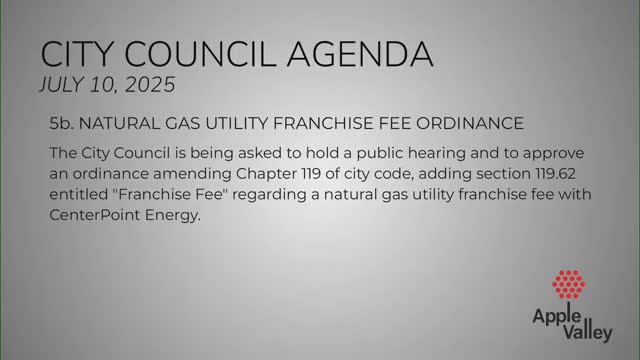
Summary
The Apple Valley City Council on July 10 adopted an amended natural gas franchise fee ordinance that keeps a 3% residential fee and adjusts fees for the city’s largest commercial accounts after CenterPoint Energy reported billing software limits; staff estimates about $590,000 in annual revenue under the revised structure.
The Apple Valley City Council adopted an ordinance on July 10 amending city code to establish a revised natural gas utility franchise fee for CenterPoint Energy customers. Staff presented the change after the utility said its billing software could not combine a percentage-of-usage fee with a per-account monthly cap.
City staff outlined why the change matters: the existing ordinance charged a 3% fee with a $25 monthly cap for residential customers and a 3% fee with a $75 cap for commercial/industrial accounts; CenterPoint said its billing system could apply a percentage or a flat cap but not both together. Matt, a city staff member presenting the item, said the revised approach keeps residential fees at 3% of monthly revenues and applies 3% of revenues to most commercial accounts but moves the largest roughly 300 commercial accounts to a flat $35 monthly fee. "We're estimating based on that new franchise fee it would bring in just under $600,000 a year," Matt said.
The council opened and then closed a public hearing with no speakers. Council members moved to pass the ordinance and waived the second reading; the motion carried on a voice vote.
The ordinance amendment is captured as a new Section 119.62 in chapter 119 of the city code and staff noted franchise-fee receipts are planned to help the city's pavement management/street program, with up to $1 million identified as a primary allocation across utility franchise revenues. Staff also said the change affects a very small share of accounts — roughly 300 of more than 15,000 accounts — and presented CenterPoint-provided usage data underlying the $590,000 estimate.
Because the utility could not implement the original percentage-plus-cap design, the city’s revision adjusts the billing mechanism while preserving the council's intent to dedicate franchise-fee revenue to capital priorities. The council's action was limited to adopting the ordinance; no additional allocation decisions were made at the meeting.