
Kane County committee debates, votes on proclamation opposing noncitizen voting after public comments
Get AI-powered insights, summaries, and transcripts
Subscribe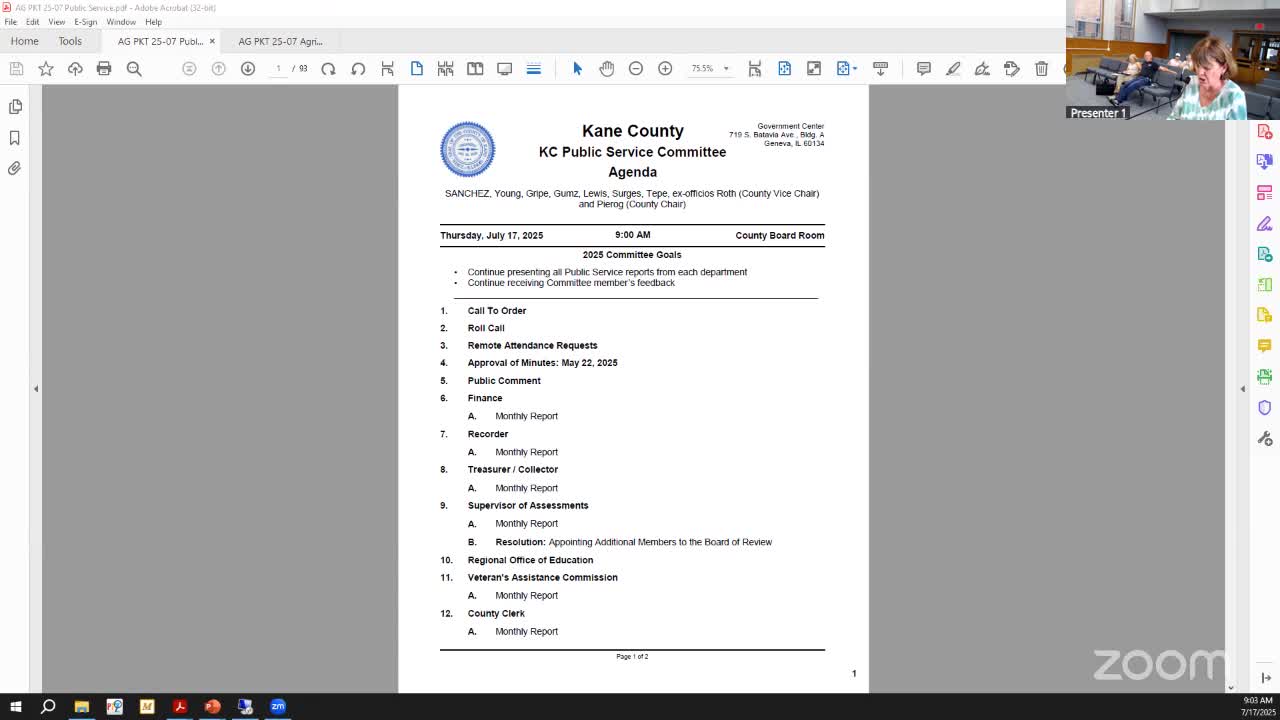
Summary
After multiple public commenters urged the committee to adopt a proclamation opposing noncitizen voting, committee members debated whether the statement was necessary or divisive. A roll-call vote was taken; the transcript shows conflicting tallies and the chair ultimately declared the motion failed.
Kane County's Public Service Committee heard more than a dozen speakers during public comment on July 17 urging the committee either to approve or reject a proclamation opposing noncitizen voting, then debated the item and took a roll-call vote. Chair Sanchez called for the vote after public comments that ranged from appeals to election integrity to objections that the proclamation would be divisive.
The matter drew residents who identified themselves as local volunteers and longtime voters. Deb Fisher, a deputy registrar and League of Women Voters member, told the committee she was “surprised and puzzled to find a resolution on page 93 of your agenda” and asked the committee to conclude the proclamation was unnecessary. Brian Anderson of Sugar Grove described such statements as symbolic, saying, “It is a gesture. It’s a symbolic gesture,” and urged the committee to let the full county board or executive committee consider it. Other speakers, including Mike Meyer of Elgin and several others, urged the committee to adopt the proclamation.
Why it matters: Committee members said the item touched on core election-law questions and community trust. Supporters framed the proclamation as an affirmation that Illinois and federal law reserve voting to U.S. citizens; opponents said publishing the statement would inflame division and call attention to a problem they said is not evident in Kane County.
The discussion moved quickly from public comment into debate among committee members. Board member David Young, who brought the proclamation forward, reviewed the legal citations that the draft references, saying the Illinois Constitution and the Illinois Election Code require U.S. citizenship for voting and pointing to federal criminal statutes imposing penalties for noncitizen voting. Members who opposed the proclamation, including Michelle Gums, said the county did not have evidence of a local problem and that issuing a proclamation would be divisive; Gums said she would not support a statement she viewed as stigmatizing residents. Several other members urged transparency and pointed to frustration among citizens seeking verification of registration status.
A motion to approve the proclamation was moved by David Young and seconded by Breifel. The clerk conducted a roll-call vote that, as read on the record, listed the following votes: Gripe — yes; Gums — no; Lewis — no; Surgis — yes; Pepe — no; Young — yes; Sanchez — no. Those names on the roll call correspond to a 3-4 tally against the motion. The transcript also records a conflicting announcement from staff that the motion passed 4-3; the committee chair subsequently declared the motion failed. The meeting proceeded with other business after the chair’s ruling.
Discussion versus decision: The public comments and committee debate were substantive; the transcript shows a formal roll-call vote took place but also records a conflicting tally and the chair’s final statement that the motion failed. The article reports the recorded roll-call names and the final chair ruling rather than attempting to reconcile the internal discrepancy.
Next steps: No committee direction to staff to alter election processes or to pursue a county-level verification effort was recorded. Several members urged state-level contacts for statutory clarity and transparency. The proclamation text appeared on the committee agenda; because the transcript shows the motion failed under the chair’s declaration, there is no adopted county-level proclamation resulting from this meeting.