
Safe schools report: SRO contract rises, district saves on radio upgrades
Get AI-powered insights, summaries, and transcripts
Subscribe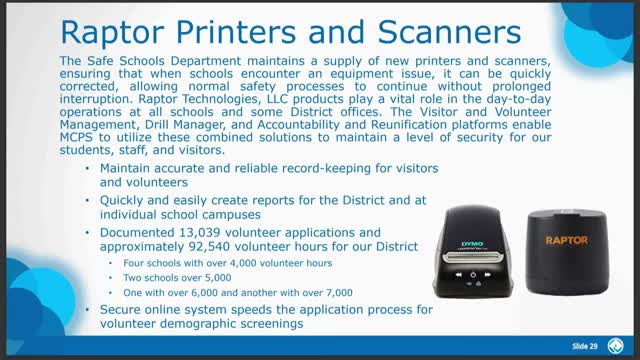
Summary
Safe Schools staff told the committee that the renewed school resource officer (SRO) agreement will cost the district about $16 million for 2025–28, and that county radio-tower upgrades reduced the planned cost of bidirectional amplifiers (BDAs) from $4 million to $1.2 million, freeing funds for other safety priorities.
Dennis McFadden, executive director of Safe Schools, briefed the committee on July 17 about school-safety spending and recent infrastructure changes. McFadden said the renewed SRO agreement effective July 1, 2025, through June 30, 2028 is projected to cost “over $16,000,000,” up from more than $12.7 million under the prior three-year agreement that ended June 30, 2025. The nut graf: the safety presentation documented both a rising personnel cost tied to the state mandate for a safe-school officer on each campus and a large one-time savings because Marion County upgraded its communications towers, reducing the number of BDAs the district must purchase. McFadden described investments funded by the referendum: visitor and volunteer management through Raptor Technologies (staff processed more than 13,000 volunteer applications and reported over 92,500 volunteer hours last year), new printers and scanners to maintain continuity, and a mutual link interoperability system at the Marion County Communications Center to speed first-responder access to district camera feeds. On BDAs, McFadden said the district had budgeted $4 million but county upgrades meant only four buildings failed radio testing, reducing the BDA bill to about $1.2 million and producing an effective $2.8 million savings. He also described procurement and installation delays for new cameras tied to internal technology capacity; the district will use a third-party vendor (Miller’s Electric) for future installations to accelerate rollout. McFadden also described the introduction of red-dot sights on Safe Schools officers’ duty pistols, saying the sights “provide officers with faster, more accurate target acquisition” in tight, low-light spaces; he said officers will receive extensive training on the equipment. Ending: McFadden told the committee the district will pursue access-control upgrades and additional camera coverage at older campuses as funds and contracts allow; no formal vote or binding contract approval occurred during the meeting.