
Budget committee recommends rollback millage after ad valorem briefing
Get AI-powered insights, summaries, and transcripts
Subscribe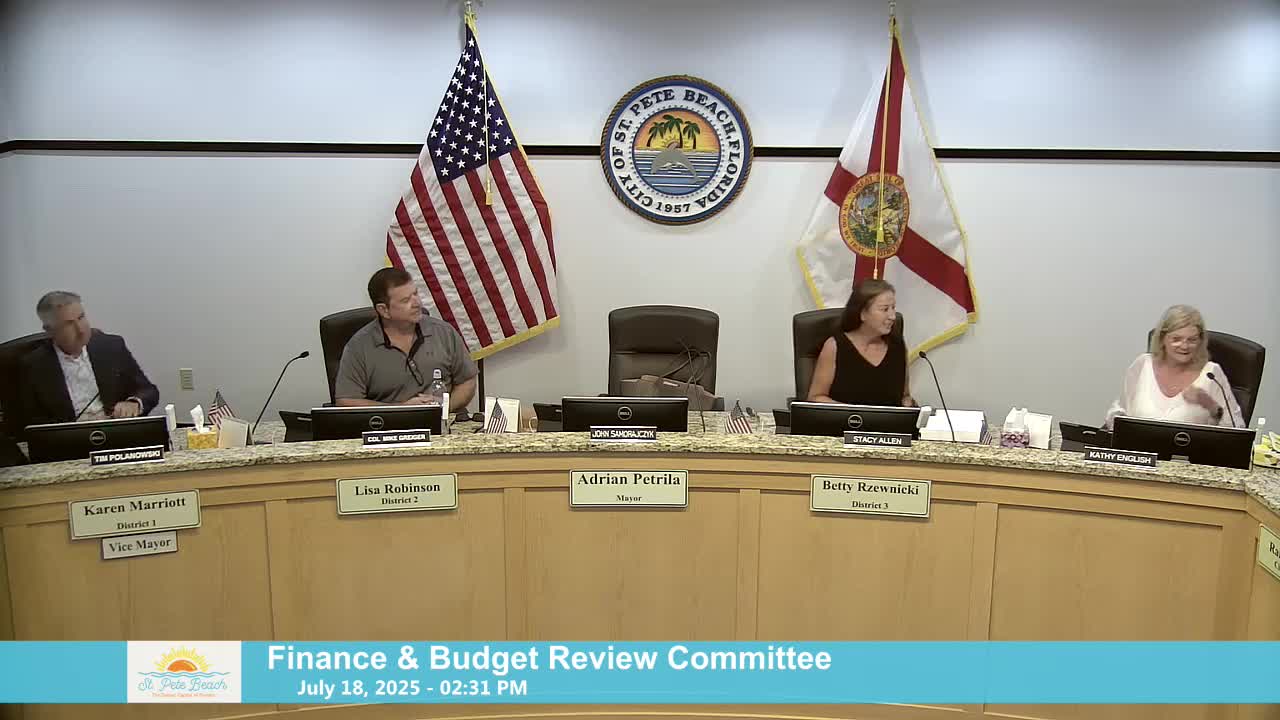
Summary
Following a detailed presentation on how property-tax (ad valorem) dollars flow, the Budget Review Committee recommended the rollback millage (option B) be forwarded to the City Commission, directing modest additions to the resiliency and capital funds.
Devin Schmidt, finance director for the City of St. Pete Beach, briefed the Budget Review Committee on the city’s ad valorem taxes and the options before the committee, then committee members recommended the rollback millage rate be forwarded to the City Commission.
Schmidt said the presentation was intended to become the annual standard for the budget process: “So today, we're gonna take you through what we're calling kind of the story of ad valorem taxes,” and to show “where do our taxes come from, who pays them” and how changes would translate into the city’s general fund.
The presentation emphasized that roughly 20% of a typical property tax bill for St. Pete Beach stays local; the other 80% is remitted to schools, the county, EMS and several other districts. Schmidt told the committee that, based on county data, approximately 70% of the city’s taxable value for the general fund comes from non‑homestead property and about 30% from homestead property (the latter reported as roughly $4.7 million in revenues to the city).
Committee members reviewed four millage options that Schmidt presented: the current rate used to build the budget (3.0913 mills as stated in the presentation), a rollback rate (3.1189 mills), a majority‑vote maximum (3.2596 mills) and a two‑thirds‑vote maximum (3.5856 mills). Schmidt explained how each option would translate into additional revenue under the current assessed values, and showed examples of what ten‑year totals could look like if assessed values and other factors remained unchanged.
After discussion about affordability and infrastructure needs, the committee coalesced around option B, the rollback rate, and instructed staff to forward that recommendation to the City Commission. Under the rollback option as presented to the committee, the staff estimated approximately $70,000 would be available for the city’s resiliency fund and about $70,000 for capital improvement projects (CIP) under the allocation rules in the city’s comprehensive plan.
Committee members and staff repeatedly framed the choice as balancing near‑term affordability for homeowners with the long‑term need to fund deferred infrastructure and resiliency projects. Committee members asked for continued tracking so the commission and staff can show year‑to‑year how additional millage revenue is allocated and spent.
Next steps: staff will carry the committee’s recommendation to the City Commission, continue the multi‑year project and resiliency planning work and return with additional budget detail at the next workshop.