
St. Lucie County adopts ordinance creating anchoring limitation areas, pairs with Fort Pierce for on-water enforcement
Get AI-powered insights, summaries, and transcripts
Subscribe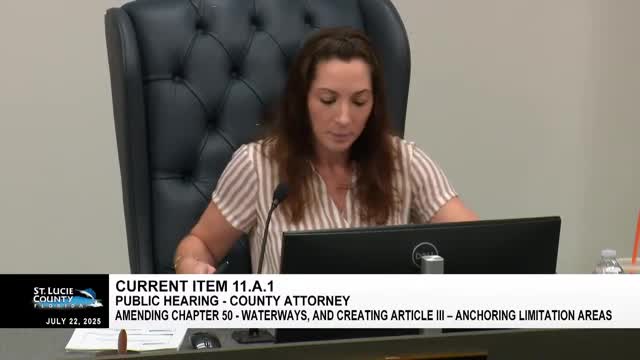
Summary
The Board approved an ordinance to establish anchoring limitation areas (ALAs) and an interlocal agreement with the City of Fort Pierce to provide daily on-water presence and enforcement; the rule is not effective until buoys and markers are placed.
St. Lucie County commissioners on July 22 adopted an ordinance amending chapter 50 of the county code to establish anchoring limitation areas and approved an interlocal agreement with the City of Fort Pierce to help implement and enforce the new rule. The ordinance establishes definitions, applicability, exemptions and the county’s authority to create ALAs, with staff and Fort Pierce responsible for day-to-day presence on the water and coordination with law enforcement and Florida Fish and Wildlife Conservation Commission (FWC). “The ordinance provides definitions, applicability and establishes the anchoring limitation areas and also provides for exemptions,” Assistant County Attorney Jean Stasio said during the hearing. The board’s action follows months of discussion about how to manage vessels that anchor in key navigation corridors and the inlet. County staff described the ALA as a “force multiplier” that gives Fort Pierce and county personnel the legal tools to contact and track vessels that remain in one location and to document potential derelict or abandoned vessels. Joshua Rebor, a county staff member who led the technical mapping, said the intent was to “lessen the burden within our main thoroughfare through the inlet” and to create a daily on-water presence that would help FWC and other partners respond more quickly. City of Fort Pierce Marine Director Dean Kupchak described the operational plan for enforcement and outreach: Fort Pierce will deploy staff to make contact, provide best-practice information such as pump-out options, and coordinate with FWC, the sheriff’s office and local police when criminal or safety issues arise. “If we have any issues associated with anybody on a vessel, what we are going to do is depart that vessel. We will go ahead and get Fort Pierce Police Department… The Sheriff’s Department, they’re excited about this as well. FWC… they’re also all in on this as well,” Kupchak said. Commissioners and stakeholders repeatedly distinguished ALAs from mooring fields. Commissioners said ALAs are intended as a near-term tool to police the inlet corridor and reduce hazards; mooring fields — permanent, often paid facilities with fixed moorings — remain a separate, more capital-intensive option. Commissioner Townsend said she supports the ALA as a first step but emphasized that the county should pursue mooring fields over time to increase accountability and create revenue and policing capacity. The board approved the ordinance and the interlocal agreement by vote. County staff said the ALA will not be enforceable until the navigation buoys and markers are placed; staff will apply to the state for those aids and expects placement within weeks after permits are issued. Staff also noted a new state registration requirement, effective Jan. 1, that will require vessels remaining at one location for more than 14 days to register, which will aid enforcement once the ALA is active. The county and city committed to annual reviews of enforcement outcomes and to adjust ALA boundaries if operational experience suggests changes. Ending: With the ordinance adopted and an interlocal in place, the county will shift to the permitting and marker-placement phase; staff said the ALA will become operational only after state-approved buoys and markers are installed and the city’s daily on-water effort begins.