Erlanger staff outline FY26 wage-scale adjustments, new pay-band placements for leadership roles
Get AI-powered insights, summaries, and transcripts
Sign Up Free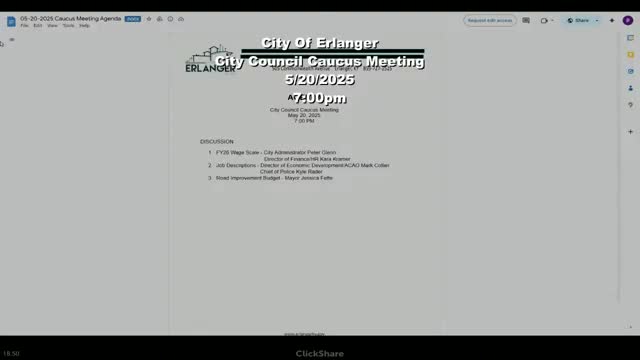
Summary
City staff presented a 2.9% inflation-based adjustment to the FY26 wage scale, added a director of public safety position with an expanded pay band, moved several director-level roles to higher bands and added a community engagement coordinator slot to pay band J.
City staff on Oct. 11 told the Erlanger City Council Caucus that the city’s fiscal year 2026 wage scale will be adjusted across the board by 2.9 percent to reflect inflation and that several leadership positions will shift pay bands.
City staff member Peter Glenn said the wage-scale numbers "had been adjusted by that alone" to reflect a 2.9% inflationary figure. He said the council packet reflects a uniform 2.9% change applied to minimums and maximums in all bands.
Glenn said the packet adds a director of public safety in pay band A; that band’s minimum-to-maximum span was raised to $40,000 to accommodate the new position (historically that band used a $30,000 span). He said pay bands B through H generally retain $30,000 spans. Glenn also said several existing positions were moved from pay band C up to pay band B to make their salaries “work out,” including the director of finance, the human-resources director, the director of public works, the economic-development director and an assistant city administrator. Finally, he noted pay bands I, J and K will continue to use $25,000 spans and that the seasonal maintenance worker classification has only a minimum, not a maximum.
The wage-scale presentation accompanied separate agenda items that described new job descriptions for a community engagement coordinator and a public-safety director role; staff said those positions were reflected in the proposed bands and job descriptions in the meeting materials. Council members did not take a formal vote on the wage-scale changes during the caucus; staff described the adjustments as part of the budget-development process and said any formal action would come through the city’s normal budget and ordinance process.
No city ordinance, statute or other legal authority was cited during the discussion; staff framed the changes as administrative budget and classification decisions tied to the FY26 budget process.
The council caucus ended with the usual adjournment motion; staff said they will return the wage-scale language for formal consideration as part of the upcoming budget ordinance process.