Secretary of State details Georgias voter database, list-maintenance and audit program
Get AI-powered insights, summaries, and transcripts
Subscribe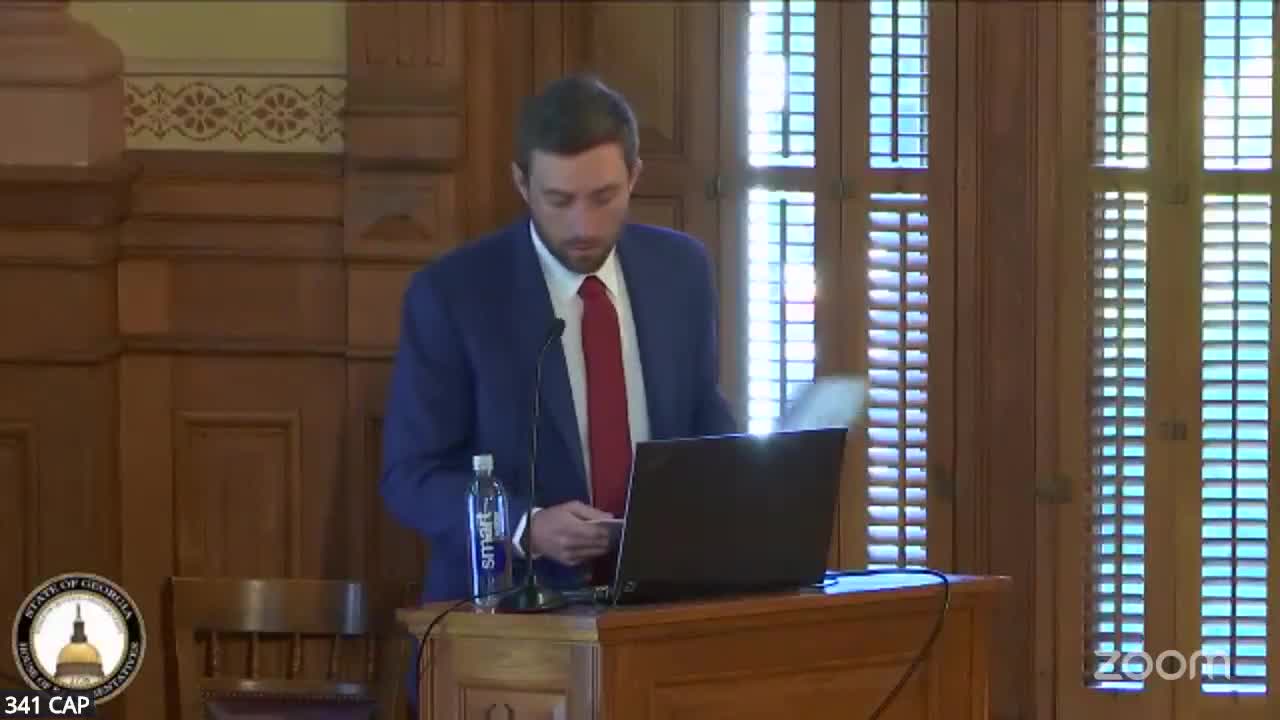
Summary
State elections director Blake Evans briefed the committee on Georgia's voter-registration database (Jarvis), list-maintenance tools, and an expanded audit program, citing nearly 7.4 million active voters, recent large-scale cancellation mailings and the state's ballot-image and risk-limiting audits.
State elections director Blake Evans told the committee the Secretary of States office operates a single statewide election-management system known as Jarvis and that counties use it daily for registration, absentee ballot management, and audits. Evans said Georgia had about 7.4 million active registered voters and nearly 1 million inactive records; he said the state relies heavily on daily data flows from the Department of Driver Services (DDS) and a set of list-maintenance tools.
Why it matters: The committee heard how the state aggregates multiple data sources to keep rolls current, why counties rely on the statewide Jarvis platform, and how Georgia performs post-election audits to verify outcomes — information central to any review of election procedures.
Key details Evans provided: - Jarvis: a FedRAMP-hosted, statewide system used by all 159 counties for registration, absentee processing, candidate qualifying, petition management, and voter tools. - Voter counts and sources: about 7,400,000 active voters and just under 1,000,000 inactive voters; approximately 72.3% of in-state moves show up via DDS transactions. - List maintenance: since 2019, the office said it has mailed more than 4,000,000 notices and recently sent roughly 477,000 cancellation mailers to addresses inactive for two federal general elections. - Tools and partners: daily/nightly checks against DDS, data from Dept. of Public Health (deaths), Dept. of Corrections (felons), ERIC cross-state reports, USPS NCOA, the SAVE database from DHS for citizenship verification, and geospatial review tools. - Audit program: Georgia conducts multiple audit types, including risk-limiting audits (RLAs), equipment health checks, parallel monitoring and, in November 2024, a statewide ballot-image audit of all contests. Evans said the ballot-image audit reviewed 5,297,264 total ballots and found 0 differences between machine tabulation of QR codes and human-readable summaries across the image audit; a single discrepancy on a summary-ballot QR-code case was traced to a county adjudication error, and most hand-mark discrepancies were attributable to voter-intent interpretation.
Evans emphasized the states approach is multi-layered: automated duplication checks, monthly processing of felon data, weekly processing of vital records, and minimum local audit coverage so every county has ballots to audit. He also described new county-facing tools: a voter cancellation request portal and a Georgia registration review application to flag commercial or suspicious addresses for registrar review.
Ending note: Committee members asked follow-up questions on ERIC membership, the technical hashing process used for cross-state matching, and the costs of ballot-image audits and ERIC membership; Evans provided figures for past mailings and said initial implementation of the ballot-image audit cost roughly $1.7million to $1.8million with smaller per-election costs thereafter.