
Mass. health-care advocates press Joint Committee to enact broad health equity package
Get AI-powered insights, summaries, and transcripts
Subscribe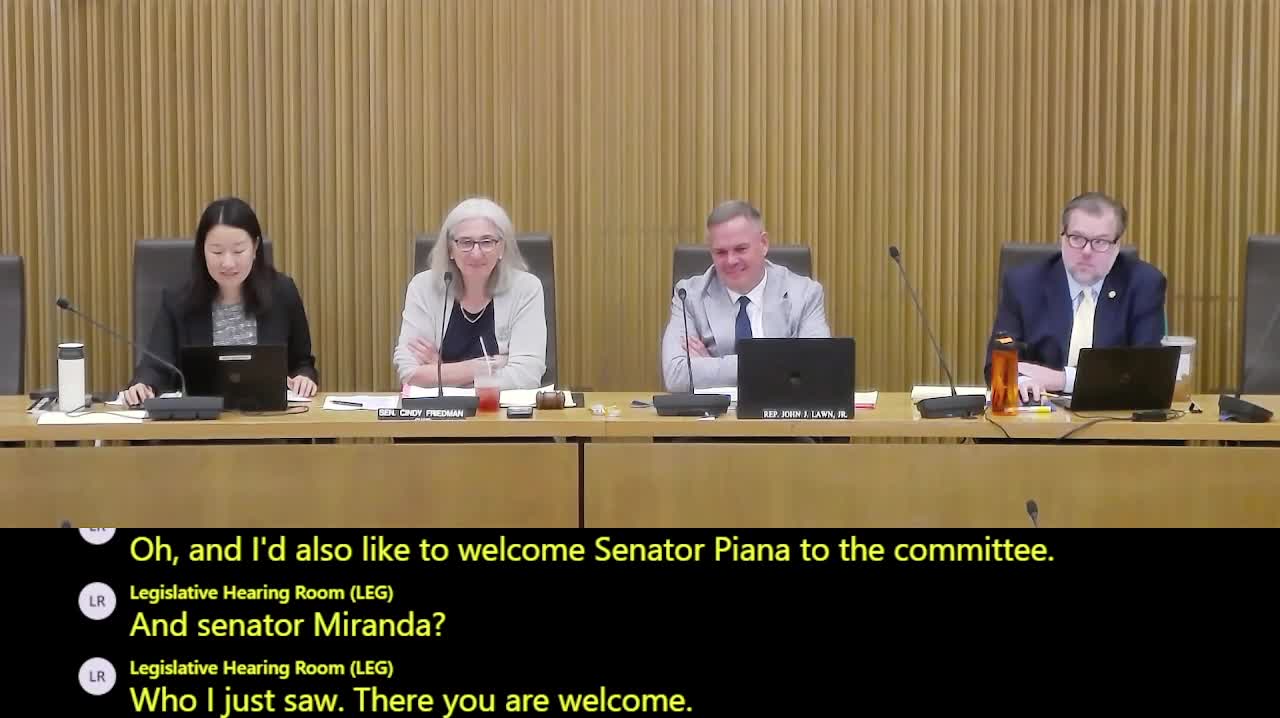
Summary
Advocates, hospitals, insurers and community providers urged the Joint Committee on Health Care Financing to report out H1416/S901 — an omnibus 'Act to Advance Health Equity' — highlighting benchmarks, workforce investment and community-based funding as central tools to reduce racial and geographic disparities in care.
A broad coalition of hospitals, community health centers, insurers, labor groups and advocacy organizations urged the Joint Committee on Health Care Financing on Wednesday to advance H1416/S901, an omnibus bill titled an act to advance health equity in Massachusetts.
The measure would create statewide benchmarks for equity, expand investment in community-based health providers and workforce development, and authorize a health-equity trust fund and targeted grants to neighborhoods identified as health equity zones. Proponents framed the legislation as a way to preserve recent gains from pandemic-era initiatives and to harden state systems against federal funding uncertainties.
"It has become increasingly more difficult for providers to care for patients and for patients to get access to the care they need when they need it," said Senator Cindy Friedman, Senate chair of the committee, in introductory remarks to the hearing. Friedman and House Chair Representative John Lawn emphasized that the proposals were meant to advance health equity "not as a slogan, but as a policy goal."
The Health Equity Compact and its supporters — including Michael Curry of the Massachusetts League of Community Health Centers and Rahsaan Hall of the Urban League of Eastern Massachusetts — told the committee the bill is built on three pillars: improving access and quality of care, investing in communities and a representative health workforce, and strengthening leadership and oversight. "When we build a system that works for the most marginalized, we build a system that works better for everyone," Curry said.
Supporters pointed to existing state work as a proof of concept. Steve Walsh, president and CEO of the Massachusetts Health & Hospital Association, highlighted the state's 1115 Medicaid demonstration work that ties hospital investments to equity milestones and said the waiver showed how shared goals and measurement can drive results. "Hospitals are devoting nearly a billion dollars to the latest version of the Massachusetts 1115 waiver," Walsh said. "Hospitals can only earn money back if they fulfill a vigorous set of equity-related milestones."
Provisions cited repeatedly at the hearing included setting measurable equity benchmarks, requiring data collection on race/ethnicity/language and social needs, Medicaid graduate medical education (GME) support targeted at community-based training, and reimbursement or coverage for community health workers, doulas and interpreter services.
Community providers described operational strain: Guali Valdez, president and CEO of Mattapan Community Health Center, said providers are spending far more time per patient as complexity increases and urged a single set of statewide goals with measurable timelines and accountability. "There are goals designed to fit and meet the needs of our communities. What we need is a common goal," Valdez said.
Employers and private-sector partners also testified in favor. Chris Redick of Takeda and Katrina Cook of Boston Children's Hospital highlighted public–private partnerships and digital-health initiatives as complementary strategies to reach families and reduce barriers.
Labor and workforce witnesses asked the committee to focus on recruitment, retention and career pathways. Marlon Washington of 1199SEIU urged expanded pay and loan-repayment support and creation of a new executive office and undersecretary for equity and workforce development to coordinate efforts. "Workforce sufficient to meet growing needs must remain a top priority," he said.
Opposition testimony at the hearing was limited; hospital and insurer witnesses generally supported the concept while asking for administrative simplification and data alignment so reporting burdens do not fall disproportionately on community providers. Sarah Stanton of Blue Cross Blue Shield of Massachusetts said a statewide, standardized set of equity measures could reduce provider burden and improve coordination across payers.
Why it matters: Backers said the bill tackles upstream drivers of health spending and racial disparities by aligning public and private investments, strengthening local capacity and tying funding to measurable outcomes. Several speakers warned that proposed federal Medicaid changes and funding uncertainty increase the urgency of a durable state framework.
What the bill does not do: The measure proposes benchmarks, funding mechanisms and reporting but does not itself create particular entitlement expansions; many provisions require later regulatory or budgetary action. Supporters said the measure enables and coordinates investments but will require appropriation decisions and further agency rulemaking.
Next steps: Witnesses asked the committee to report the bill out favorably so stakeholders can negotiate implementation details and funding in later stages. The committee did not take votes at the hearing; proponents said they are prepared to work on technical changes and to phase implementation where needed.
Ending: Proponents closed by urging the legislature to codify gains achieved under the 1115 waiver and other initiatives so progress continues regardless of federal policy shifts. "Set shared goals, bold but collaborative," Walsh said. "When we come out of this wave…this work will be hardwired into daily operations of our hospitals and health systems."