
Economists tell committee vehicle‑miles tax could replace shrinking gas tax but raise equity questions
Get AI-powered insights, summaries, and transcripts
Subscribe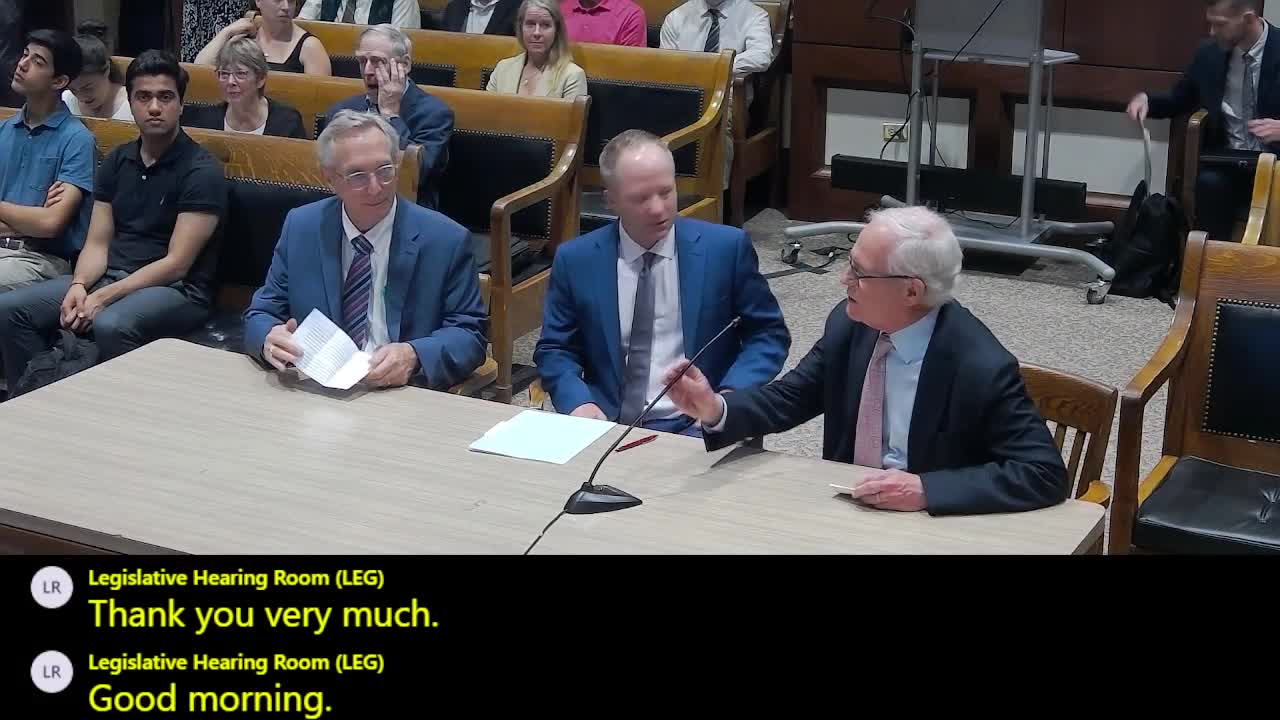
Summary
Economists told the Joint Committee on Revenue that replacing a shrinking gas‑tax base with a vehicle‑miles‑traveled tax could stabilize transportation revenue, but urged pairing any swap with EV purchase incentives and smoothing mechanisms to avoid regressive outcomes or administrative burdens.
A trio of economists and transportation policy experts briefed the Joint Committee on Revenue on a proposal to consider a vehicle‑miles‑traveled (VMT) tax to stabilize transportation funding as fuel‑tax revenue falls.
State Sen. Mike Barrett introduced academic witnesses who described two rationales for a VMT tax: align payments with the public benefits and costs of road use (user‑pays) and account for driving‑related externalities such as congestion and accidents. Professor Max Auffhammer and Professor Christopher Knittel (MIT) said the Massachusetts 24¢ per‑gallon gas tax is a shrinking revenue base as vehicles become more fuel efficient and electric vehicles (EVs) proliferate.
Their analysis, described in testimony, found a carefully‑designed swap from gasoline tax to a broad VMT tax could be revenue neutral and in some scenarios be mildly progressive — benefiting many lower‑income census tracts — because wealthier households tend to own more fuel‑efficient vehicles and drive less in some metro suburbs. The distributional results, they said, vary by geography: rural regions could benefit while some high‑income suburbs and certain urban tracts could pay more under a VMT tax.
Witnesses emphasized that a VMT tax should be paired with other policies to meet climate goals, chiefly stronger EV purchase subsidies to maintain incentives for electrification while taxing road use per mile. Committee members raised administrative and enforcement questions — how states would collect VMT data, privacy safeguards, whether annual bills would “shock” EV owners accustomed to paying at the pump, and legal challenges in states that have tried similar policies — and asked about experiences in pilot programs in Oregon and other states. Witnesses said Massachusetts is relatively well‑positioned because of an existing annual vehicle inspection and encouraged smoothing payments over time to avoid large annual bills.
No committee vote was taken; proponents offered to supply further analysis on interactions with EV incentives and distributional impacts.