
Advocates press committee to remove immigration status as barrier to full coverage for children
Get AI-powered insights, summaries, and transcripts
Subscribe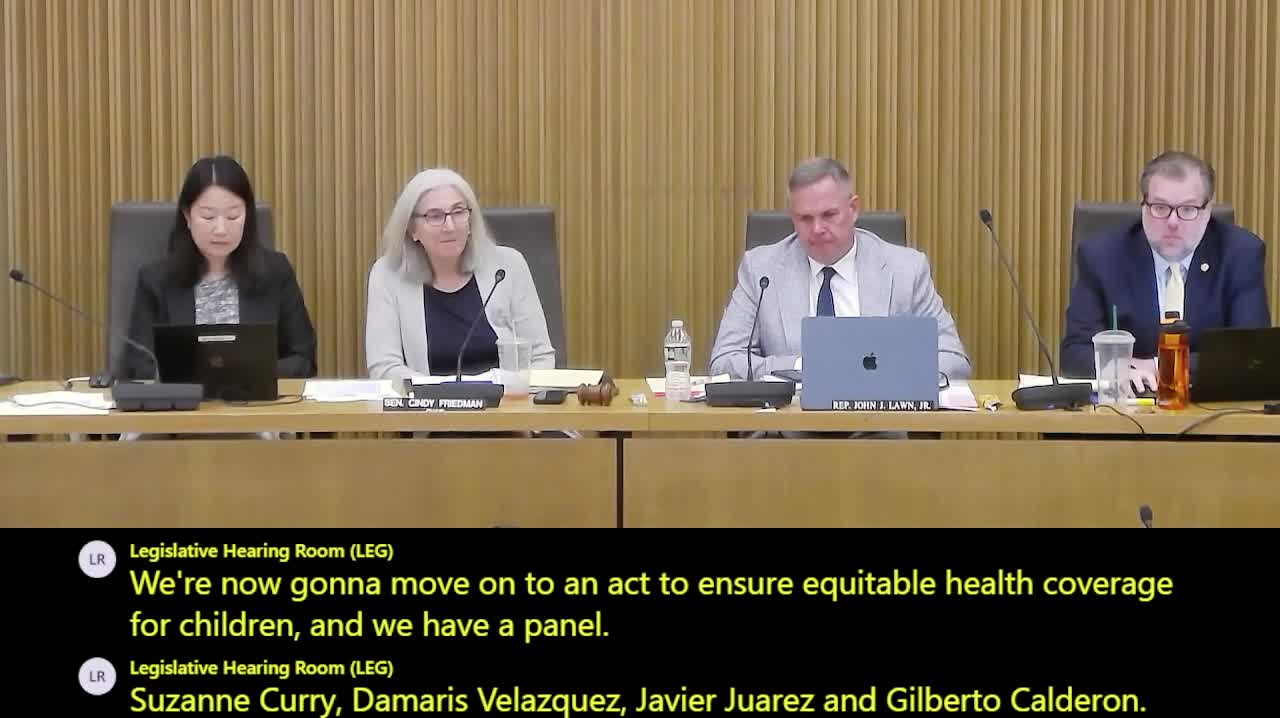
Summary
Health and immigrant-rights groups urged the Joint Committee to report Cover All Kids (H1403/S855), which would extend full MassHealth coverage to children regardless of immigration status; witnesses cited clinical cases of avoidable hospitalizations, administrative complexity and fiscal savings from earlier care.
Advocates, community organizations and clinicians urged the Joint Committee to advance Cover All Kids (H1403/S855), a bill that would extend full MassHealth coverage to children up to age 21 regardless of immigration status.
Suzanne Curry of Health Care for All framed the change as closing long-standing gaps in access: "MassHealth Limited only covers emergency services; the Children's Medical Security Plan has caps and variably available services — these limits create gaps that may lead to avoidable hospitalizations," she said.
Clinicians gave examples of the policy's potential impact. Dr. Catherine Bick, a pediatrician who treats complex hospitalized children, described an 11-year-old boy she called "Manny" who required inpatient rehabilitation but could not receive speech, physical and outpatient neurology after discharge because he was enrolled in MassHealth Limited; she said that without full coverage he faces lifelong deficits. "It is unconscionable as a physician to tell his mother, 'no, we cannot give you the therapies your child needs to get better,'" Bick testified.
Community organizations emphasized practical barriers. Damaris Velasquez of Agencia Alpha and Eloisa Galvan of the Brazilian Women's Group stressed that families fear navigating complex eligibility rules and that language access and outreach are required to enroll eligible children. Gilberto Calderon of MIRA estimated tens of thousands of children could benefit; witnesses reminded the committee that 11 other states and the District of Columbia already provide comprehensive coverage to children regardless of immigration status.
Health Law Advocates presented case examples and argued that broader coverage would reduce costly late-stage care and hospitalizations, while simplifying eligibility systems and reducing misclassification errors. "For many of our clients and their families, gaining health coverage is life changing," testified Mindy Greenberg of Health Law Advocates, who gave several case examples where limited coverage led to invasive surgery, readmission or delayed hospice care.
Why it matters: Supporters argued the bill would reduce avoidable high-cost care, improve child development outcomes, and address inequities in health and education tied to untreated childhood conditions.
Next steps: Advocates acknowledged current federal uncertainty over Medicaid funding and urged the committee to protect and expand state programs that reach immigrant children. The committee did not take votes at the hearing.
Ending: Witnesses urged the legislature to lead on child health coverage, characterizing the policy as a moral and fiscal imperative to prevent avoidable suffering and long-term costs.