
Committee hears bills to boost incentives for starter homes and fix school-reimbursement gap
Get AI-powered insights, summaries, and transcripts
Subscribe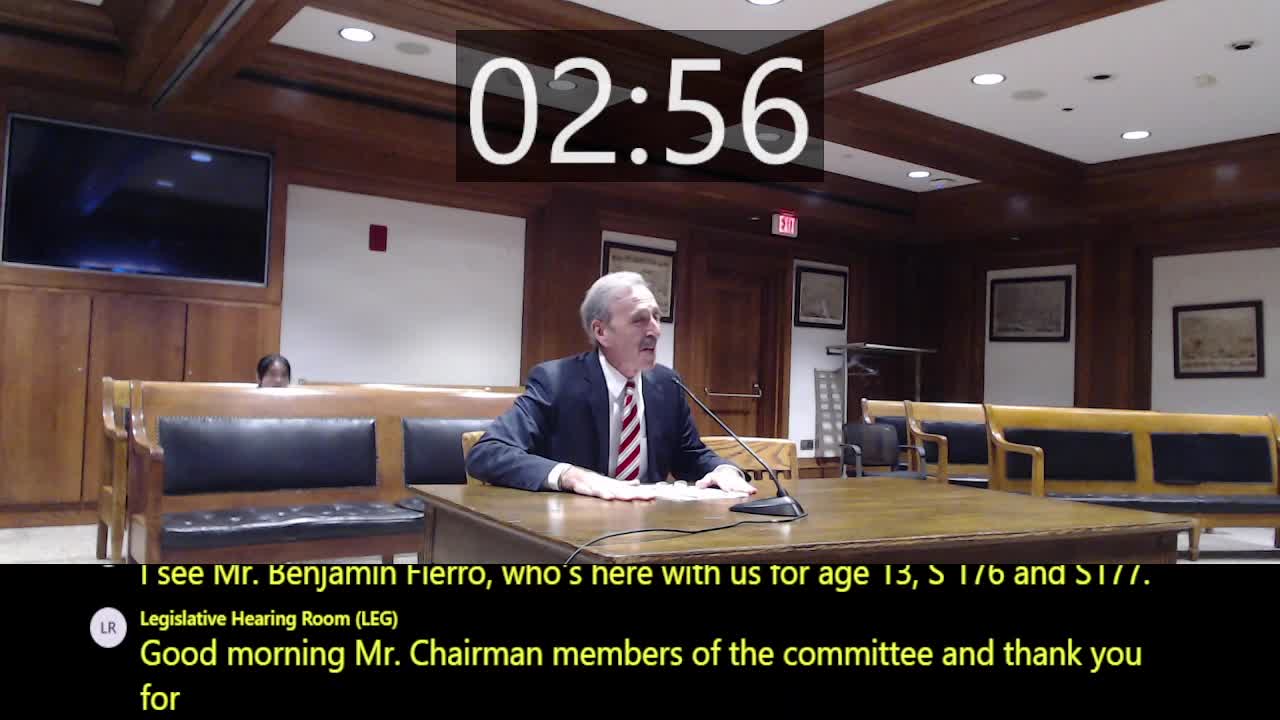
Summary
Lawmakers and housing advocates urged the Joint Committee on Community Development and Small Business to approve bills that would increase municipal incentives under Chapter 40R, add a new Chapter 40Y for starter homes, and correct a technical gap in school-cost reimbursement law.
Members of the Joint Committee on Community Development and Small Business heard testimony on legislation aimed at increasing state incentives for so-called starter homes and updating related school-reimbursement rules. Attorney Benjamin Fierro, representing the Home Builders and Remodelers Association of Massachusetts, and Nelly Soto, president of the Massachusetts Housing Coalition, urged the committee to advance bills including Senate Bill 176 and its House companion and a technical correction in Senate Bill 177.
Fierro told the committee the bills focus on encouraging production of smaller, single-family “starter” homes for first-time buyers by changing the incentive structure in the Smart Growth Zoning and Housing Production Act (chapter 40R). “All 3 of these bills…goes to the issue of housing and encouraging housing production, especially starter homes, single family homes that young people, first time homebuyers and hopefully first generation buyers could actually afford,” Fierro said. He described a proposal that would double the per-unit incentive paid to municipalities from $3,000 to $6,000 and raise other zoning-payment minimums (for example, moving a stated minimum from $10,000 to $20,000 under the bill’s formula).
Fierro and other testifiers traced the proposals to two related pieces of law. The MBTA Communities law (section 3A of chapter 40A) requires MBTA-district municipalities to zone for multifamily housing by right; chapter 40R, enacted in 2004, created incentive payments for municipalities that adopt smart-growth zoning overlays. Fierro said the administration previously proposed moving the starter-home provisions out of chapter 40R into a distinct Chapter 40Y to focus incentives on smaller single-family starter homes, and he described Senate Bill 177 as a “technical correction” to make related school-cost reimbursements operate as intended across the statutes.
Fierro also described a technical gap involving chapter 40S, which provides smart-growth school-cost reimbursement: when chapter 40Y was created, the corresponding language in chapter 40S was not updated to reference the new chapter, so communities that adopt starter-home districts might not receive the school-cost reimbursement the law was intended to provide. “Ironically…if they zone for starter homes for families, under the law right now, they wouldn't be entitled,” Fierro said, urging the committee to adopt the fix.
Nelly Soto of the Massachusetts Housing Coalition told the committee the bills would significantly increase payments to municipalities that adopt zoning overlays. She said the proposed zoning payments would range from a stated $20,000 for small districts to as much as $1,200,000 for districts that zone more than 500 units, and that the per-unit incentive would rise from $3,000 to $6,000. Soto said those payments go to municipalities, not developers, and can be used for infrastructure and other local needs. “These zoning payments and the per unit incentives do not go to developers. They are directly funding sources for our community,” she said.
Committee members asked several policymakers and witnesses about how school-cost reimbursement is calculated and about the bills’ likely effects in suburban and rural communities. Fierro summarized the statutory formula in chapter 40S: reimbursement equals “the positive difference, if any, between… the total educational cost for each eligible student and the sum of all local smart growth revenues for education plus any additional chapter 78” revenues, noting that the statute contains the measurement method.
Speakers also discussed market and land-cost barriers. Fierro described land-price pressures in communities with large minimum-lot zoning, saying density requirements (for example a minimum of four units per acre in starter-home districts) and smaller-lot options are a critical component of making starter homes feasible. Several committee members praised the legislation and said they would support advancing the bills to executive session.
No formal committee action on the housing bills occurred at the hearing; the session ended after testimony and questions. The committee chair closed the hearing and took a motion to adjourn that was seconded and carried.
Why this matters: The bills would change financial incentives offered to municipalities to create denser zoning for transit- and town-center-focused housing and would fix a statutory mismatch that currently may exclude starter-home districts from school-cost reimbursement. Supporters said the financial changes are modest but necessary to prompt municipal action and help address shortages of affordable starter housing for young and first-time buyers.
What’s next: Committee members said the bills would be considered further in executive session and in later hearings scheduled by the committee.