
Public Advocates Office urges stricter cost scrutiny, rethought rate design to ease bill increases
Get AI-powered insights, summaries, and transcripts
Subscribe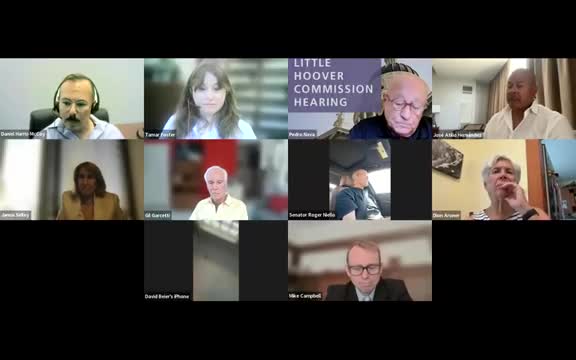
Summary
The Public Advocates Office told the Little Hoover Commission that cutting unnecessary operating and capital spending and rethinking rate design are the most direct ways to reduce electricity bills for California customers.
Michael Campbell, deputy director for energy at the Public Advocates Office, told the Little Hoover Commission that the office's statutory mission is to “advocate for the lowest possible rates for utility customers” and that the sharp rise in electricity rates over the last decade has multiple causes that warrant scrutiny.
Key drivers and levers: Campbell highlighted three principal areas for immediate attention: (1) operating and maintenance (O&M) costs that utilities recover dollar-for-dollar in rates and have grown faster than inflation; (2) capital spending (capex) that adds to rate base and interacts with the authorized return on equity; and (3) rate design, where reliance on volumetric (per-kWh) charges and inadequate fixed-cost recovery can create regressive effects when participants avoid volumetric charges.
Recommendations described at the hearing included stronger scrutiny of O&M in general rate cases, careful review of capital investment prudence, exploration of lower-cost financing such as securitization for large legacy costs, and reconsideration of rate design to align cost causation with who pays. Campbell said some programs funded through rates do not pass cost-effectiveness tests and that redirecting poorly performing programs to non-ratepayer funding could yield more than $500 million in annual rate relief, subject to statutory and budgetary constraints.
On data centers and new load: Campbell told commissioners that whether new large loads lower or raise rates depends on timing, interconnection costs and permanence. He cautioned against assuming new load will always reduce rates and urged careful protections to avoid leaving ratepayers with stranded costs if large customers depart.
Process and oversight: Campbell described the Public Advocates Office's role as an active litigant within CPUC proceedings with discovery, testimony and cross-examination powers and said the office uses those tools to test utilities' cost claims. He also said that returning more spending forecasts to general rate case processes would produce better trade-offs and stronger discipline on utility proposals.