
Irvine council directs city attorney to draft ballot options after weeks of debate over Oak Creek Golf Course
Get AI-powered insights, summaries, and transcripts
Subscribe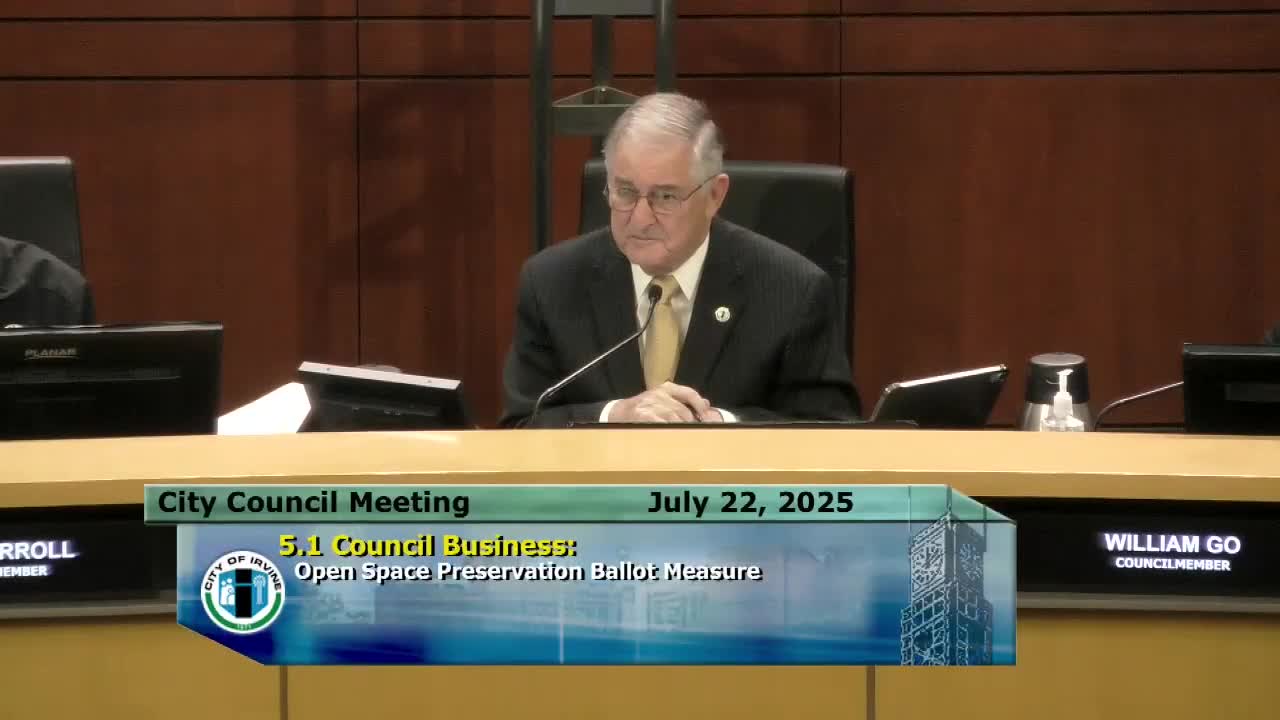
Summary
After hours of public comment, the Irvine City Council voted unanimously to ask the city attorney to prepare ballot language that would (a) confirm and expand voter protection for open space across the city and (b) provide an alternative two-measure approach including an up-or-down vote specifically on the Oak Creek Golf Course redesignation.
Irvine — The City Council voted 7-0 on July 22 to ask the city attorney to prepare ballot language to settle whether preserved open space in Irvine can be changed without direct voter approval and to draft an alternative two-measure approach that would separately put the future of the Oak Creek Golf Course before voters.
Supporters and opponents packed the council chambers for the discussion, which followed several scoping sessions earlier this summer about a proposed 3,100-unit residential project on the Oak Creek Golf Course submitted by the Irvine Company. The council’s motion directs staff to return with formal ballot language and related election resolutions at the council’s Aug. 12 meeting; staff said any council-initiated ballot measure that would change land use designations likely would trigger environmental review under the California Environmental Quality Act (CEQA).
The vote came after hours of public comment, with dozens of residents urging the council either to protect Oak Creek as part of Irvine’s preservation system or to allow a public vote on whether that parcel may be redesigned for housing. City Attorney Jeff Melching framed the legal background: a 1988 voter initiative (often referenced in staff materials as Initiative Resolution 88-1) and a subsequent 1988 open space memorandum of understanding between the city and the Irvine Company set out a phased program for clustering development and dedicating open space. Melching told the council those historic agreements and later Measure C (1991) shaped the current preservation framework but that the practical effect and reach of those documents can be clarified by a new ballot measure.
“Voters endorsed a program for the preservation of open space resulting in the clustering of development,” Melching said during a presentation that reviewed the 1988 initiative, the implementing MOU and the general-plan amendments that followed. He told the council a measure could (a) prohibit council amendments to preservation designations without another public vote, (b) extend voter protections to other city-owned or city-designated preservation lands, and (c) — if included — permit a redesignation of the Oak Creek Golf Course only upon a public commitment to convey 315 acres of compensating publicly owned open space noted in the MOU. Melching cautioned the council that a council-placed measure to redesignate Oak Creek itself may require CEQA review and therefore a longer schedule.
Many speakers urged a single, clear ballot question limited to Oak Creek. Others said a broader measure that updates and codifies protections for the city’s preserved lands was appropriate. The outreach and comments included homeowner association leaders, longtime Irvine residents, and representatives of groups organized as Save Irvine Open Space. Several speakers and legal counsel for community groups asserted the Irvine Company has not recorded a required open-space easement for Oak Creek and urged the city to enforce existing agreements before considering changes.
After discussion the council asked the city attorney to prepare: (1) ballot language substantially in the form described in staff materials that would confirm, expand and update voter protections for lands currently designated for preservation; and (2) an alternative two-measure option that would present voters with a standalone yes/no question about whether to remove preservation protections from the Oak Creek Golf Course and a separate measure to confirm expanded protections for other open-space parcels. The council asked staff to return with the draft language and the associated election resolutions for the Aug. 12 meeting and to note the likely CEQA implications for any council-initiated redesignation measure.
Council members and speakers also discussed logistics and timing: staff advised that, if the council calls a special municipal election, legal windows require a call by Aug. 12 for a possible Nov. 18, 2025 election date, but Melching said an initiative that attempts to change a general-plan land use may require environmental analysis that would push any implementation timeline into 2026.
With the city attorney directed to prepare the proposed language and an alternative two-measure approach, council members said they expected multiple drafts and legal review before final action at the Aug. 12 meeting.
Votes at a glance
- Motion directing the city attorney to prepare ballot language for (a) a citywide open-space confirmation/expansion measure and (b) an alternative two-measure approach (including a standalone Oak Creek question): Motion moved by the mayor (mover not stated on the record), seconded from the dais; roll-call approval 7-0 (yes: Carroll; Goh; Liu; Martinez Franco; Tresider; Vice Mayor Mei; Mayor Larry Agran). The council instructed staff to return Aug. 12 with draft language and related resolutions. (Source: council action during the July 22 meeting.)
Why it matters
The council’s direction puts the question of Oak Creek and of broader preservation policy before voters and opens a legal and political path that intersects decades-old agreements between the city and the Irvine Company. The outcome will determine whether the council, by majority vote, can change preservation designations in the future or whether such changes must return to the electorate.
What’s next
Staff will prepare draft ballot language and any supporting resolutions and return to the City Council’s Aug. 12 meeting. Melching warned that a council-placed redesignation question would likely require CEQA review and related technical work prior to final council or ballot action.