
Louisiana launches educator certification portal; TeachLA Live accepts PDFs through Aug. 11
Get AI-powered insights, summaries, and transcripts
Subscribe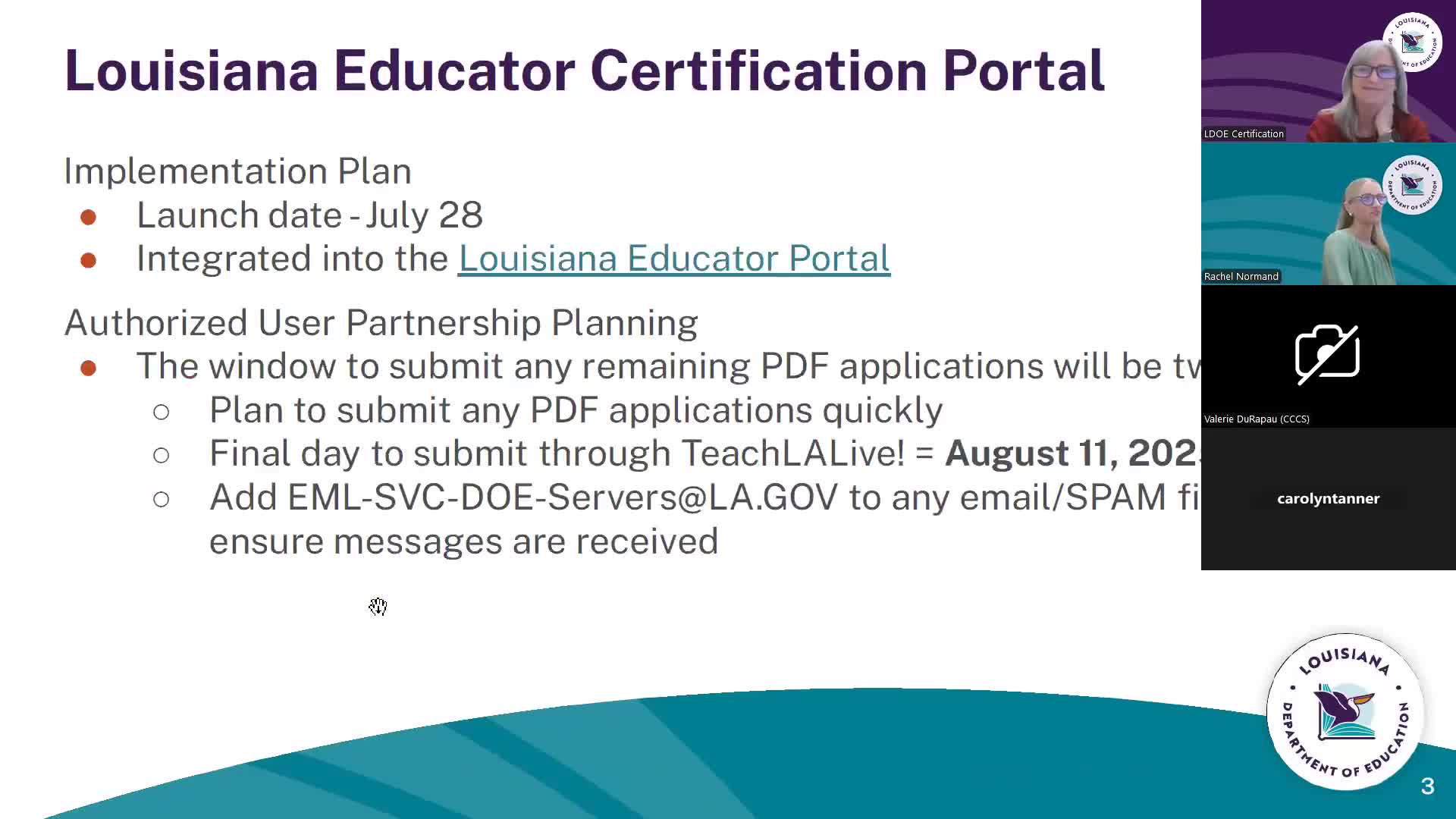
Summary
The Louisiana Department of Education launched a new certification module within the Louisiana educator portal on July 28, moving all certification applications from TeachLA Live to the online portal effective Aug. 12; HR staff and nonpublic schools must obtain eScholar staff IDs and MyLA accounts and request permissions to review applications.
The Louisiana Department of Education’s certification office demonstrated a new online certification module that “did officially launch yesterday on July 28,” and said paper or fillable-PDF applications submitted through TeachLA Live will be accepted only through Aug. 11, with the portal becoming the exclusive submission method on Aug. 12.
The portal integrates certification features into the Louisiana educator portal, which the department has used for evaluations for more than a year, and aims to consolidate certification and evaluation tools into a single site. “We are gonna be posting all of these presentations on our website,” said Rachel Norman, director of the certification office, at the start of the webinar. Lana Hutchinson, deputy director of the certification office, led a live demonstration and answered questions.
Why it matters: The change affects educators, HR staff and nonpublic schools across Louisiana that process certification requests. Department presenters said the switch is intended to reduce errors and re-submissions by auto-checking required items such as criminal background checks (CBCs) and by importing verified identity data from MyLA and eScholar accounts.
Key details from the demonstration
• Transition dates: The department will accept PDF applications through TeachLA Live until Aug. 11. Effective Aug. 12, applicants must use the online Louisiana educator portal certification forms; PDF packets will no longer be accepted. Hutchinson said the two systems cannot run in parallel for technical reasons.
• Access requirements for HR/nonpublic users: Nonpublic HR personnel must have an eScholar staff ID, a MyLA account and then submit a permission request (instructions are posted in the department’s guidance). Hutchinson demonstrated using the EdLink ops portal to request an eScholar staff ID and said staff IDs can take a day or two to be issued when volume is high.
• Applicant verification and CBC handling: Applicants who lack a CBC on file will be routed to a fingerprint-clearance application first; the new system prevents applicants from starting other certification requests until their background check is on file. Hutchinson said the portal will import verified Social Security numbers from MyLA/eScholar accounts to reduce delays caused by mistyped SSNs and inconsistent CBC report matches.
• Application workflow and time limits: Applicants complete online forms and click a "complete" button on each page; applications started must be fully completed and submitted within 45 days or the draft will expire and the applicant must start over. Digital signatures are time-stamped when the applicant submits or when the HR office signs and routes the packet.
• HR review and experience verification: When an application requires HR review, it routes to the selected HR office (for example, the Baton Rouge diocese). HR staff review applicant-entered fields but cannot edit applicant profile fields; they complete HR-specific forms such as in-state experience verification and add local-evaluation attestations or uploaded PDFs where required. Hutchinson noted an import-from-state-databases option exists for public-school employment records but warned that long histories can produce duplicate or messy records that may require cleanup before signing.
• Payment and receipts: The portal computes fees at checkout; once an applicant pays and clicks submit, the application is routed to the certification office. The system can also accept prepaid receipts from the previous system during the transition, using a documented, temporary process.
• Messaging and record keeping: The department’s messaging feature sends application responses to all signers on the case (applicant, HR office and, where applicable, preparation providers). Submitted applications can be exported to a single PDF that contains the full application, attachments and receipts for local recordkeeping.
• Optional membership code for nonpublic employers: Nonpublic HR offices may set an optional six-character membership code that educators can use to link themselves to a school or system; connecting educators requires HR approval. Hutchinson said this is optional and not required to review or sign applications but enables additional features such as sending start-application requests to tied educators and viewing expiration flags.
Support and next steps
Department presenters asked attendees to whitelist the email address used to send portal messages to avoid spam filtering and to consult posted user guides and reference crosswalks that map old PDF packet names to the new portal application names. For one-on-one or account-specific issues — for example, confirming whether a staff ID already exists — presenters directed users to submit requests to the teacher certification help center.
The session recording and supporting slide decks will be provided to the department communications team; presenters said recordings should be posted to the website after that team publishes them.
Quotes and attributions in this article come from webinar remarks by Lana Hutchinson, deputy director of the certification office, and Rachel Norman, director of the certification office.