
Trustees approve new natural gas aggregation agreement after presentation on recent billing spikes
Get AI-powered insights, summaries, and transcripts
Subscribe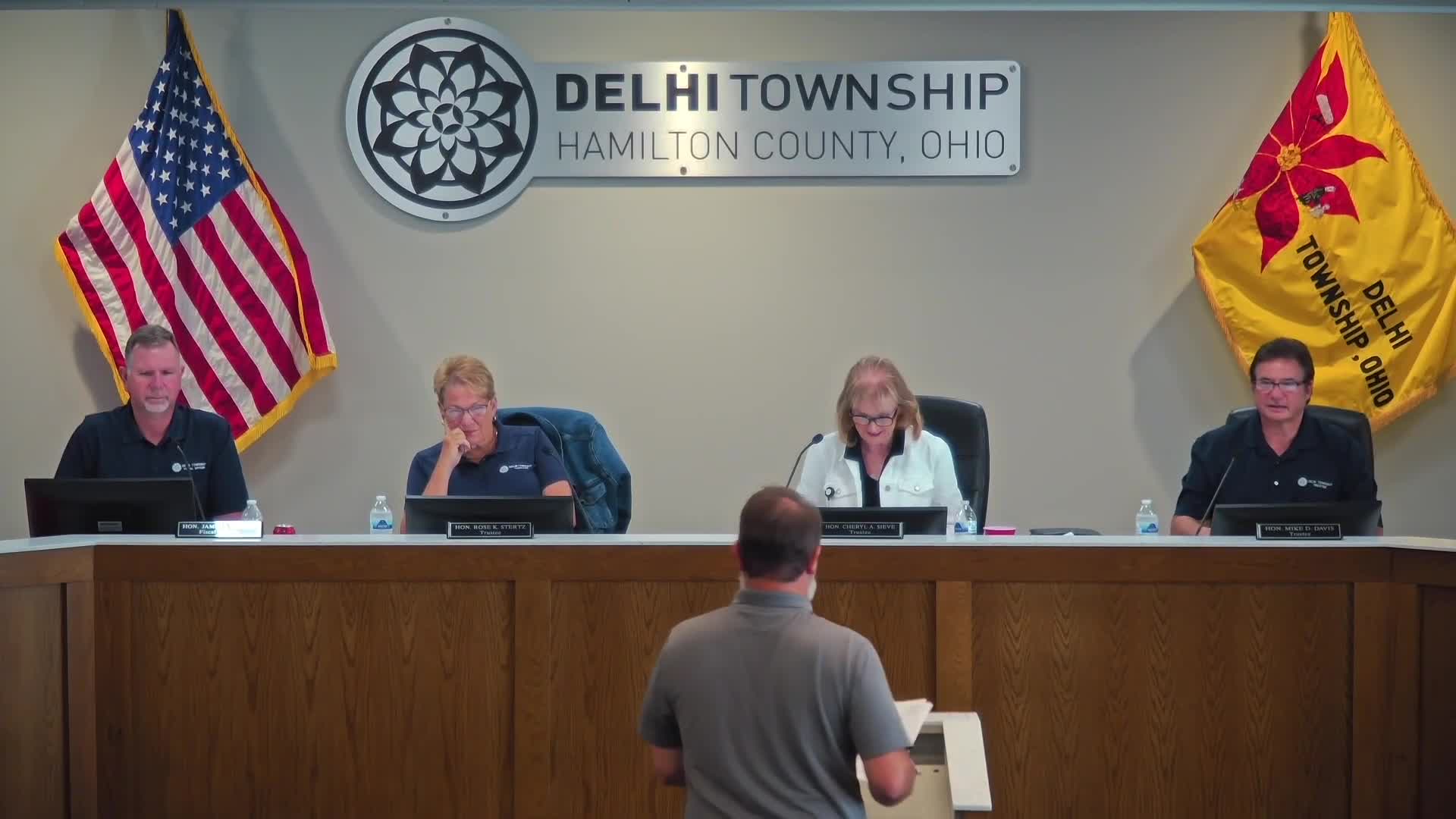
Summary
Delhi Township trustees voted July 30 to authorize the township administrator to sign a 12-month natural gas aggregation agreement recommended by Energy Alliance following a presentation that blamed market volatility and unusually high summer usage for recent bills.
Delhi Township trustees on July 30 adopted a resolution authorizing the township administrator to enter a natural gas aggregation agreement with a supplier recommended by Energy Alliance, after a presentation explaining why residents saw unusually high utility bills this summer.
The township’s consultant, Rich Sarrais of Energy Alliance, told trustees the township’s existing natural gas contract with AEP Energy expires in October and recommended a 12-month renewal at a supplier price of 0.6499 (quoted in the presentation as 0.6499) per unit; Sarrais summarized the current contract rate as roughly 50.224¢. He advised that a decision be made immediately so staff can lock in the supplier and preserve enrollment continuity.
The trustees heard Sarrais explain that price volatility and unusually high electricity use during a recent heat event combined to produce bills that were larger than many residents expected. Sarrais said the township’s electric aggregation supplier rate currently sits at about 9.32¢ compared with Duke Energy’s default of about 10.43¢, and that the aggregation program has saved participating residents roughly 11 percent on the supplier portion of their electric bills compared with Duke’s published rates.
Sarrais told trustees the township’s prior gas aggregation contract lapsed in May after staff and the consultant decided in March not to re-contract when suppliers’ offers were not clearly favorable to residents. He said prices fell in April, allowing the township to re-offer an aggregation that has since produced savings compared with Duke’s default supply.
Trustees also discussed consumer confusion: residents receiving high bills did not always know whether Duke or a third-party supplier was their current supplier, and some had migrated to third-party sellers after sales calls. Sarrais emphasized that Energy Alliance is a consultant and not the gas supplier. Township staff and Energy Alliance urged residents with questions about their bills to call the township or Energy Alliance for a bill review and to check the supplier name on their Duke bill.
The trustees adopted Resolution 2025-132 — authorizing the administrator to execute the recommended natural gas agreement and declaring an emergency — by voice roll call. The board recorded votes in favor from Trustee John Davis, Trustee Michael Sturtz and Trustee Sarah Seavey; the resolution passed.
Why it matters: the aggregation program pools residents to negotiate fixed supplier prices and aims to shield consumers from market swings on the commodity portion of gas and electric bills. Township officials and the consultant said the program does not change other components of a utility bill — transmission, distribution, and mandated riders — but can reduce the supplier charge when market conditions allow.
Trustees and the consultant reiterated that enrollment in Delhi’s aggregation is opt-out: residents are automatically enrolled unless they exercise their right to opt out; a permanent do-not-aggregate list is maintained by the Public Utilities Commission of Ohio. Sarrais said historically fewer than 5 percent of customers actively shop outside aggregation and that the opt-out model lets the aggregation capture those savings for the majority.
Trustee Seavey summarized the board’s position in the meeting: “Trust me, had you stayed with Duke, you’d be at 11% more than where you are now.” Township staff posted materials, rate comparisons and Energy Alliance contact information to the township website for residents seeking more detail.
The resolution takes effect immediately; new supplier pricing will be reflected in residents’ bills per supplier and meter-read timing (presentations referred to the November bill as representing October usage, depending on meter read dates).