
Senate subcommittee probes how Congress should act after Supreme Court ended Chevron deference
Get AI-powered insights, summaries, and transcripts
Subscribe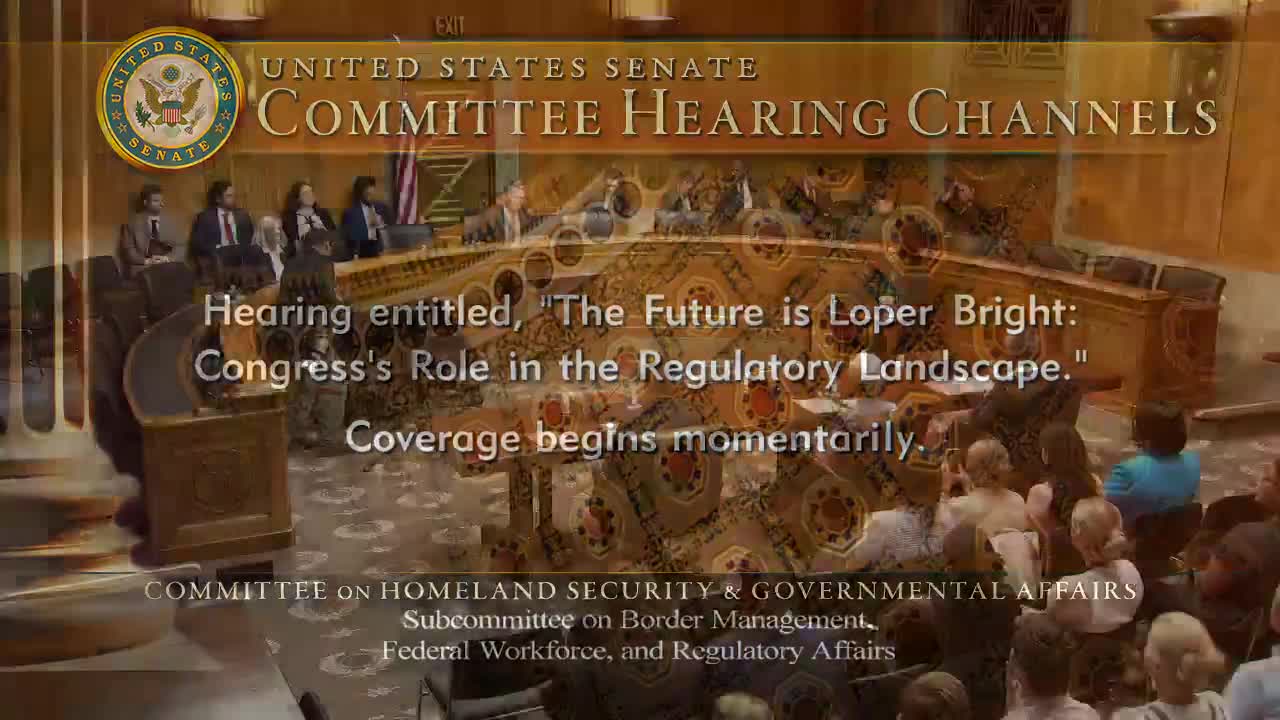
Summary
Senators and three witnesses debated how lawmakers can draft clearer statutes, strengthen congressional expertise, and use retrospective review after the Supreme Court’s June 28, 2024 decision in Loper Bright v. Raimondo ended decades of judicial deference to agencies’ statutory interpretations.
A Senate Homeland Security and Governmental Affairs subcommittee on regulatory affairs heard bipartisan testimony on how Congress should respond after the Supreme Court ended Chevron deference in the June 28, 2024, decision Loper Bright v. Raimondo.
The hearing made clear that lawmakers face competing demands: write statutes that are specific enough to survive judicial review while preserving agency flexibility to apply technical expertise. "That era is now over," Chairman James Lankford said, describing the Supreme Court ruling that removed Chevron as a routine path for agencies to have courts defer to their readings of ambiguous statutes.
Why it matters: Agencies implement nearly every federal law; courts and witnesses warned that courts will now be asked to reach the "best reading" of statutes rather than defer to agency interpretations. Senators said that change could affect public health, consumer safety and economic rules if Congress does not adapt its drafting and oversight.
Three witnesses—Representative Allyson Schwartz, Professor Susan Dudley and Professor Chaz Scrutieri—offered overlapping recommendations: clarify legislative purpose and authority; bolster congressional drafting capacity and expertise; require agencies to be more transparent about factual assumptions and tradeoffs; and use retrospective review and reauthorization more actively.
Representative Allyson Schwartz, who co-chaired the Bipartisan Policy Center working group that produced the report Legislating After Loper, urged clearer statements of purpose and more explicit boundaries on delegation. "We sought bipartisan, achievable remedies," she said, and recommended stronger committee debate, better legislative records and more staff expertise to reduce ambiguity that courts might later be asked to resolve.
Professor Susan Dudley argued Congress should distinguish questions of fact, policy and legal interpretation in statutes and require agencies to disclose the studies, models and assumptions that underlie rulemaking. "By requiring agencies to lay out their judgments and assumptions transparently, explicitly authorizing them to weigh important tradeoffs and learning from ex post evaluation, Congress can ensure regulatory decisions are more transparent, accountable and grounded in both sound science and legitimate policy judgment," Dudley said.
Professor Chaz Scrutieri framed agency outputs as falling into three categories—findings of fact, policy judgments and conclusions of law—and said Loper Bright affected primarily judicial review of legal conclusions. He recommended that Congress consider whether to cabin policy discretion and, where appropriate, make more policy choices itself rather than delegate broad authority.
Senators pressed witnesses on practical steps. Senator John Fetterman said the change could be "the difference between whether the water that we drink is clean or the cars that we drive are safe," and asked what Congress should tackle first. Senator Maggie Hassan asked how to expand congressional capacity without making the legislative process so cumbersome that bills cannot pass.
Witnesses and senators discussed specific ideas: creating a congressional counterpart to the Office of Information and Regulatory Affairs (an independent congressional regulatory office compared by witnesses to the Congressional Budget Office); increasing resources for legislative counsel to improve drafting; using statutory "speed bumps"—explicit factors agencies must consider when a statute uses open-ended terms such as "reasonable" or "appropriate"—and committing to routine retrospective review and timely reauthorization of major statutory programs.
On enforcement and judicial review, witnesses said courts will now use the full interpretive toolbox—canons of construction, precedent and other aids—and may give Skidmore-style respect to agency expertise without treating that respect as binding deference. Professor Scrutieri characterized the post-Loper landscape as one where courts must reach an independent judgment about statutory meaning while still recognizing agency expertise when appropriate.
Two administrative items concluded the hearing: Representative Schwartz asked that the Bipartisan Policy Center report be entered into the record; the subcommittee entered that document without objection. Chairman Lankford also announced the hearing record would remain open for 15 days for additional submissions, with a deadline of August 14, 2025.
The senators and witnesses repeatedly urged a balance: strengthen Congress’s drafting and oversight muscles while preserving agency ability to apply technical expertise and update rules in light of new evidence. The subcommittee recessed for votes and will retain an open record to receive additional materials and questions for the record.
Ending: Lawmakers at the hearing described a policy agenda that ranges from modest procedural changes—more staff, clearer legislative records and reporting requirements—to larger structural steps such as a congressional regulatory office and statutory changes to the Administrative Procedure Act. The hearing record will remain open through August 14, 2025, for further submissions.