
Plumas staff outline remaining Dixie Fire recovery funds and propose scattered-site affordable rentals
Get AI-powered insights, summaries, and transcripts
Subscribe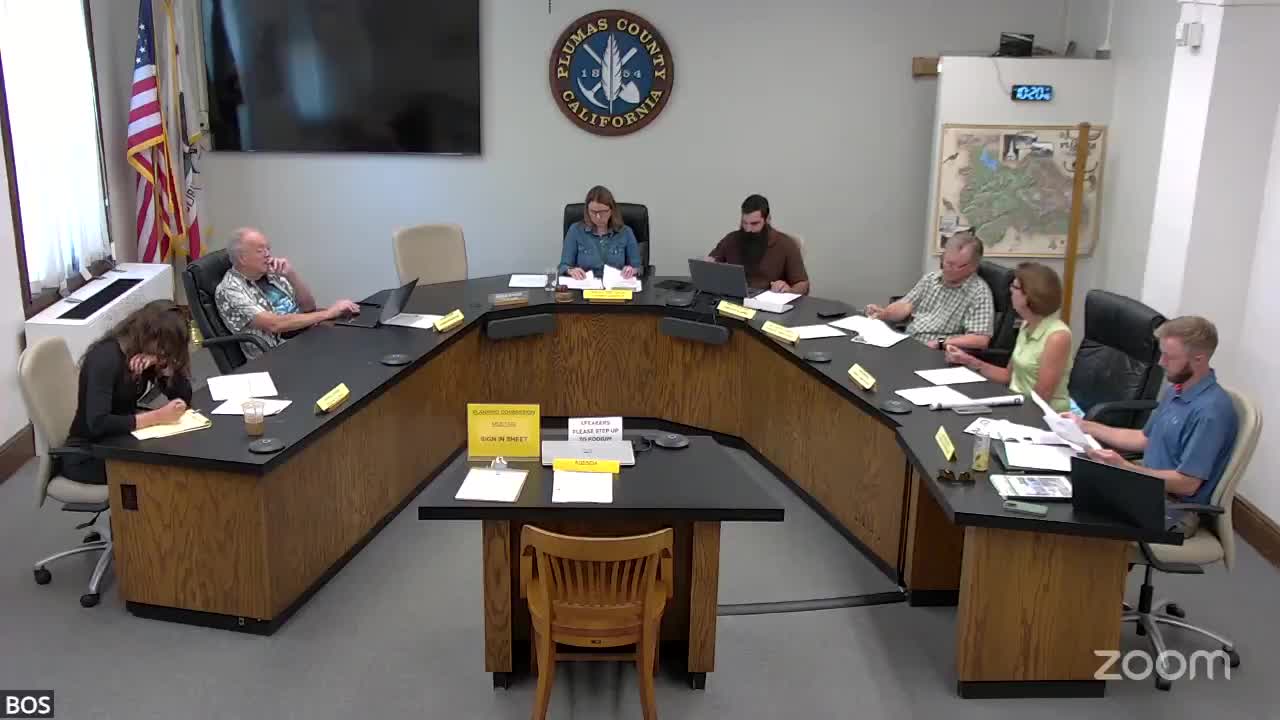
Summary
Planning staff told the commission the county has roughly $10–11 million remaining from CDBG-DR disaster recovery funds for housing and infrastructure. Staff described a proposed multifamily scattered‑sites rental model, with Plumas Rural Services as the nonprofit sponsor and an estimated 20–22 parcels to host 40–42 units at 80% AMI.
Tracy, a member of the Plumas County planning staff, told the Planning Commission the county continues to work with the State Department of Housing and Community Development and HUD on Community Development Block Grant disaster recovery (CDBG‑DR) funds from the Dixie Fire and Beckwourth Complex Fire.
Tracy said the county currently has "approximately, 10 or $11,000,000 left in in funding there," and described one potential distribution: roughly $8 million for housing, $2 million for infrastructure (road resurfacing related to wildfire impacts), and $1 million for state administration and program delivery. "We will be able to bring another housing program," Tracy said of the proposal under discussion.
Under the model presented to the commission, the county would pursue a multifamily scattered‑sites program in which a nonprofit would sponsor acquisitions and a developer would build rental housing on multiple parcels across the county. Tracy said Plumas Rural Services has stepped forward as the nonprofit sponsor and has a developer partner. The concept discussed was roughly 20–22 parcels, producing about 40–42 units (two units per parcel: a primary unit with an attached accessory dwelling unit). Units would target households at 80% or less of area median income (AMI).
Tracy described program differences from the single‑family reconstruction program that previously distributed federal disaster funds. The older program focused on owners rebuilding on the same parcel after a direct loss; the scattered‑sites model would concentrate on rental units owned and managed by a nonprofit, with a 55‑year affordability covenant. Tracy said timeline expectations are tight: an action plan amendment with state HCD could be complete by the end of the year, contracts by January 2026, planning and entitlements in 2026, construction in 2027–28 and lease‑up into 2028.
Commissioners and members of the public raised questions about unit size, target households and site criteria. Staff said units would likely be small two‑bedroom designs (about 800 square feet) to meet program rules and timelines, and acknowledged community concerns that 800 square feet may be small for a household of four. Tracy said the program would be rental housing for households at or below 80% AMI and that details on parcel selection, costs and pro forma would be worked out with the nonprofit and developer.
Why it matters: The county's remaining CDBG‑DR funds could finance both housing for people displaced by the Dixie Fire and infrastructure repairs to wildfire‑impacted roads. The scattered‑sites nonprofit‑sponsor model would shift from homeowner reconstruction toward long‑term affordable rentals with multi‑decade covenants, changing who benefits and how units are owned and managed.
What happens next: Tracy said staff will continue working with HCD and HUD on an action plan amendment. If the amendment is approved, contracts and entitlements would follow; staff expects the earliest lease‑ups in 2028. The commission was asked to receive updates and to note that the program details (parcel acquisition, exact unit counts and per‑parcel costs) remain to be finalized.