
City Council overrides mayoral veto to retain control over recreational marijuana fund spending
Get AI-powered insights, summaries, and transcripts
Subscribe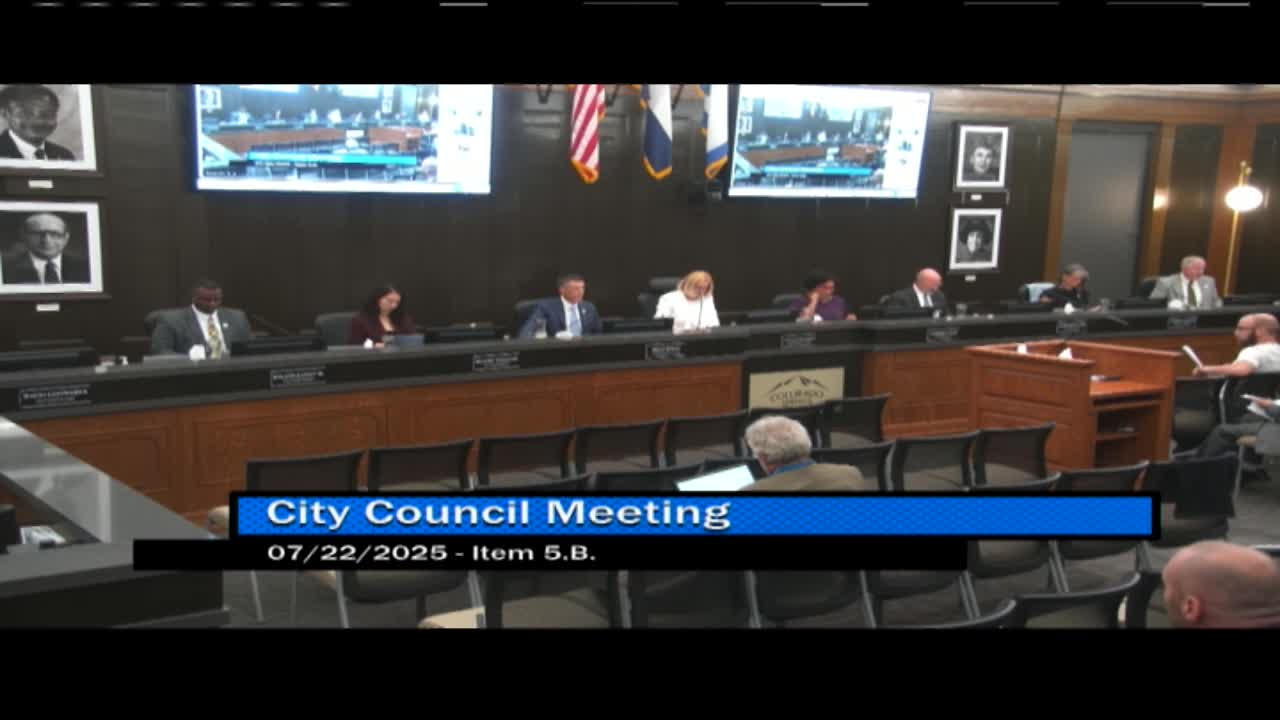
Summary
Colorado Springs City Council voted 6-3 on July 22 to override the mayor's veto of Ordinance 25-59, restoring council authority to make recommendations and establish processes for expenditures from the recreational marijuana sales tax special fund intended for police programs, mental-health services and veterans' mental-health services.
Colorado Springs City Council voted 6-3 on July 22 to override Mayor's veto of Ordinance 25-59, a measure that sets a framework for how the city may allocate revenue from the recreational marijuana sales tax to three voter-approved categories: police programs, mental-health services and veterans' mental-health services. The vote restores council authority to solicit and review grant applications and to make recommendations to the mayor about expenditures from the special fund.
The override follows months of debate over whether an ordinance is needed to implement the ballot initiative voters approved and how the money should be allocated. Supporters said the ordinance creates an explicit process so councils — present and future — can direct funds into programs the ballot identified. Opponents said the charter and earlier ordinance language already constrain the money to the three voter-approved buckets and that the proposed ordinance would create an unnecessary new layer of procedure.
Council members who supported overturning the veto described the ordinance as a tool for future councils to “get upstream” on public-safety and behavioral-health investments and to ensure the limited fund — estimated by city administration at about $1.4 million for 2025 — is not absorbed into general-purpose spending. Council members opposing the override said they would rather work through the administration's existing budget and audit processes and that the ballot language and code already provide mechanisms and citizen oversight.
City staff described several implementation options if the override stood. Michael Montgomery, deputy city council administrator, said council could establish a council subcommittee to review grant applications, but that no committee membership, schedule or application process has been set; those details would be decided only after an ordinance is in place. A member of the city administration noted that the mayor’s preferred path is to address uses for the fund through the regular budget process and an upcoming mayor–council retreat.
The council debate addressed who would make recommendations and how those recommendations would be used. One council member noted the enabling petition language for placing the question on the ballot used the phrase “at the discretion of city council,” while staff said the ballot text that voters saw referenced only that the revenue “will be used” for the three purposes. The ordinance under consideration would give council a clearer, codified role in soliciting and reviewing applications if council chooses that route.
The motion to override the mayoral veto was made by Councilman Risley, seconded by Councilman Williams, and passed 6 to 3. The record does not show individual roll-call vote names in the transcript excerpt; the chair announced the tally as 6–3.
Council members and staff indicated next steps would include discussion about whether to form a subcommittee, whether recommendations would be made annually, and whether the council or administration would drive an application process if council decides that route. Several speakers emphasized the need to collaborate with the administration and the fire department, which already performs community mental-health work through its Community Public Health division.
The override restores the ordinance changes that had been vetoed by the mayor; it does not itself appropriate funds. Any specific grants or expenditures would be subject to future appropriation decisions and to the city’s budget and auditing processes.