
Assembly committee hears ordinance to amend borough ethics code to allow dismissal of de minimis complaints and clarify spokesperson rules
Get AI-powered insights, summaries, and transcripts
Subscribe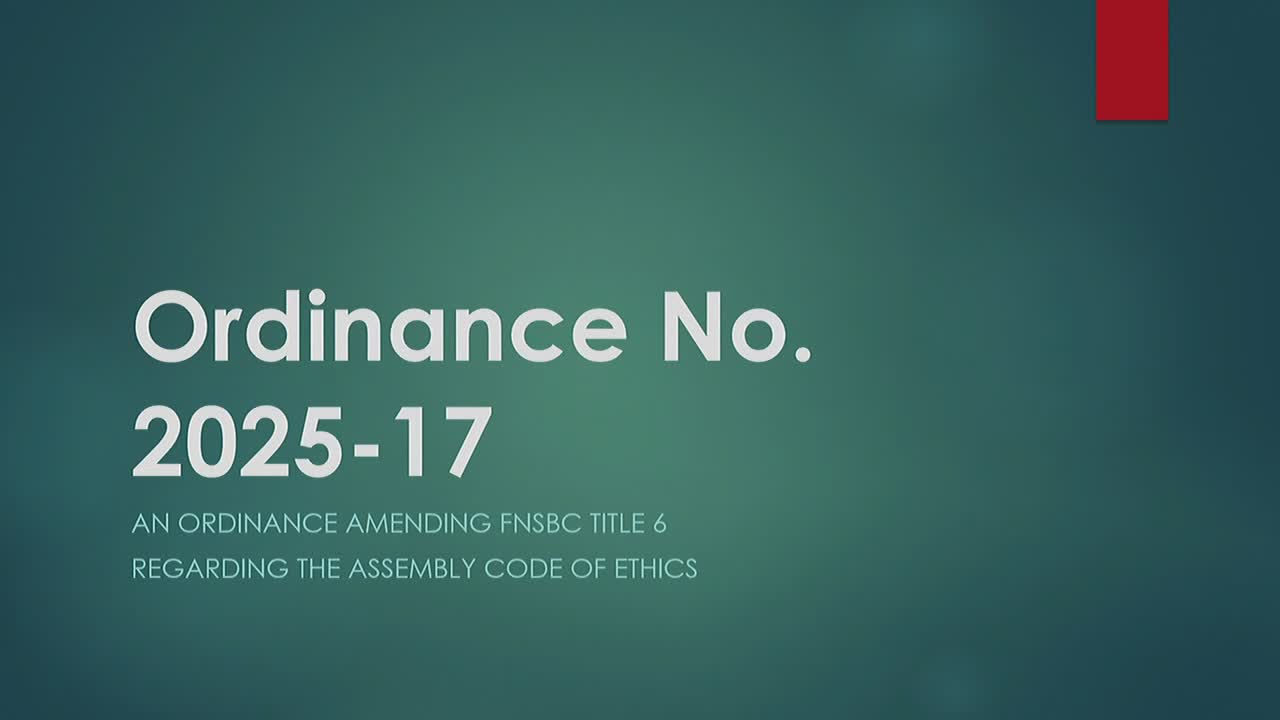
Summary
The Assembly considered an ordinance that would let the Board of Ethics dismiss frivolous or minor complaints at its discretion, clarify when an official may speak for the Assembly, and add anti-retaliation language; sponsors said the changes respond to recent ethics complaints and Board requests for flexibility.
An ordinance amending the borough's assembly ethics code was presented at the Committee of the Whole on July 17. Sponsor Assemblymember Greer Crass said the proposed changes implement recommendations from the Board of Ethics to give the board discretion to dismiss frivolous or de minimis complaints and to clarify the rules governing when a public official may represent the assembly's position.
The draft ordinance would allow the Board of Ethics to decline or cease review of a complaint when the complaint alleges solely a de minimis violation that did not pose a risk of harm, when a complainant acted in bad faith, or when the respondent self-reported the issue within 30 days of learning of it. It would also add a rule requiring that a public official presenting a public statement must present only a personal opinion and must not represent that they speak for the Assembly unless a majority of the Assembly has specifically authorized that official to serve as the Assembly's spokesperson on that issue. The sponsor said the intent is to prevent misrepresentation of the Assembly's official position while preserving ordinary free-speech activity by individual members.
The ordinance also would add explicit protection from retaliation for people participating in ethics proceedings and would clarify complaint-handling procedures, notification requirements and the Assembly's role at hearing and penalty stages. Borough legal staff confirmed the change would not remove the presiding officer's existing authority under Title 3 to designate a member to serve as an official spokesperson in a particular instance, but counsel clarified the text is intended to address standing representations tied to formal appointments or confirmations to outside bodies.
Several Assembly members expressed concern about phrasing and training; sponsors said the board's narrow interpretation of current language and repeated formal hearings on relatively minor matters prompted the proposal. One Assemblymember asked that further discussion be scheduled because a related hearing (an oral defense) is set for July 29 and he requested the ordinance not be advanced until the Assembly had a chance to review in full.
Why it matters: The ordinance changes how the borough handles ethics complaints and clarifies the boundary between personal speech and official representation; it responds to prior complaints that led to full hearings and could reduce procedural burdens for minor allegations if adopted.