
County staff recommend temporary CUP for land‑farm to treat contaminated soil from Paola gas station
Get AI-powered insights, summaries, and transcripts
Subscribe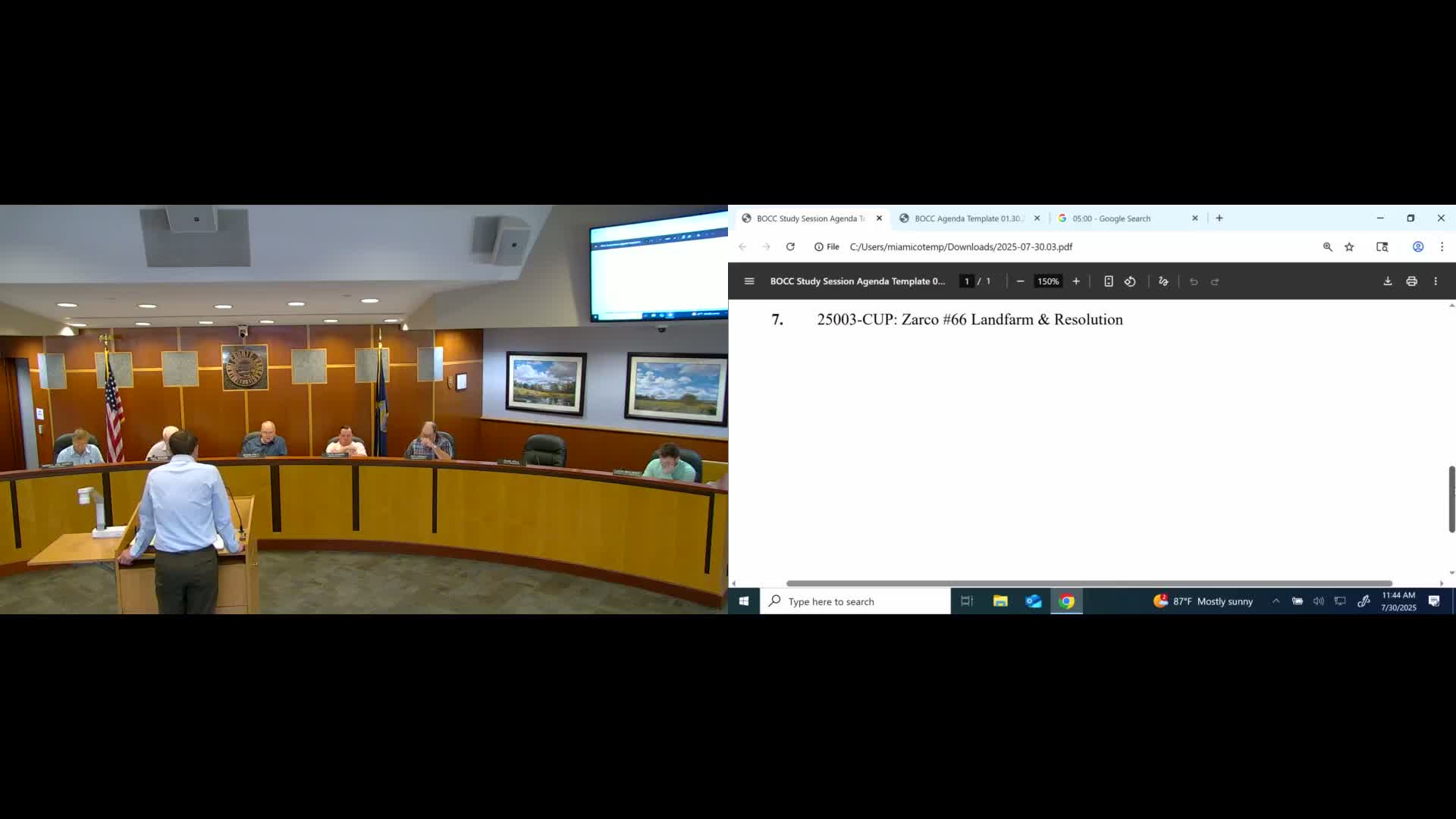
Summary
Planning staff asked commissioners to approve a temporary conditional‑use permit to operate a land‑farm on a rural parcel to treat petroleum‑contaminated soil removed from a small gas station north of Paola.
Miami County planning staff presented a request for a temporary conditional‑use permit (CUP) to operate a land‑farm to treat petroleum‑contaminated soil removed from a small gas‑station site north of Paola. Kenny Cook, planning director, said the gas‑station parcel is small and not suitable for on‑site treatment, so the applicant proposes hauling contaminated soil to a rural county property where the material would be placed inside bermed, erosion‑controlled plots for treatment. Cook described the process: periodic discing to aerate soil and encourage volatilization and microbial breakdown, monthly monitoring and lab sampling, and final laboratory confirmation before the site is returned to agricultural use. Time frame and conditions Staff proposed a three‑year CUP even though applicants expect typical treatment times of about four to eight months, to allow for weather or scheduling delays. The Planning Commission recommended approval (vote reported as 7–0). Staff noted Condition No. 7 was revised by the Planning Commission to make the applicant responsible for damage to culverts specifically caused by hauling and to require watering of gravel roads where necessary to limit dust while hauling. Regulatory and oversight notes Cook said the state of Kansas oversees the remedial standards and sampling protocols; the county requires submission of the state documentation when the site is declared remediated so the county has a record. Staff noted the county does not independently test soil; it relies on state oversight and final lab results provided by the applicant and the state's clearance process. Next steps If the board approves the CUP the applicant will proceed with permitting and hauling under the state’s and county’s requirements and provide the county with the sampling and closure documentation once treatment is complete. Ending Cook said the land‑farm use was a standard remedial method the state approves for petroleum contamination and the county will require documentation of closure; the CUP was scheduled for board action that afternoon.