
Carefree advisory group begins public process to explore redevelopment of Town Hall site
Get AI-powered insights, summaries, and transcripts
Subscribe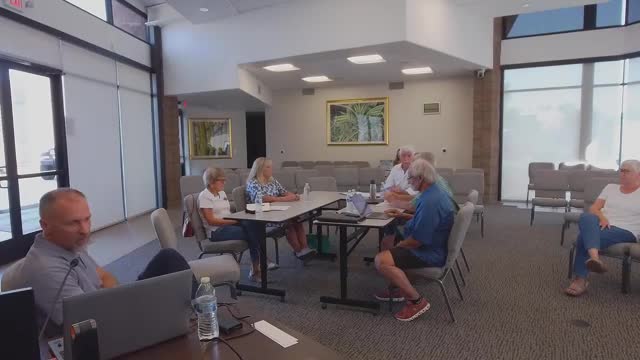
Summary
At a meeting of the town's economic development advisory group, staff opened a broad discussion about redevelopment options for the Town Hall site, weighing short-term parking against longer-term mixed-use development and public input via listening sessions and design competitions.
Carefree's economic development advisory group opened a months-long conversation about the future of the town's Town Hall site, discussing whether to hold the property as short-term parking or pursue a redevelopment strategy that would let the town set conditions and solicit specific projects.
Steve, a town staff member, told the group the issue grew out of the town's strategic planning work and the village-center master plan and said the town is weighing how to structure a redevelopment process rather than rely on a standard public auction process. "When we go through [a] redevelopment process, we actually have the opportunity to set all the terms that we'd like to see," Steve said, describing how a redevelopment path would let the town require specific uses, design standards and evaluation criteria rather than sell the parcel to the highest bidder.
The nut of the discussion was whether the one-acre site should be used temporarily as a landscaped gateway parking lot or planned now for a denser, mixed-use project that could include retail, restaurants, performing arts space and structured parking. One participant argued against a permanent parking lot: "If we turn this into a parking lot, we will have missed an opportunity," the speaker said. Others said a temporary parking solution could be acceptable until a developer willing to build a multi-level project arrived.
Advisors and residents raised several recurring themes for the site and the adjacent town center: the importance of on-site and gateway parking; compatibility with existing small retail parcels on Easy Street; the town hall's operational needs and options for relocating staff; and design goals (for example, a multi-story building with a restaurant and conference space, or a performance venue). Speakers reviewed past work on the site, including Urban Land Institute (ULI) panels and the village-center planning effort, and said those efforts informed the idea that the Town Hall parcel might serve as a "keystone" project for the town center.
Staff and members discussed practical constraints and possible next steps. Steve said prior work suggested a public outreach phase of listening sessions and recommended giving the public a framework to comment on uses, design character and parking. He estimated listening sessions and initial outreach could take about four to six months. He also said staff has budgeted money for outside assistance: roughly $20,000 is currently in the municipal budget for a related effort, and the initial ULI-style advisory option was described as a roughly $10,000 engagement.
Several participants proposed concrete techniques to gather ideas, including a design competition with architecture students, targeted listening sessions timed for both year-round and seasonal residents, and one-on-one interviews with local merchants and property owners. Developers who spoke to staff previously said they would consider development on the site only if rules allowed greater height or density and a mixed-use program, participants said.
The group also discussed options for relocating town operations if the Town Hall site were redeveloped. Staff noted the town owns a cluster of municipal properties (warehouse, public works and storage) and an upstairs space of about 1,200 square feet that is currently underutilized; speakers suggested those properties could be part of a relocation or phased build strategy. Participants flagged trade-offs: building new offices on town-owned land, leasing nearby existing office space (estimates ranged around 3,800'5,000 square feet of need), or negotiating a developer-led swap in which the town exchanges the Town Hall parcel for a new municipal building built elsewhere as part of a larger project.
Ending: Staff closed the discussion by asking advisory-group members to provide initial written or verbal priorities and to help shape a public outreach program. The group asked staff to pursue targeted listening sessions, reach out to ASU architecture/real-estate programs and to refine a scope and budget for a ULI-style panel so the town can present concrete options and four or so straw-man scenarios at a future meeting.