County creates Clinical and Community Services Department to centralize behavioral health, juvenile prevention programs
Get AI-powered insights, summaries, and transcripts
Subscribe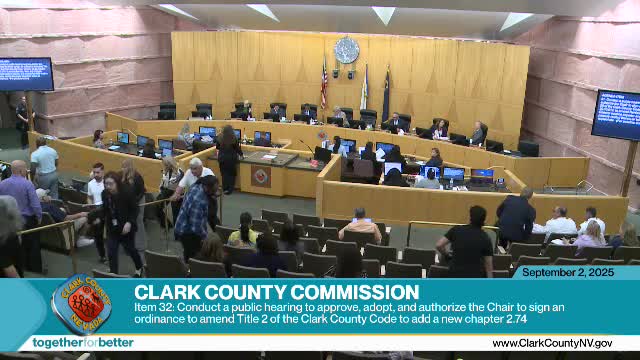
Summary
The commission adopted an ordinance to create a new Clinical and Community Services Department that combines county mental‑health, institutional services, truancy prevention and diversion programs, with a stated goal of creating centralized intake, care coordination and Medicaid billing capacity.
Clark County commissioners voted on Sept. 2 to adopt an ordinance creating a new Clinical and Community Services Department (added as Chapter 2.74 to Title 2 of the Clark County Code) to consolidate behavioral‑health services, institutional mental‑health teams, truancy prevention and diversion programs.
Jill Marano, who introduced the item as the department’s director, described a "one‑door" model: centralized intake, a consistent assessment process and care coordination so a single clinician follows a child or adult across settings (shelter, detention, hospitalization) rather than creating multiple handoffs. "Our goal is to put that to one so that you've got one clinician who's managing that child's entire care," Marano said.
Why it matters: County staff said consolidation is intended to reduce duplication, improve continuity of care for children and adults with mental‑health needs, expand community care coordination for youth on probation, and position the county to bill Medicaid directly (staff said they hope to begin billing in the next calendar year).
What the ordinance does: It makes the office a separate county department (county departments are created by ordinance) rather than an office inside another department, centralizing grant and contract management, institutional mental‑health services (Child Haven, juvenile detention, Spring Mountain Youth Camp), adult case management, and the Truancy Prevention Outreach Program (TPOP). Marano said the department did not add headcount via the ordinance; it reorganized existing staff into five program areas and aims to standardize assessment and expand care coordination.
Concerns and follow‑up: Commissioners pressed Marano on implementation details: training for staff who will serve in institutional settings, caseload sizes, and whether the centralization could dilute specialized services. Commissioner Michael Kirkpatrick, Commissioner Jim Gibson and others asked for executable 30/60/90‑day plans and reporting on caseloads and use of community providers. Marano reported TPOP currently has about 44 staff and said the program received nearly 8,000 referrals from the school district last year, which Commissioners said raised questions about scope and timing of interventions.
Decision vs. direction: The commission adopted the ordinance to create the new department; commissioners also asked staff for additional implementation plans, audit of partner providers and more detail on caseload expectations and billing readiness.
Next steps: County staff will return with implementation timelines and details on Medicaid billing, community‑provider integration, and proposed audits of outside contractors and partners.