
Committee approves realignment of police science program, places item on consent agenda
Get AI-powered insights, summaries, and transcripts
Subscribe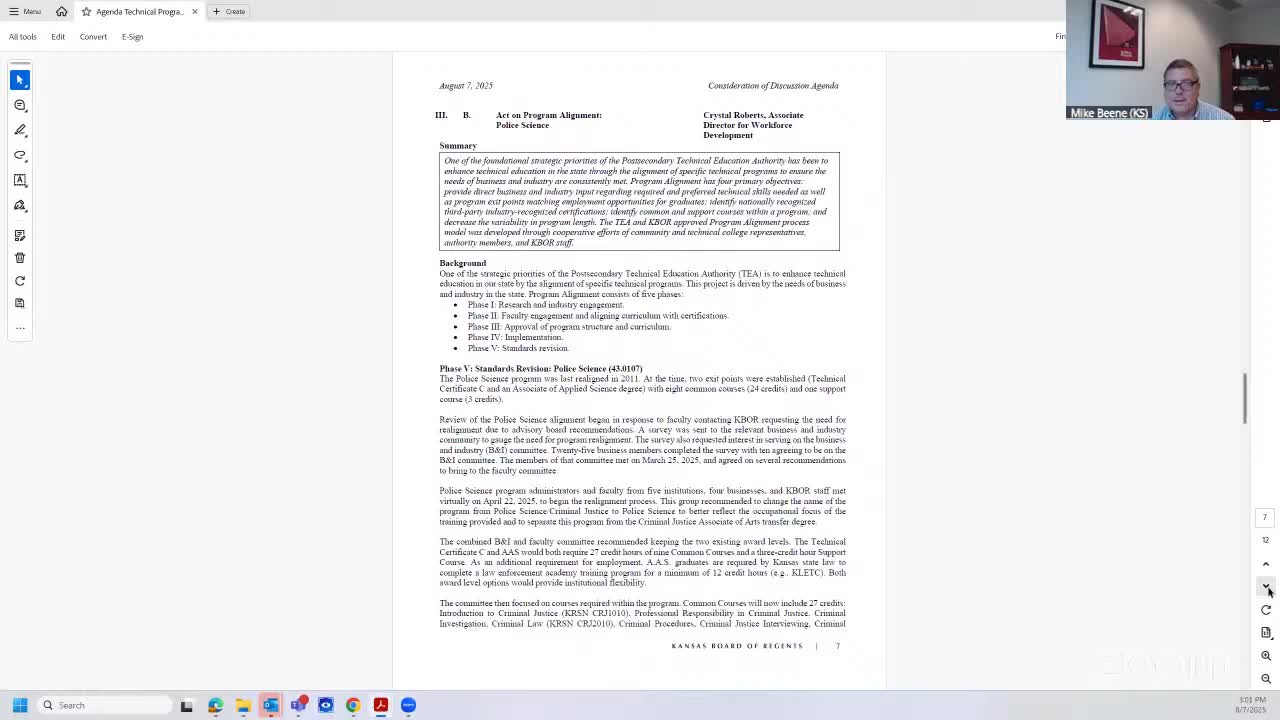
Summary
The Program and Curriculum Committee approved a realignment of the police science program, renaming it and updating required courses; the committee also placed the item on the TEA consent agenda.
The Program and Curriculum Committee of the Technical Education Authority approved a realignment of the police science program at its Aug. 7 meeting and placed the item on the TEA consent agenda.
Committee members voted to adopt the alignment staff recommended after a presentation by Crystal, a KBOR staff member who led the review. The committee approved a change to the program title to “police science,” removal of the broader criminal-justice SIP code, a new course structure that raises the common-course total to 27 credits across nine courses, and a newly recommended support course addressing mental-health crisis response.
The change follows a review prompted by faculty and advisory-board recommendations. Crystal told the committee that 25 businesses completed a survey and 10 business representatives attended the business-and-industry committee meeting; administrators and faculty from five colleges, four businesses and board staff met on April 22 to develop the alignment.
The committee recommended keeping two award levels — a technical certificate (Cert C) and an associate of applied science (AAS) — both requiring the nine common courses and one support course listed in the alignment map. Crystal said the alignment adds three total credit hours because a single interview-and-report-writing course was split into two three-credit courses, and professional responsibility in criminal justice moved from a support course into the common course block.
Crystal said the AAS retains a state employment requirement: “graduates are required by Kansas State law to complete a law enforcement academy training program for a minimum of 12 credit hours.” The committee’s packet lists the program operating under SIP 430107 and previously also under SIP 430104; staff recommended removing the broader criminal-justice SIP and keeping SIP 430107 as the program code.
Committee Chair Bean asked whether the total credit hours increased; Crystal confirmed the program increased by three credit hours due to the split course. A committee member asked whether the 12-credit academy requirement was still mandatory for employment; Crystal replied that the academy requirement remains a state law requirement for employment and is not a college-taught 12-credit course for most community and technical colleges.
Cindy moved to approve the program realignment and place it on the consent agenda; Tiffany seconded. The chair called for the ayes and the motion carried.
The committee recorded one presidential comment in opposition from among 11 institutions offering the program; that comment asked to retain the dual program title and provide an alternative to the 12-credit academy requirement. Board staff said the BNI (business and industry) recommendation and faculty majority favored the single-title police science and the academy requirement for employment.
The committee voted to forward the alignment to the full TEA on the consent agenda; no additional formal direction to staff was recorded at the committee meeting.