
Senate committee hears AOT on certified payroll; members debate prevailing‑wage reporting and impact on small contractors
Get AI-powered insights, summaries, and transcripts
Subscribe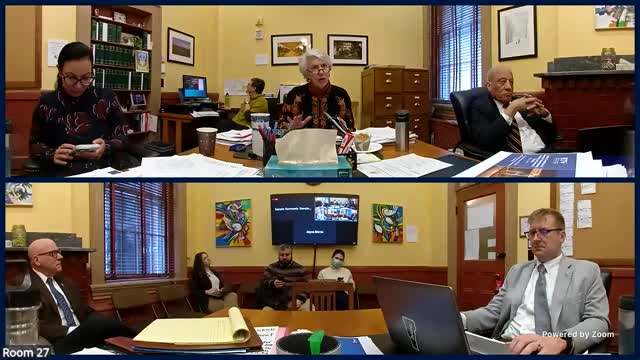
Summary
Agency of Transportation staff told the Senate Economic Development, Housing and General Affairs Committee that certified payrolls are routine on federally funded projects but can be burdensome for small contractors; senators debated whether to require similar reporting for state prevailing‑wage projects and agreed to draft changes to decertification thresholds while continuing work on the payroll question.
MONTPELIER — The Senate Economic Development, Housing and General Affairs Committee heard testimony from the Agency of Transportation on certified payroll procedures and spent more than two hours debating whether to require similar reporting for state prevailing‑wage construction projects.
Sonia Bover, civil rights labor compliance program manager at AOT, told the committee that AOT requires certified payroll (Davis‑Bacon) for federally funded construction projects and reviews weekly payroll submissions through a Doc Express platform. She said the agency monitors projects ranging from small jobs to multi‑million‑dollar contracts, and that most contractors who work on AOT projects have become familiar with the weekly certified‑payroll routine. Bover added that onboarding a handful of small “mom‑and‑pop” contractors can require additional staff assistance and that in some seasons — especially after emergency work such as flood recovery — new contractors unfamiliar with certified payroll have been unable or unwilling to complete the reporting.
Why it matters: Committee members framed the question as a balance between two aims — preventing misclassification and underpayment on public projects versus not discouraging small contractors from bidding for state work. The committee considered whether to require certified‑payroll reporting for projects that fall under the state prevailing‑wage statute (thresholds discussed ranged from $100,000 to $200,000 depending on funding source) and whether any new requirement should be phased in to give contractors time to comply.
Key testimony and points of debate
- Scope and practice: Bover said AOT currently enforces prevailing‑wage compliance on projects that carry federal Davis‑Bacon obligations and that contractors submit certified payroll weekly; the agency reviews those reports and, when discrepancies appear, resolves them with contractors and secures restitution to affected workers where required.
- Small‑contractor burden: Bover and Jayna (Jane) Morris, AOT director of administration, said the paperwork and equal‑employment‑opportunity compliance pieces can impose an administrative burden on smaller firms that lack dedicated office staff. Morris told senators that extending state requirements beyond federally funded projects may significantly shrink the pool of contractors able to bid on some state work if new administrative needs are not paired with assistance programs.
- Prevalence of misclassification: Discussion participants said misclassification and wage disputes have arisen in past years but disagreed about scale. Labor advocates and committee members who support tighter reporting said certified payroll is a transparency tool that makes it easier to detect and resolve underpayment. Representatives of contractors said many long‑established firms already comply and that the marginal burden is concentrated among very small operators.
Committee direction and amendment drafting
Committee members agreed to pursue two parallel steps: (1) refer the state employees’ affirmative‑action (AAP) matter as a standalone bill to the appropriate committees, and (2) continue work on two amendments for the labor bill that the committee is considering. The two amendments under active discussion were (a) raising the threshold for a decertification petition and (b) certified‑payroll reporting for projects covered by the prevailing‑wage statute.
- Decertification threshold: Senators moved to change the threshold that triggers a decertification petition process. A motion to prepare draft 3.1 that increases the showing‑of‑interest threshold to 50% plus one (from 30%) was put on the table. A non‑binding straw poll showed three committee members in support (Senators Tom Chittenden, Allison Clarkson and Ron Hinsdale) and two opposed; the chair requested that drafters prepare the new language (draft 3.1) for the committee record.
- Certified payroll requirement: Committee members did not adopt a final position on inserting a state certified‑payroll requirement into statute. AOT and small‑contractor advocates recommended a phased approach and technical assistance; labor proponents argued certified payroll would provide transparency and reduce misclassification and restitution costs over time. The committee agreed to extend conversation, draft possible language that would delay implementation to allow contractor onboarding, and to move technical pieces (the AAP matter) to other committees for further review.
Ending: The committee left the certified‑payroll question open, requested draft language for the decertification threshold, and asked staff to prepare amendments so the body could continue deliberations. No formal committee floor vote was recorded on the certified‑payroll requirement during this meeting.
All direct quotes are from committee testimony and are attributed to speakers in the speaker list below.