
South Berwick council reaches consensus on FY26 draft that includes town-run EMS
Get AI-powered insights, summaries, and transcripts
Subscribe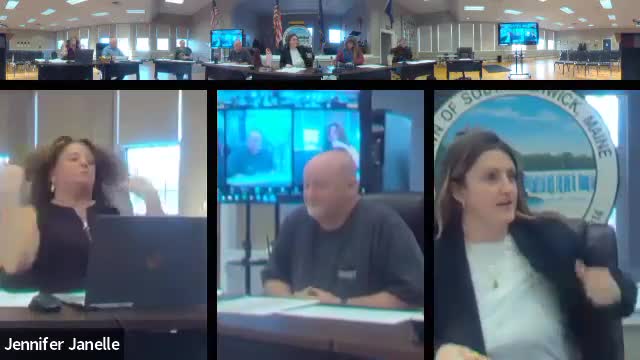
Summary
At a March budget workshop, the South Berwick Town Council agreed by consensus to a draft FY26 budget option (4.2) that adds a municipal EMS service, cuts capital improvement program (CIP) spending by half for one year, and withdraws $1 million from undesignated funds. The council set a March 25 review and an April 8 public hearing on the draft.
South Berwick Town Council members agreed by consensus on a draft FY26 budget option that adds a town-run emergency medical services (EMS) program, applies a 50% temporary reduction to capital improvement program (CIP) spending, and plans a $1,000,000 withdrawal from undesignated funds.
The council’s consensus on “option 4.2” came during the third FY26 budget workshop; staff will prepare a draft budget for review at the council’s March 25 meeting and a public hearing at the April 8 meeting before final votes on warrant articles in May. Councilor Jeff said he intends to oppose the final budget vote, but four other councilors indicated support for the chosen option.
Council staff presented four families of budget options showing different combinations of: whether to add a municipal EMS service; whether to restore portions of CIP; and whether to withdraw $900,000 or $1,000,000 from undesignated reserves. The selected option — 4.2 — includes the EMS program, restores 50% of CIP requests, and uses a $1,000,000 undesignated-fund withdrawal. Finance staff said option 4.2 produces an estimated town-budget increase of about 6.6 percent in the town’s expenditure plan (staff noted that that is a town-side budget number and not a direct 6.6 percent increase in individual property tax bills because school and county budgets, new growth, and assessments also affect taxpayers).
Tim, the town manager, described the EMS implementation pathway the council would fund under the draft: the town would budget for start-up equipment and staffing, apply for a state EMS license, secure a hospital medical oversight arrangement already discussed with a hospital contact, and recruit eight firefighter/paramedic staff with a goal of going live roughly July 1 of the year after hiring. Tim said the state licensing step requires documentation of equipment and staffing and that a state inspection is performed before a full EMS license is issued. He also described a separate first‑responder license the town has pursued and an upcoming EMT training course planned to build local staffing capacity.
Councilors and staff discussed funding trade-offs at length. Staff reported a $75,000 reduction in merit raise costs after changing the proposed merit-pay structure (the revised approach produces an estimated $75,000 savings). They said next year’s budget will drop a remaining library construction loan payment and a vehicle loan (staff cited the library construction loan at $102,500 and a vehicle loan at $25,000), which create budget space in FY27. The manager noted that the town hall renovation is on an interest‑only payment this year and will increase in the following fiscal year; staff identified the original town hall project amount discussed earlier in the meeting as about $7,300,000.
Councilors raised concerns about the duration and visibility of CIP cuts. Staff said the 50% CIP reduction would be applied strategically to lower-priority CIP requests while preserving funding for public-safety and public-works priorities (police, fire, highway and the transfer station were identified as higher-priority CIP areas to restore first). The council discussed the undesignated‑fund balance reported by staff at about $8,100,000 and staff described a plan to earmark $433,000 as a one-time CIP allocation to cover ambulance start-up capital as part of warrant language.
Councilor Jeff registered continuing concern about whether the council had seen sufficient options and data for EMS and said, “I just want you guys very clear. I’m not voting for this budget,” while other councilors said they had reviewed analyses, town staff presentations and comparative options (private contract ambulance, municipal fire-based EMS, and regionalized/county models) and felt the municipal, fire-based EMS model was the most feasible path forward.
Staff said the next steps are to finalize the draft budget and the warrant language for the council’s March 25 meeting, present the budget publicly at a hearing on April 8, and then finalize and vote on individual warrant articles (each warrant article will be read and voted separately). Staff and councilors also noted a pending, separate warrant item tied to a long-term transfer‑station contract and associated mortgage-like payment that will appear on the warrant for council approval.
The council’s consensus to advance option 4.2 is not a final appropriation. Final votes will occur on individual warrant articles at subsequent meetings and at town meeting as required by the town’s warrant process.