
Westwood committee hears update on federal education actions; district says FY26 funding stable
Get AI-powered insights, summaries, and transcripts
Subscribe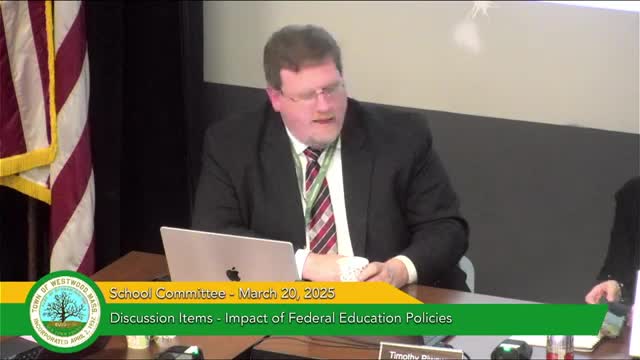
Summary
Superintendent briefed the committee on federal education developments, noting Westwood receives federal funds through DESE (about $1 million overall, largely IDEA), identifying potential downstream risks for FY27 and citing a Massachusetts Attorney General memo supporting state nondiscrimination laws.
The superintendent briefed the School Committee on March 20 about recent federal developments affecting education policy and funding and how they apply to Westwood Public Schools.
He said Westwood does not receive federal education dollars directly from the U.S. Department of Education; federal funds flow from the U.S. Department of Education to the Massachusetts Department of Elementary and Secondary Education (DESE), which then distributes funds to districts.
"We received roughly about a million dollars collectively, as a from DESE, from the feds. The vast, vast, vast majority of that is in the special education IDEA grant," the superintendent said, referring to the Individuals with Disabilities Education Act. He identified two smaller federal allocations: about $23,000 designated for special education early childhood/preschool and approximately $26,000 for the Title II Teacher Quality grant (the source of funds for the after‑school PD catalog discussed earlier).
The superintendent added that the U.S. Department of Agriculture provides reimbursements for school lunch and breakfast programs; those federal meal reimbursements flow as offsets to the FY26 budget.
He said that because of timing differences between federal and state fiscal calendars, the district does not anticipate disruptions to FY26 funding. However, he cautioned there could be implications for FY27 depending on federal developments.
On civil‑rights guidance, the superintendent summarized legal guidance provided to Massachusetts districts and the attorney general's statement. He said the Massachusetts Attorney General Andrea Campbell issued a memo affirming that state nondiscrimination laws remain in effect and that nothing in recent federal guidance changes existing law or established principles that allow schools to promote educational opportunities for students of all backgrounds.
"To be clear, nothing in the letter changes existing law and well established legal principles that encourage and even require schools to promote educational opportunities for students of all backgrounds," the superintendent quoted from Attorney General Campbell's memo included in the committee packet.
Committee members expressed support for maintaining the district's inclusive practices and acknowledged potential legal and fiscal uncertainty at the federal level. Several members said the district should remain focused on student belonging and curriculum rather than getting distracted by outside legal noise.