
Southborough finance subcommittee lays out $108.5 million plan for new Neary school; town’s share about $68 million
Get AI-powered insights, summaries, and transcripts
Subscribe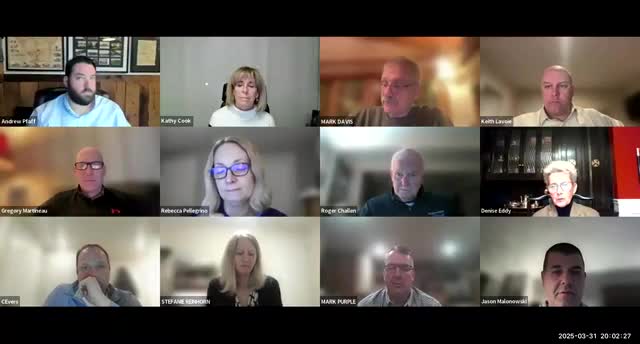
Summary
At a March 31 joint meeting, the Town of Southborough NHERI Building Committee finance subcommittee presented final schematic costs, MSBA grant expectations and tax impacts for a proposed new 4‑grade Neary school. The committee set a May 10 special town meeting and a May 13 Proposition 2½ ballot question as the next steps.
The Town of Southborough’s NHERI Building Committee finance subcommittee on March 31 presented final schematic estimates and projected tax impacts for a proposed replacement of the Neary (NHERI) School, listing a total project cost of $108,517,025 and a projected town share “just above $68,000,000.” The committee said it expects an MSBA (Massachusetts School Building Authority) grant of about $35,000,000 and roughly $5,000,000 in federal and state credits tied largely to a proposed geothermal system.
Why it matters: The project would require two votes — a two‑thirds favorable vote at a May 10 special town meeting and a majority vote on a Proposition 2½ exclusion at the May 13 town election — and would add long‑term debt for the town. Committee leaders and town finance staff said the plan is intended to resolve long‑standing capital and educational issues at Neary while limiting near‑term impacts on other capital projects.
Committee leaders said the proposal develops from a multi‑year MSBA process and a unanimous internal vote on Aug. 12, 2024, to bring forward a single option: a new 4‑grade school on the current Neary site. The schematic design completed in January 2025 calls for a 99,564‑square‑foot building designed for up to 610 students; committee members said the current Neary building is roughly 60,000 square feet and that the new building would be substantially more space‑ and program‑efficient.
The committee described its current financial picture as follows: total project cost $108,517,025; expected MSBA grant about $35,000,000 (roughly 32.5 percent of total cost); an anticipated $5,000,000 in federal/state rebates or credits tied primarily to a geothermal HVAC system; and a net town cost of a little more than $68,000,000. Using an assumed permanent interest rate of 4.25 percent, the town’s bond consultant projected stabilized annual debt service of about $4,000,000 and an incremental annual increase to the townwide budget of about $2,900,000 when the permanent bond is outstanding.
The committee estimated the tax impact to the average‑valued house (projected average value $1,245,274 at the time of permanent financing) would be about $703 per year; presenters noted the assessor’s office provided a baseline average of roughly $1,000,000 for 01/01/2025 and the $1.245 million figure is a multi‑year projection used for modeling. The committee said an interactive calculator will be posted on the project website to allow residents to estimate the effect on individual property values.
Cost changes and contingencies: Committee members said two independent outside estimators produced recent reconciled cost estimates in February 2025, and that reconciled figure is the basis of tonight’s warrant number. Presenters attributed the drop in the town’s share from an earlier $123,000,000 estimate to several factors: reductions in square footage (from an earlier 118,000 estimate to the current schematic), design refinements, and a larger MSBA reimbursement tied to green building incentives. Committee members said they are carrying an approximate overall contingency (design/owner) of about 11 percent and described the current cost per square foot as conservative compared with recent Massachusetts school bids.
On the geothermal (green) credits: committee members said about $4,000,000 of the $5,000,000 in projected rebates is expected from federal programs (Inflation Reduction Act programs), with another roughly $1,000,000 from the state. When asked whether the project could proceed without federal support for geothermal, presenters said options exist: the committee and designers have preliminary estimates for two alternative HVAC systems and would discuss changes publicly before construction. “If the federal government … does not fund the expected $4,000,000 for the geothermal, yes, [it] would increase our project cost by about $4,000,000,” the finance chair said.
Operational savings and staffing: The committee noted at least $1,200,000 in recurring K–8 operational savings expected beginning in fiscal 2027 tied to headcount reductions and efficiencies from consolidating to a two‑building elementary configuration. In response to questions, Assistant Superintendent for Finance Becky Palangrino said specific positions not added in the FY2026 budget would be among the earlier savings: “We did forego that position in that FY26 budget…we will not be filling a third world language teacher if a building project moves forward,” Palangrino said, referring to a planned additional librarian, an instructional technology position and an additional world‑language educator that the committee expects will not be hired if consolidation proceeds. The superintendent confirmed the district plans to move from three elementary principals to two principals plus one assistant principal in the consolidated model.
Schedule and transition: If voters approve the project, construction would begin when school ends in June 2026 and continue for roughly two years, with an anticipated opening in February 2028. To accommodate students during construction, the plan calls for shifts of NHERI grades into Fenn and Woodward (Fenn: pre‑K–2; Woodward: grades 3–5) and a limited number of temporary modular classrooms.
Procurement and risk management: The committee said it intends to use a construction management at‑risk (CMAR) delivery model to increase collaboration and provide greater price certainty than a straightforward low‑bid approach. Committee members said the CMAR and the contract structure include mechanisms for capturing savings (for example, commodity price drops) back to the town and for shifting some cost risk to the construction manager. “We are comfortable that we have a number that will allow us to build the building that is planned,” the finance chair said in describing reconciled estimates and contingencies.
Other budget items and capital schedule: Presenters said the Neary project is included within the town’s seven‑year capital plan and that, despite the Neary debt, the town continues to schedule other projects such as roofs, DPW equipment and fire equipment. The library’s recent state grant application was not approved and was removed from the state‑assisted pipeline for reasons unrelated to Neary, committee members said. The committee also noted a $3.6 million debt placeholder for the Breakneck Hill cleanup is included in the multi‑year capital plan.
Public questions and committee answers: During a 45‑minute public Q&A, residents pressed on cost drivers, contingency, guarantees around federal rebates, the sample size of cost estimators, furniture and moving costs, and potential impacts to the town’s bond rating. Committee members said the MSBA has appropriated its share of the grant funding and will vote to confirm the recommendation on April 30; they reiterated that final contract bids will determine actual costs when detailed construction documents are complete and the project is publicly bid.
Votes at the meeting: The committee adjourned by formal motions at the end of the session. A motion to adjourn the NEARY finance subcommittee was moved by Mark Davis and carried on a roll call (ayes recorded). A motion to adjourn the NHERI Building Committee was moved and seconded and carried on a roll call vote (ayes recorded).