
Pennsylvania geoscientist warns on supply-chain dependence, stresses responsible extraction and remediation
Get AI-powered insights, summaries, and transcripts
Subscribe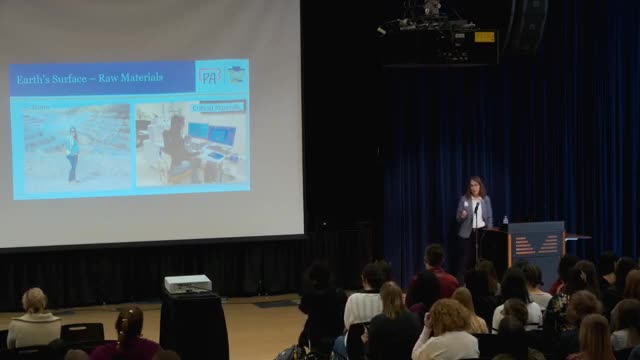
Summary
Dr. Blackmer said the U.S. imports many critical minerals, that federal funds support exploration, and that geoscientists play a role in reducing environmental impacts from extraction and waste disposal.
Dr. Blackmer, a geoscientist at the Pennsylvania Geological Survey, told an audience that many minerals critical for electronics and batteries are imported to the United States and that the federal government is funding efforts to find domestic sources.
Why it matters: Critical minerals underpin technology and energy transitions. Blackmer said domestic exploration can reduce supply-chain disruptions but must be balanced with environmental protections and community concerns.
Blackmer said critical-mineral work at state surveys typically begins with field sampling and geochemical analyses; those results are shared with companies and other entities that would pursue exploration and extraction. "There's a big effort now to find sources of critical minerals here in the United States," she said.
She addressed environmental responsibilities in extraction and waste handling during a later question-and-answer session. Asked whether geoscientists have ethical obligations to ensure extraction does not harm environments or communities, Blackmer said geoscientists "do play a part in ensuring that extraction is done responsibly" and that modern approaches aim to minimize impacts. "You try to do that responsibly, and you try to minimize that impact," she said.
Blackmer warned that some environmental issues arise not from subsurface activity itself but from surface waste handling. She cited Pennsylvania's early gas-boom problems, saying they were "related to waste disposal on the surface because the companies weren't used to our geology" and that companies did not consult local geologists before work began.
On remediation, she pointed to acid mine drainage as a visible example where geoscientists trace contamination, identify sources and help design cleanup strategies. She also described projects—such as wetland restoration led by nearby faculty—that remove sediment, improve water quality, sequester more carbon and help filter runoff before it reaches the Chesapeake Bay.
Hydroelectric and engineering interactions: In response to a question about hydroelectric power, Blackmer said geoscientists typically advise before construction on foundation suitability and later to help maintain the physical infrastructure; engineers handle the electricity generation work.
Less critical detail: Blackmer noted that industry responsibility varies, that companies have developed waste-management approaches of varying quality, and that geoscientists can help design mitigation systems based on geochemical understanding.