
Panel endorses bill tying added education funding to extra instructional days; lawmakers debate teacher pay and local control
Get AI-powered insights, summaries, and transcripts
Subscribe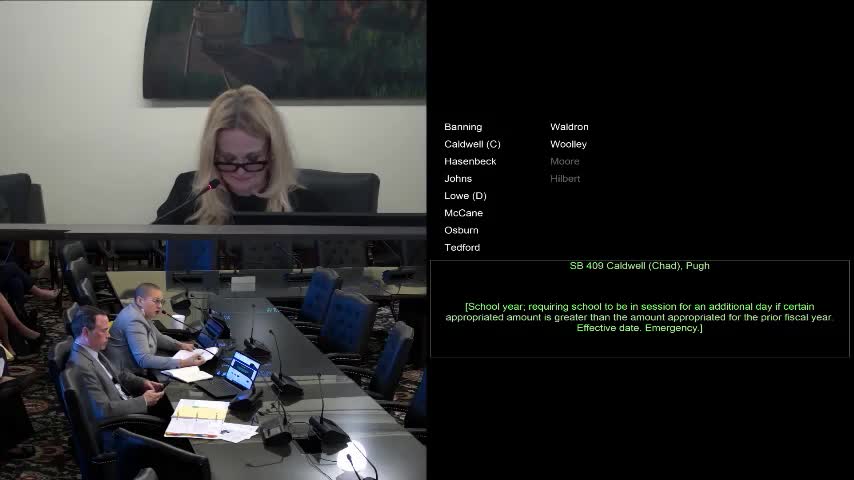
Summary
The committee passed a measure (Senate Bill 409) requiring that when the funding formula increases by at least $25 million, an extra instructional day be added; members discussed whether added days would automatically require higher teacher pay and whether districts could "game" the rule by adding minutes rather than meaningful instruction.
Senate Bill 409, presented by Representative (chair) (sponsor recorded in transcript as "Representative"), would add an extra instructional day to school calendars each time the state increases the funding formula by at least $25 million.
Sponsor remarks and intent
The bill—s sponsor told committee members the idea is simple: when the Legislature increases support for public schools by substantial amounts (increments of $25 million), the extra funding should translate into added instructional time for students. "If we are increasing our funding formula by at least $25,000,000 that we would add an extra instructional day," the sponsor said.
Committee concerns: teacher pay, contract length and gaming the system
Members asked how the added day would affect teacher contracts and pay. Representative McCain and others asked whether increases would be sufficient to cover the cost of an extra day, and whether districts would simply add minutes across the year to meet the requirement rather than provide a meaningful additional instructional day.
The sponsor responded that the funding tied to the formula is intended to be distributed through the funding formula (not merely retained by SDE) and that it is expected districts would invest in teacher pay to cover additional days. The sponsor acknowledged some districts might try to "game" the system by minimal changes but said local leaders and districts that prioritize instruction would implement meaningful extra time.
Vote and outcome
After extended questioning, staff opened the vote queue; the presiding chair declared the bill passed after a majority vote. The committee did not record a precise roll tally in the transcript excerpt available to the committee reporter beyond the chairman—s declaration that the bill passed.
Ending
Supporters described the bill as a mechanism to ensure state investments flow into more instructional time, while critics cautioned the measure could require additional local expenditures (for contract adjustments) and urged clearer guarantees that funds would cover teacher compensation for the added day.