
Planning commission approves alternative sidewalk design for Columbia Mall outparcel, developers to add crosswalks and easement dedication
Get AI-powered insights, summaries, and transcripts
Subscribe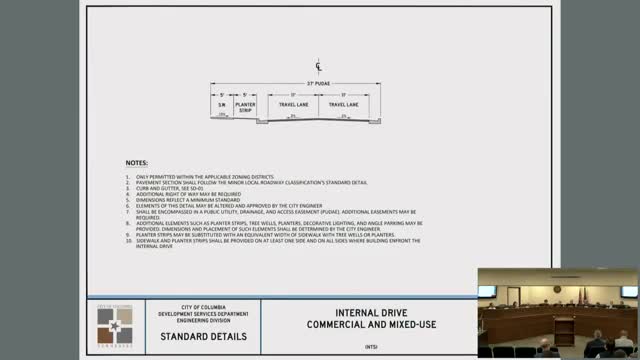
Summary
Commission granted an alternative performance for a proposed 12,000‑square‑foot outparcel at the Columbia Mall, allowing the developer to defer some internal‑drive sidewalks in favor of dedicated crosswalks, raised crossings and access easements; commissioners debated future fragmentation and the right timing for sidewalk construction.
The Columbia Municipal Planning Commission approved an alternative performance request for a new 12,000‑square‑foot outparcel at the Columbia Mall that allows the applicant to limit full internal‑drive sidewalk construction now and instead install targeted pedestrian connections and raised crosswalks.
The commission heard that the developer is redeveloping the Mall property, bringing multiple national tenants and outparcels, and sought to balance pedestrian safety with avoiding premature sidewalk construction that could be torn up as future tenants finalize their site plans.
Preston Ayer of SWS Engineering said the proposal focuses on ‘‘adding pedestrian safety within the site’’ through raised crosswalks and crosswalks across existing drive aisles, curb ramps at key corners and dedication of access easements to support future internal connectivity. He said the plan includes crosswalks to connect the new outparcel to the mall’s primary retail building and that the raised crossings would also act as speed‑reducing features.
Wyatt Welche, principal of Highland Capital, the property owner and redeveloper, told commissioners he had signed multiple leases and was ‘‘pushing very, very hard to kind of strike while the iron is hot’’ to deliver tenants, and said the owner prefers to avoid installing sidewalks that would be torn up by near‑term construction on adjacent parcels.
Staff and several commissioners warned that approving only piecemeal sidewalks could lead to a fragmented internal‑drive sidewalk network; staff noted the code requires internal drives to have sidewalks and planter strips and that, when subsequent parcels develop, partial sidewalks could leave gaps. Staff also pointed to technical constraints around a wide existing entrance area, a sanitary trunk line and property ownership at the mall entrance that increase the cost and complexity of completing the full sidewalk standard without reconfiguring the entry.
The commission ultimately approved the alternative performance request, noting the developer will provide crosswalks, raised crossings and dedicated access easements and will work with staff on future connectivity; one commissioner opposed the motion. The commission discussed the option of the developer using private lease terms to require future tenants to complete missing sidewalks, but staff noted the commission cannot enforce private lease conditions and can only condition city approvals.
Next steps: the developer will proceed with the outparcel site development plan under the alternative performance approval. Staff said future tenant site plans will be reviewed against the city’s in‑frontment and internal‑drive standards, and the commission said it expects applicants for subsequent parcels to address links and continuity as those applications arrive.