
Hubbardston trustees revise draft solicitation policy, lean on state law for enforcement
Get AI-powered insights, summaries, and transcripts
Subscribe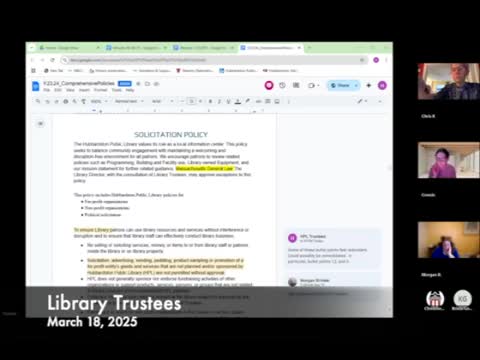
Summary
Trustees reviewed a rewritten solicitation policy that would require prior permission for solicitation, consolidate overlapping clauses and rely on Massachusetts General Laws for enforcement of political petitioning; trustees favored removing a strict 20-foot rule and agreed to revisit rules as building use changes.
Hubbardston Public Library trustees continued work on a revised solicitation policy at their meeting, debating whether the library should require prior permission for all solicitation and how to reflect state law on political petitioning.
Trustees said the policy should balance community use of library space with keeping the building free from persistent sales or disruptions. They discussed consolidating multiple overlapping bullets into a single requirement that individuals or groups must obtain permission from library leadership before soliciting on library property.
The trustees spent extensive time on political solicitation. The draft cites Massachusetts General Laws and proposes rules such as keeping petitioners 20 feet from entrances and curbside pickup. Several trustees said the 20-foot prescription is unnecessary and difficult to enforce in Hubbardston’s small facility; they agreed instead to cite the applicable state statutes and rely on the law’s prohibitions against creating a disturbance, intimidation or harassment. The draft also requires that anyone soliciting signatures or distributing leaflets inform library staff during normal business hours and prohibits leaving political materials unattended in a way that could be construed as the library using public funds to support a candidate or issue.
Trustees flagged practical enforcement questions tied to the library’s layout. Several speakers noted that narrow entryways, the check-out desk and program areas can function as staff workspaces and are not appropriate for petitioning or solicitation; the trustees said they will clarify which interior spaces are considered circulation areas versus staff-only areas when finalizing the policy. They also discussed future changes if the library expands use of a basement or other areas as public program space.
The trustees asked staff to verify the exact language of the state law cited (chapter and section references were discussed in the meeting) so the policy can quote or link to the statute correctly, and suggested checking whether town policies on sidewalks and public solicitation should be mirrored in the library policy. Several trustees said they preferred striking a strict, measured distance requirement (the draft’s “20 feet” language) and instead relying on the state statute’s disturbance/harassment standard plus a requirement that petitioners notify staff.
The meeting did not include a formal vote on the solicitation policy. Trustees agreed to continue editing and to bring a revised draft back for review with the full board and, where appropriate, to consult the town for any overlapping rules.