
Appropriations Committee on Health and Human Services advances two dozen health bills; foster‑care housing, vaccine nondiscrimination and behavioral‑health work
Get AI-powered insights, summaries, and transcripts
Subscribe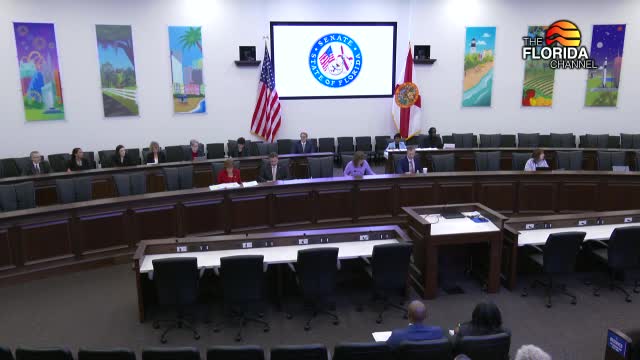
Summary
The Appropriations Committee on Health and Human Services advanced about 20 bills in a two‑hour session and reported most items favorably, while debating key measures affecting foster‑care housing for college students, vaccine nondiscrimination language in the Department of Health package, and oversight of behavioral‑health managing entities.
The Appropriations Committee on Health and Human Services met in a two‑hour session and moved roughly 20 bills forward, reporting most items favorably to the next legislative stop while debating several on policy details and implementation.
The committee chair, Senator Trumbull, opened the meeting and noted the packed agenda and the two‑hour limit. Committee members reported favorable recommendations for a large group of bills; several drew public testimony or extended debate and are described below.
Why this matters: Many bills reported favorably in the committee would change how state agencies administer health and human services, affect Medicaid service delivery, and alter regulatory requirements for providers. Several items the committee discussed have direct effects on vulnerable Floridians, including young people leaving foster care, medically fragile children, and people who rely on ongoing Medicaid services.
Key debates and public testimony
- Foster youth housing and college access (CS for Senate Bill 584): The committee heard two young adults with foster‑care experience, Austin Lawson and Quaviona Peoples, testify in support of SB 584, which prohibits some housing requirements — for example, cosigners or guarantors — for students in extended foster care or receiving housing supports. Testimony emphasized that housing supports do not transfer across counties and that some voucher programs are available in only 11 counties, a gap that can block college enrollment. Senators praised the bill and it was reported favorably.
- Department of Health omnibus package and vaccination nondiscrimination (CS for Senate Bill 1270): The agency package includes multiple provisions: changes to medical marijuana background‑screening language (sections 381.986 and 381.988 were discussed), creation of temporary physician licensure authority in areas of critical need, and a provision prohibiting discrimination based solely on vaccination status. Senators questioned whether the bill’s language would require physicians to accept or continue to treat unvaccinated patients even when a physician’s medical judgment would indicate otherwise. Sponsors said the intent is to prevent discrimination solely on immunization status and that they are working on clarifying language; the committee adopted a technical amendment to conform background‑screening language and reported the bill favorably.
- Parkinson’s research consortium (Senate Bill 1800): Sponsors described SB 1800 as creating a Parkinson’s Disease Research Board and a consortium at the University of South Florida to coordinate research and clinical trials. The bill was described as a shell for future investment; committee members asked about funding and were told there is no state budget appropriation attached at this time. An amendment adding academic medical centers to the consortium was adopted and the bill was reported favorably.
- Medically fragile children, caregiver payment and waiver redesign (CS for Senate Bills 1156, 1490 and CS for 14‑90 package components): Senator Harrell presented several related items aimed at improving Medicaid coverage and care for medically fragile children: clarifying that parents who receive payment to care for their medically fragile children will not have that income count against Medicaid eligibility, increasing Medicaid minimum reimbursements for private‑duty home health, allowing 12‑hour shifts in certain cases, and moving some programs administratively from the Department of Health to the Agency for Health Care Administration (AHCA) so managed‑care operations are centralized. Sponsors argued these changes preserve continuity of care and expand options to keep children out of institutional settings; the committee reported these measures favorably.
- Mental health and substance use reforms (CS for Senate Bill 1620 and CS for SB 1354 / SB 1354 audit provisions): Senator Roussan presented SB 1620, implementing priority recommendations from the Commission on Mental Health and Substance Use Disorders, including establishing a research center at the University of South Florida and steps to improve crisis response, workforce development and school‑based behavioral health. Separately, SB 1354 would require audits and standardized reporting of managing entities that administer behavioral health services; proponents said the bill increases transparency and accountability. Both bills received broad support and were reported favorably.
Other contested items
- Patient access to records (CS for Senate Bill 1606): The committee took public testimony from physicians, health information professionals and privacy advocates who warned that the bill’s time frames, portal access provisions and civil penalties could create implementation burdens and privacy risks for vulnerable patients (for example, survivors of domestic violence who rely on existing privacy protections). The committee initially reported CS for SB 1606 unfavorably but later reconsidered and reported it favorably after further motion and discussion.
- Stem cell therapies (CS for Senate Bill 1768): The bill would authorize certain physicians to perform specified stem cell therapies that meet manufacturing and informed‑consent requirements. Senators asked whether the required consent must tell patients the treatments are not FDA approved and how outcomes would be tracked; sponsors said the bill requires written informed consent and creates a process to monitor outcomes. The committee reported the bill favorably.
Votes at a glance (committee action summarized)
- CS for Senate Bill 976 (parental challenges to court‑appointed psychologists): reported favorably. - CS for Senate Bill 306 (Medicaid provider network access / after‑hours access): reported favorably. - CS for Senate Bill 584 (student housing for foster youth): reported favorably. - CS for Senate Bill 1270 (Department of Health agency package; medical marijuana screening language; vaccination nondiscrimination): amendment adopted; reported favorably. - Senate Bill 1412 (home health modernization / workforce flexibility): reported favorably. - Senate Bill 1800 (Parkinson’s research consortium; amendment adopted adding academic medical centers): reported favorably; no state funding attached at present. - CS for Senate Bill 524 (newborn screening addition — Duchenne muscular dystrophy): reported favorably. - CS for Senate Bill 1156 (Medicaid caregiver income disregard / medically fragile children supports): reported favorably. - CS for Senate Bill 1490 / CS for 14‑90 components (agency / Medicaid program transfers for medically fragile children): reported favorably. - CS for Senate Bill 1174 (foster‑home license amendment when relocating): reported favorably. - CS for Senate Bill 1620 (mental health & substance use commission recommendations; USF research center): reported favorably. - CS for Senate Bill 1568 (e‑prescribing exemptions and clarifications, substitute amendment adopted): reported favorably. - Senate Bill 788 (veterans nursing home beds / CON transfers): reported favorably. - CS for Senate Bill 1606 (patient access to records): initially reported unfavorably, later reconsidered and reported favorably after motion and discussion. - CS for Senate Bill 1736 / 1768 (insulin administration by direct support professionals; stem cell practice items): reported favorably. - SPB 7032 (presumptive eligibility protections for permanently disabled Medicaid beneficiaries during redetermination): adopted as a committee bill and reported favorably.
(Committee minutes show additional bills on the agenda; the items above reflect those called and recorded with testimony or roll‑call outcomes in the transcript.)
What’s next and implementation notes
Several sponsors said fiscal or implementation details remain to be resolved later in the process. Notably, SB 1800 (Parkinson’s consortium) was described as a statutory vehicle that currently lacks a state appropriation; sponsors said the bill is designed to position Florida for future funding. Sponsors of the DOH package said they would continue to refine language on vaccination nondiscrimination to address physician concerns about clinical judgment and patient safety.
The committee adjourned after completing its printed agenda and moved several bills to the next committee or floor stop.