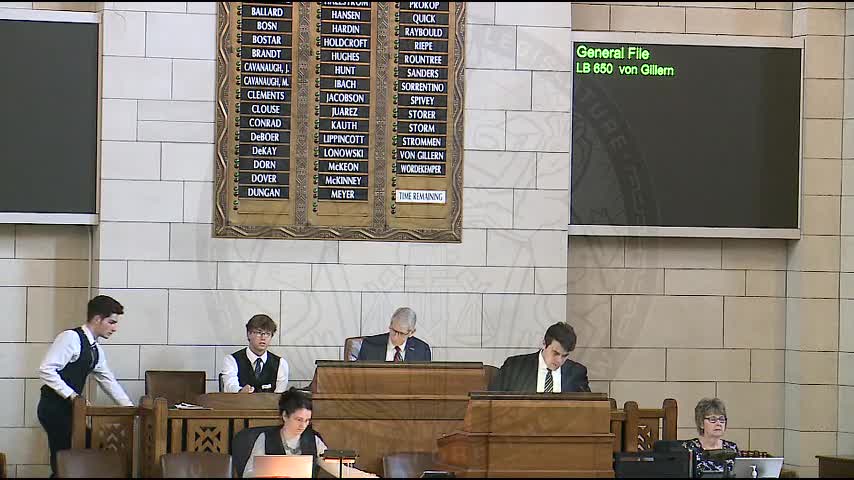
Revenue committee advances bill rolling back recent tax incentives to help close projected budget gap
Loading...
Summary
Lawmakers advanced LB650, a revenue committee measure that pares back several recently enacted tax incentives and exemptions to help close a projected budget shortfall, with sponsors estimating roughly $71 million in revenue for the upcoming biennium.
Lawmakers advanced LB650, a revenue committee bill that rolls back a set of recently created tax incentives and exemptions, after floor debate that ranged from technical fixes to broader objections over who will shoulder the state’s budget gap.
The bill, introduced on the floor by Senator Von Gillen, would rescind or narrow several credits and exemptions and is projected by the bill sponsor to increase state revenue by about $71,000,000 in the upcoming biennium; the sponsor said that figure covers roughly one-quarter of a projected $289,000,000 shortfall for the next biennium beginning July 1, 2025.
Supporters said the measure follows a ‘‘last in, first out’’ approach that pares back the most recently created incentives while preserving longer-standing programs. "LB 650 pairs back programs and business incentives that were all granted in the past several years and seeks to increase revenue by eliminating tax incentives or pairing them back," Senator Von Gillen said on the floor. Proponents argued the state has a constitutional obligation to present a balanced budget and that this package is one of several steps — along with appropriations cuts and other revenue proposals — to do that.
Opponents, including Senator McKinney and Senator Conrad, said the bill would undo incentives intended to spur investment in distressed areas and questioned the net fiscal effects and distributional impact. McKinney said the bill would roll back programs such as the Urban Redevelopment Act and objected that alternative spending cuts (he repeatedly pointed to prison construction spending) were not being prioritized instead of reducing incentives. "If we need $71,000,000 in revenue, let's cut it from the spending for the prison," McKinney said.
Floor debate included a series of technical and policy clarifications. Committee amendments (AM 9 23 and later AM 9 81 and AM 10 20) folded several separate bills into the package, adjusted program funding between certain credits (including shifting funds from the casting crew act to short-line rail), and restored language to protect nonprofit purchasing agent exemptions. Senators sought and received handouts and follow-up lists identifying exact statutory repealers and other changes; the sponsor said his office and committee staff would provide a detailed repealer list.
The amendment package and the bill drew detailed questions about specific items: changes to notice and fee provisions for tax sale certificates included language from Senator Bostar’s work to create uniform processes across counties; Senator Dorn described math clarifications to transfer formulas for certified forecasts; Senator Rountree summarized two bills in the amendment relating to municipal notice to the auditor and an exemption for disabled veterans from the state motor vehicle tax.
Roll-call tallies on the floor were recorded as follows: AM 9 81 (adjusting program funding) adopted by voice tally recorded as 38–0; AM 10 20 (restoring nonprofit purchasing-agent pass-through rules) adopted (38–0 recorded); the committee amendment AM 9 23 was adopted 38–1; and LB650 advanced to E & R initial with a recorded vote of 36–2.
Sponsor materials circulated on the floor said the measure is estimated to generate about $71 million in the coming biennium and a larger amount thereafter; the sponsor said the Appropriations Committee is working on the spending side while Revenue’s work focuses on revenue measures. Multiple senators asked for, and were promised, supplemental fiscal notes and lists identifying specific statutory sections that would be repealed or amended before select file.
The bill’s proponents emphasized the package is reversible and focused on recent incentives, while opponents raised distributional and programmatic concerns and warned of likely legal and political fights ahead. The bill now moves to enrollment and review and later to select file, where additional amendments and updated fiscal estimates are expected.
Less critical details: the debate included references to former and current state credit-rating upgrades (Moody’s), several one-off program names that the amendment affects (for example, the Reverse Osmosis System Tax Credit Act and Nebraska Biodiesel Tax Credit Act), and multiple senators urging colleagues to weigh electoral pressure against constitutional duty.
Outcome and next steps: AM 9 23 and related cleanup amendments were adopted on the floor and LB650 advanced to E & R initial; the Legislature recorded vote tallies above. Committee staff will provide a list of repealed statutes and updated fiscal notes prior to select file consideration.