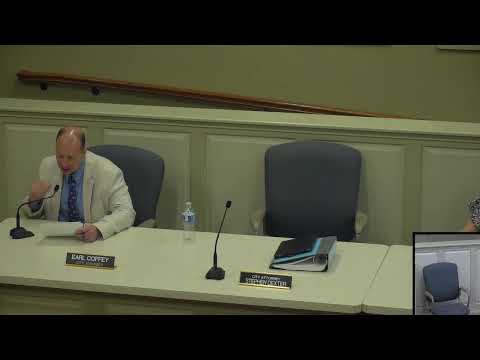
Danville commission accepts planning record on Shaker Town Road zone-change; will decide in two weeks
Loading...
Summary
After a lengthy legal briefing and public concerns about traffic, flooding and density, the Danville City Commission voted to accept the planning commission record for the Shaker Town Road zone‑map amendment and to consider the matter at its next regular meeting on April 28.
The Danville City Commission on Monday agreed to accept the planning commission’s written record for a proposed zone‑map amendment affecting Shaker Town Road and to take up a substantive decision at its next regular meeting on April 28.
The vote follows a lengthy presentation from legal staff about the limited options before the commission and repeated concerns from nearby residents about traffic, drainage and density. City Attorney Dexter told commissioners they must proceed using only the evidence already in the planning record and that they have a 90‑day statutory deadline to act.
“The procedure for a zone map amendment is clearly outlined in KRS 100.211,” City Attorney Dexter said during the meeting. “By law now, you have a couple of options. … First of all, you must act within 90 days of receipt of the forwarded record.”
Resident Daniel Wells, who said he lives at 313 Spring Hill Road and attended the planning hearing, told the commission he is “concerned about the traffic on Spring Hill Road” and about repeated flooding near his property. “Spears Creek has been in my backyard, over the bank, into my backyard twice this year already,” Wells said.
Planning and zoning staff and the applicant already held two public hearings; the planning commission did not issue a recommendation within the statutorily required timeframe. Counsel advised the commission that, because the planning commission failed to make a recommendation within the deadline, state law allows the applicant to have the full record forwarded to the city for a decision without a recommendation.
Counsel laid out three primary paths: accept the existing planning record and decide at a later council meeting; reopen and hold a new public hearing (which would require fresh notice to all parties); or deny or approve based on findings tied specifically to the comprehensive plan and future land‑use map. Counsel warned that reopening the hearing is appropriate only if the record is missing “critical information” necessary to reach a legally sustainable decision.
Commissioners debated whether they had enough time to review the documents after receiving the record the prior week. Commissioner Cottle moved that the commission accept the planning commission record for use as the basis of its discussion at the next regularly scheduled meeting; the motion passed on a voice vote.
The city manager’s memo identifies the official planning record as: the developer’s completed application, the planning commission staff report, the February 26 and March 26 agendas and minutes, attorney materials included in the planning packet, and video recordings of the planning commission hearings. The city attorney repeatedly admonished commissioners to avoid private or public communications about the matter while the quasi‑administrative proceeding is pending.
“You are admonished from considering things that are not in the record,” City Attorney Dexter said. “You would have to refrain from any public or private discussion of this matter among yourselves and amongst any public person in regards to this matter.”
Next steps: commissioners will review the file and may at the April 28 meeting either move to approve the zoning change, move to deny it with findings tied to the comprehensive plan, or — if they determine the record is legally insufficient — vote to open a new public hearing. Counsel reminded the commission that failure to act within the 90‑day statutory period would result in the application being approved as a procedural matter.
The discussion on the Shaker Town Road item occupied a large portion of Monday’s meeting and included public comments raising traffic, stormwater and density concerns as the commission weighed how to protect due process while listening to resident concerns.