
Oklahoma City pension fund hears market outlook from Earnest Partners; consultant recommends $15 million cash raise
Get AI-powered insights, summaries, and transcripts
Subscribe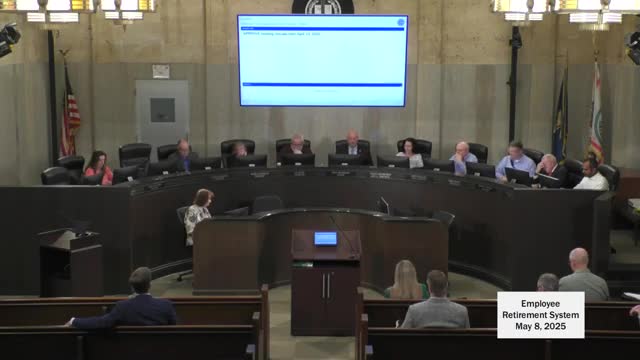
Summary
Earnest Partners and the retirement system—s investment consultant reported mixed returns, drivers of recent volatility and recommended tactical moves including raising $15 million from a large-cap index fund and shifting an international manager into a lower-fee vehicle.
Trey Greer, a partner at Earnest Partners, and the retirement system—s investment consultant presented the fund—s market update on May 8, 2025, outlining recent performance, portfolio positioning and two recommended changes: raise $15 million in cash from the State Street S&P 500 index fund and move an international manager from a mutual fund into a lower-cost collective investment trust.
The presentations matter because the Oklahoma City Employee Retirement System portfolio has exposures across U.S. large-cap, small- and mid-cap value, non-U.S. equity, fixed income and private assets; the consultants said those allocations and a broadly diversified structure helped limit losses during April—s tariff-driven volatility and positioned the plan for possible liquidity needs and private-equity capital calls.
Greer described Earnest Partners— small- to mid-cap value strategy, which has managed the plan—s allocation since February 2003 and represents roughly 5% of the system—s assets (about $50 million). He said Earnest is an "employee-owned firm" that pursues a bottom-up, fundamental approach and keeps portfolio turnover low (about 15% to 20% in recent years). He told trustees the manager—s portfolio has slightly outperformed the Russell 2500 Value benchmark over several trailing periods and that small-cap valuations remain depressed relative to large caps.
Patty, presenting the monthly and quarterly consultant reports, said markets in April were driven by tariff announcements and subsequent pauses, which created sharp price swings across equities and fixed income. Patty said the S&P 500 finished April down roughly 4.9% and that yields and fixed-income markets experienced extreme volatility before partial rebounds. She noted recent macro readings showed GDP contracted in the first quarter, inflation softened as energy prices declined, and the unemployment rate was 4.2%.
On portfolio positioning, Patty reported the fund—s April market value at about $882 million (ending market value reported in the quarterly table about $884 million). Asset-allocation highlights she gave: policy targets include 15% private equity (current ~10%), 10% small cap (target 10%), 20% non-U.S. equity (15% developed / 5% emerging), 25% fixed income (current ~23%) and 15% real assets (just under 14%). U.S. large-cap equities were overweight at about 20% versus a 15% target.
Patty recommended two tactical steps: 1) raise $15,000,000 in cash from the State Street S&P 500 index fund to fund upcoming benefit payments and anticipated private-equity capital calls; and 2) transfer the fund—s allocation to Harding Loevner from its current mutual fund vehicle into a new collective investment trust (CIT) offered by the manager to capture lower fees. Patty said the Harding Loevner fee would decline from 73 basis points in the mutual fund to roughly 58—61 basis points in the CIT, saving an estimated $70,000 to $90,000 per year depending on assets.
Trustees asked clarifying questions about timing and risk. A trustee asked whether keeping 5% in U.S. large caps while funding private-equity commitments was risky; Patty responded the private-equity pacing plan calls for funding over several years and that the allocation is expected to be deployed over time rather than all at once. On the Harding Loevner change, Patty said there would be no change to the investment team or strategy and that staff would work with "Jenna" to complete required documents and logistics.
Earlier in the meeting, trustees approved a document conversion and scanning contract using the City of Oklahoma City purchasing contracts to convert historical paper files to electronic records, with an estimated cost not to exceed $40,000; they also received and approved the monthly and quarterly investment reports as presented.
The presentations emphasized that diversification has mitigated downside and that private assets and international exposure contributed positively year-to-date because of a weaker dollar and relative performance in foreign markets. Patty and Greer cautioned that uncertainty around tariffs and the macro outlook could continue to drive volatility and that small-cap performance historically tends to lag during periods of heightened uncertainty.
Trustees did not vote on the consultant—s recommendation to raise cash or on the Harding Loevner vehicle change during the meeting; Patty indicated operational steps would follow to implement the manager transition and to prepare for any decision on cash rebalancing.
The board adjourned at 10:36 a.m.