
Anchorage School District projects $70–$80 million fiscal‑2027 shortfall without new state funding
Get AI-powered insights, summaries, and transcripts
Subscribe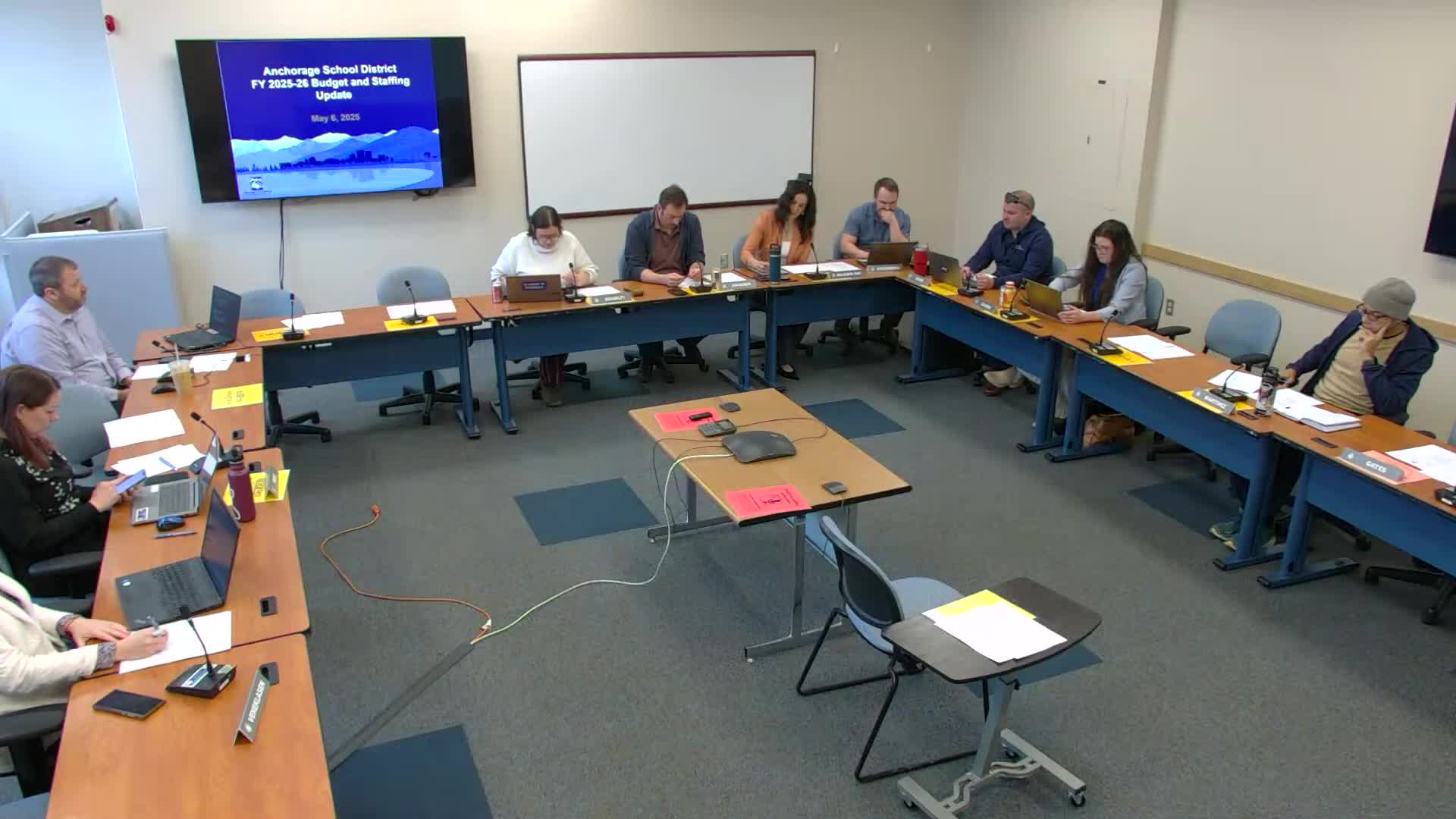
Summary
At a May 8 meeting, Anchorage School District CFO Andy Ratliff told the Assembly Legislative Committee the district faces an estimated $70 million to $80 million deficit in fiscal 2027 unless additional state funding arrives.
At a May 8 Assembly Legislative Committee meeting, Andy Ratliff, chief financial officer for the Anchorage School District, told committee members the district faces an estimated $70 million to $80 million deficit in fiscal 2027 if additional state education funding does not materialize.
Ratliff said the school board approved a budget revision that relies on a prospective $560 increase in the Base Student Allocation (BSA) included in the governor’s proposal and that some legislative proposals (HB 57) would increase the BSA further. "So, really, it's trying to get ahead of those layoff notices going out and be able to place folks in these buildings and taking that risk to be able to do so," Ratliff said.
The district’s presentation to the committee outlined two linked choices: add back instructional and instructional‑support positions now to avoid wholesale layoffs, or hold the cuts in place and delay placements until the state budget is finalized. Ratliff said the school board’s amendment would restore a package of instructional items and supports that the board described as roughly $40 million in revisions, and that the assembly should expect roughly $23 million in reductions to remain under the plan.
Among the add‑backs Ratliff described are holdback teachers to address class‑size gaps, restoration of paraprofessionals tied to kindergarten and summer programs, funding for the Ignite program, increased allotments for correspondence programs, reading specialists, library assistants, nurses, sports, and about 2.5 new counselor positions intended to move the district toward a half‑time counselor at every elementary school. He said some funding is statutorily required for charter schools.
Ratliff said HB 57 had passed both legislative chambers and was awaiting the governor’s signature; he summarized the bill as including a $700 BSA increase (roughly $50 million statewide), a 10% transportation increase, CTE multipliers and proficiency incentives contingent on passage of SB 113 (digital sales tax). He cautioned that even if HB 57 becomes law, the governor could use line‑item veto authority in the operating budget to reduce or short‑fund parts of that increase.
Ratliff described the district’s contingency plan if the assumed revenue does not arrive: hiring freezes, reductions in discretionary school and department budgets, and liquidation of assigned fund balances and encumbrances to avoid a negative fund balance. He said the district expects to draw down reserves substantially under current assumptions and that the board’s chosen approach is a calculated risk to retain staff and avoid large‑scale attrition that followed past pink slips.
Assembly members pressed on specifics. Assembly Member Aaron Baldwin Day asked whether the HB 57 $700 BSA would be incremental or total; Ratliff said the $700 figure in HB 57 would be the total BSA under that proposal. Member Zach Johnson asked whether the district had considered preserving a larger fund balance to smooth future deficits; Ratliff said the level of reserves and the board’s policy choices would determine that tradeoff.
Ratliff also laid out a simple projection model for FY 2027 that assumed a permanent $560 BSA, projecting roughly $585 million in revenue against about $635 million in costs and an ongoing structural gap that could exceed $70 million after accounting for likely inflation and unsettled labor contracts. He warned the district’s unassigned fund balance available for emergencies would be largely depleted under those scenarios.
Discussion: committee members agreed to continue monitoring developments and to discuss the issue at a scheduled joint meeting with the school board on June 7.