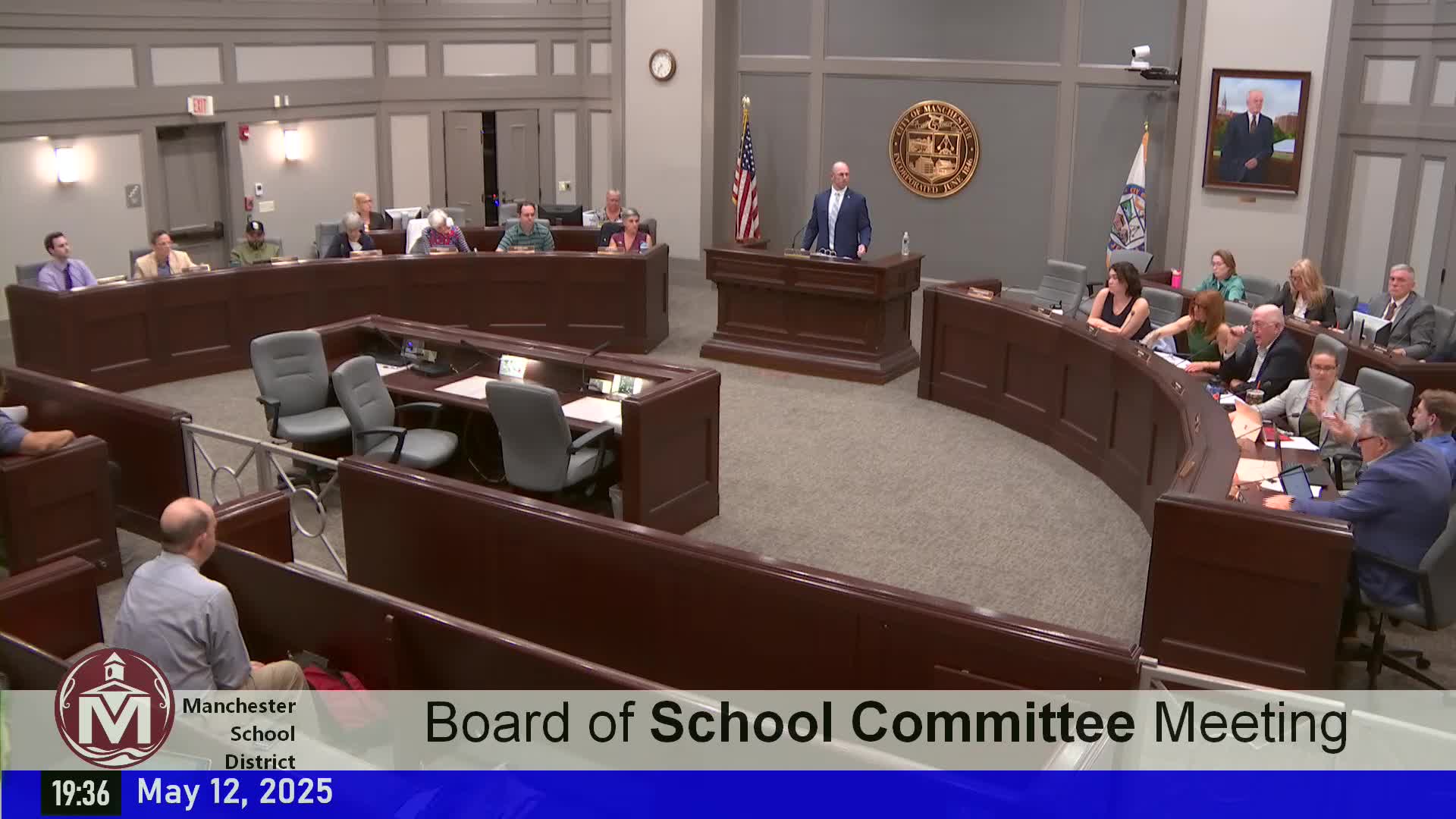
School committee accepts $237.99 million FY26 spending total; schedules a special meeting to spell out cuts
Loading...
Summary
The Manchester School Committee voted May 12 to accept the Board of Mayor and Aldermen’s FY2026 appropriation of $237,999,925 for the school district while directing staff to return with a detailed, line-by-line accounting of recommended cuts to close an $8 million gap.
The Manchester School Committee voted May 12 to accept the City’s FY2026 general-fund appropriation for the schools — $237,999,925 — while reserving the committee’s statutory authority to determine how the district spends that appropriation. The vote to “accept for discussion” and then to approve the mayor-and-aldermen figure cleared the board; the committee subsequently directed the superintendent to present detailed, line-by-line impacts of recommended reductions at a special meeting.
The vote followed several hours of public comment and more than an hour of committee discussion about the consequences of the appropriation approved by the Board of Mayor and Aldermen. Committee members and administrators described a $8 million gap between the Board of School Committee’s tax-cap-compliant budget (previously unanimously adopted in February) and the final appropriation from the Board of Mayor and Aldermen. The superintendent outlined recommended reductions designed to close that gap while trying to protect classroom sizes and key services.
Superintendent (Dr. Camille) told the board her team adjusted an earlier proposal that had 38 school-based reductions and other cuts. In the updated recommendations presented May 12, the superintendent said the district reduced the school-based personnel cuts to 22 positions — a $1.4 million line-item for “reduction in force” — and intends to protect elementary class-size priorities where possible. The superintendent also reported staff-level restorations intended to keep transportation, rebuild athletics expansion at about $90,000, and avoid proposed cuts to core transportation services; she said transportation remains a roughly $16,000,000 line item in the budget.
The board’s budget discussion emphasized two financial risks repeatedly raised by members: (1) heavy use of expendable trust (rainy-day) funds to balance operations this year and (2) the sustainability of one-time funds after the coming fiscal year. District staff said the district projected an expendable-trust balance of roughly $25,000,000 by June 30; auditors have recommended reserves roughly in the mid-teens percentage range. Under the board’s current plan the district expects to use roughly $8,300,000 in one-time expendable trust funds this fiscal year (including amounts already used), on top of $9,000,000 tapped the previous year; staff warned that repeated use of one-time funds leaves the district with a substantial hole to fill in subsequent budgets.
The board debated scheduling and process. Several members expressed frustration that the Board of Mayor and Aldermen considered and finalized its budget vote with only minimal, late-stage communication to the school board. Vice Chairman O’Connell and several committee members said the school board should have been more fully involved before the final aldermanic vote. Committee members called for a written menu of the superintendent’s updated reduction options and clearer impact statements for each line item; the superintendent agreed to prepare a tuned-up, itemized list of effects and costs and to present it at a special meeting to be scheduled for the coming week.
Formal actions captured from the meeting included: a motion, moved by Vice Chairman O’Connell and seconded by Committee Member Senecal, to accept the aldermanic appropriation figure (motion approved by voice vote); a motion to take all public comments under advisement (approved); and a unanimous motion to hold a special board meeting to review the superintendent’s detailed recommendations and the likely impacts of the reductions. Committee members also pressed for written clarification on the number and location of the positions affected, which the superintendent said would be produced after HR and principals verify vacancy, attrition and bumping effects.
Board members and staff repeatedly emphasized that many of the recommended personnel reductions are planned to occur through attrition (vacancies, retirements, resignations) rather than immediate layoffs; the superintendent said the recommended losses would largely be absorbed by vacancies and voluntary departures, with the goal of limiting increased class sizes at the elementary level. Nonetheless, members warned that reductions could still affect programming at the middle- and high-school levels and could eliminate some boutique or low‑enrollment elective sections, potentially including advanced-placement offerings where enrollments fall under policy thresholds.
The board noted the potential debt-service and credit impacts of drawing down reserves: an auditor-recommended cushion is used in credit analyses, and repeated depletion of reserves could raise borrowing costs for capital projects. Committee members urged caution about continued one-time spending and asked finance staff to quantify long-term consequences and to propose alternatives to repeated draws on reserves.
Next steps: the superintendent and finance staff will produce a detailed, itemized docket of recommended cuts and their impacts for review at a special meeting the board authorized; HR and principals will map vacancy and attrition data to any recommended school-based reductions before final actions are taken. The committee accepted the aldermanic dollar figure for FY26 but left allocation decisions, and approval of final recommendations, to the upcoming special-session discussion.