
Nantucket beach water testing: surface water below DPH screening but foam shows high PFAS; foam advisory issued
Get AI-powered insights, summaries, and transcripts
Subscribe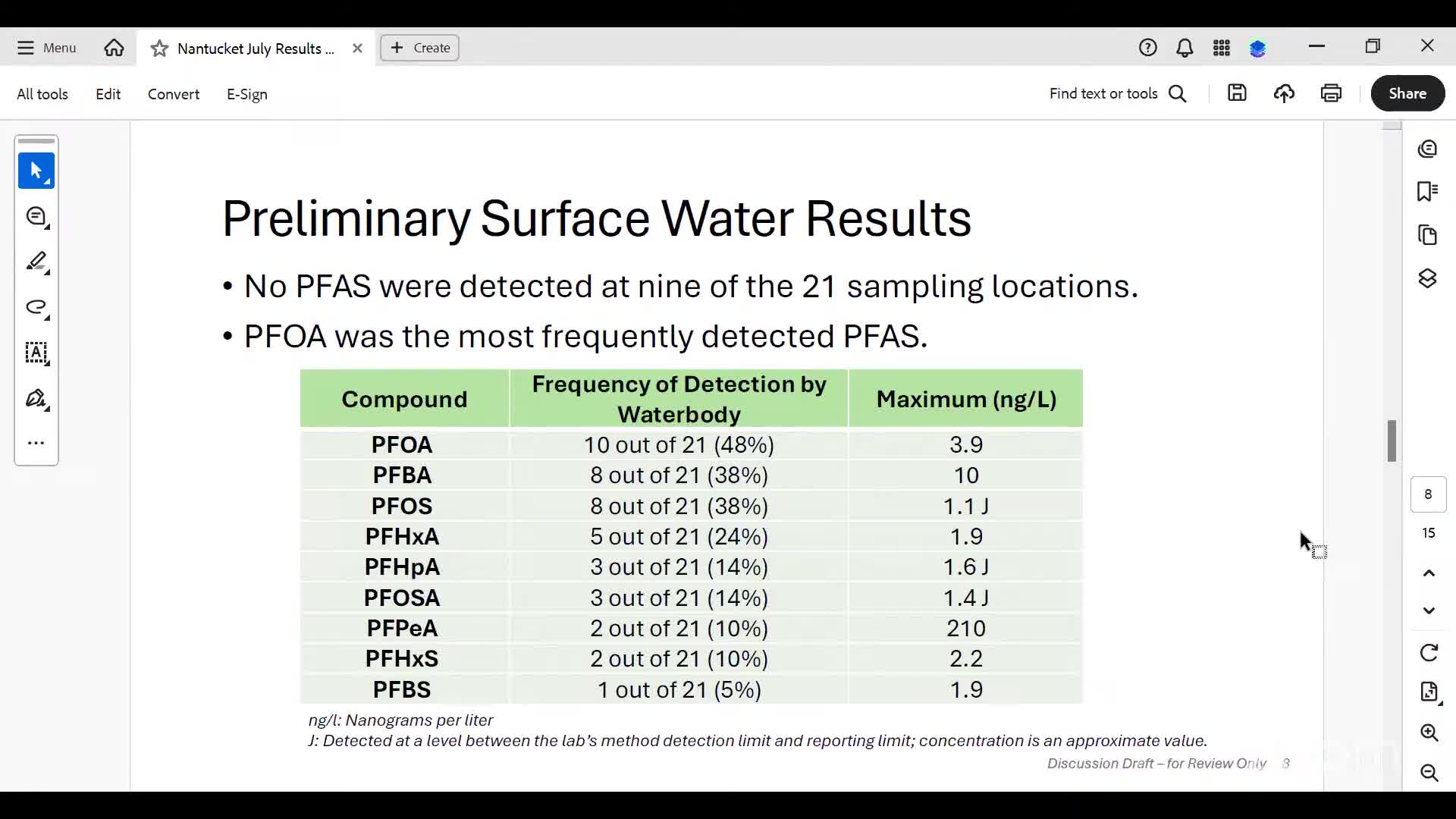
Summary
Town and consultants reported surface water PFAS results below Massachusetts DPH beach screening values in July samples, while seafoam samples contained much higher concentrations and were flagged by the lab; the health department will issue a foam advisory and collect a second round of samples.
Nantucket health officials on Aug. 21 reported preliminary results from an island‑wide PFAS sampling effort at 21 coastal and inland locations. The first round of surface‑water samples showed no individual PFAS above the Massachusetts Department of Public Health (DPH) screening value used for bathing beaches, while foam samples at two locations produced markedly higher PFAS concentrations and laboratory qualifiers that limit precise interpretation.
Rebecca DeVries, a consultant from Eastern Research Group who designed and led the sampling, told the Board of Health that samples followed DPH operational guidance and were analyzed by an accredited commercial laboratory using EPA method 1633a. “The good news is that no individual PFAS result was detected above DPH’s screening value for these eight compounds,” DeVries said, referring to DPH’s conservative 20 nanograms per liter (ng/L) initial screening value. She added that PFOA was the most frequently detected PFAS in surface water and that most coastal locations had non‑detects.
At the two locations where foam was present—Madaket Harbor (saltwater) and Siasconset Pond (freshwater)—analysts detected many compounds and generally higher concentrations in the foam‑derived liquid than in adjacent surface water. DeVries cautioned the board that the laboratory qualified many foam results because the sample volumes were far smaller than the lab’s preferred 500 milliliters; the team recovered closer to 150 milliliters in some cases. She said the qualifiers and small volumes make exact concentrations uncertain.
Because of the elevated and qualified foam results, Andrew Shapiro, environmental contamination administrator, said the health department will issue a foam advisory that encourages people and pets to avoid contact with seafoam and to rinse if contact occurs. “Out of an abundance of caution, we are recommending that residents avoid direct contact [with foam] until further information is available,” Shapiro said.
DeVries also flagged one surface‑water sample where PFPEA measured 210 ng/L at a beach with a dense bloom of red algae. That sample was resampled two weeks later under different environmental conditions; DeVries said PFPEA was not detected in the resample and that only one PFAS compound was detected at a low level. The site will be sampled again as part of the second round next week, and a summary report combining July and August results is due in October.
The town will post the sampling and analysis plan, raw data and a frequently asked questions page on the health department website and has coordinated with the laboratory to accept smaller foam volumes for the upcoming round. DeVries emphasized that scientific work on foam is still exploratory and that there are currently no published health‑based screening values for PFAS measured in foam.
For now, the health department’s operational actions are: (1) issue a foam advisory; (2) collect a second round of surface‑water and foam samples next week; (3) resample unique or outlier sites (for example, the red‑algae site); and (4) publish a combined summary and recommendations in October. The department also advised residents to consider testing private wells and to consult the health department for assistance.
No regulatory closure or swimming bans were announced for beaches; DeVries said surface water results fell below DPH’s conservative screening thresholds and thus require no immediate swimming restrictions under the guidance. The board and consultants said they will continue sampling and update the public as new validated data arrive.