
Finance committee approves Columbia‑Greene 2025–26 budget; tuition to remain flat
Get AI-powered insights, summaries, and transcripts
Subscribe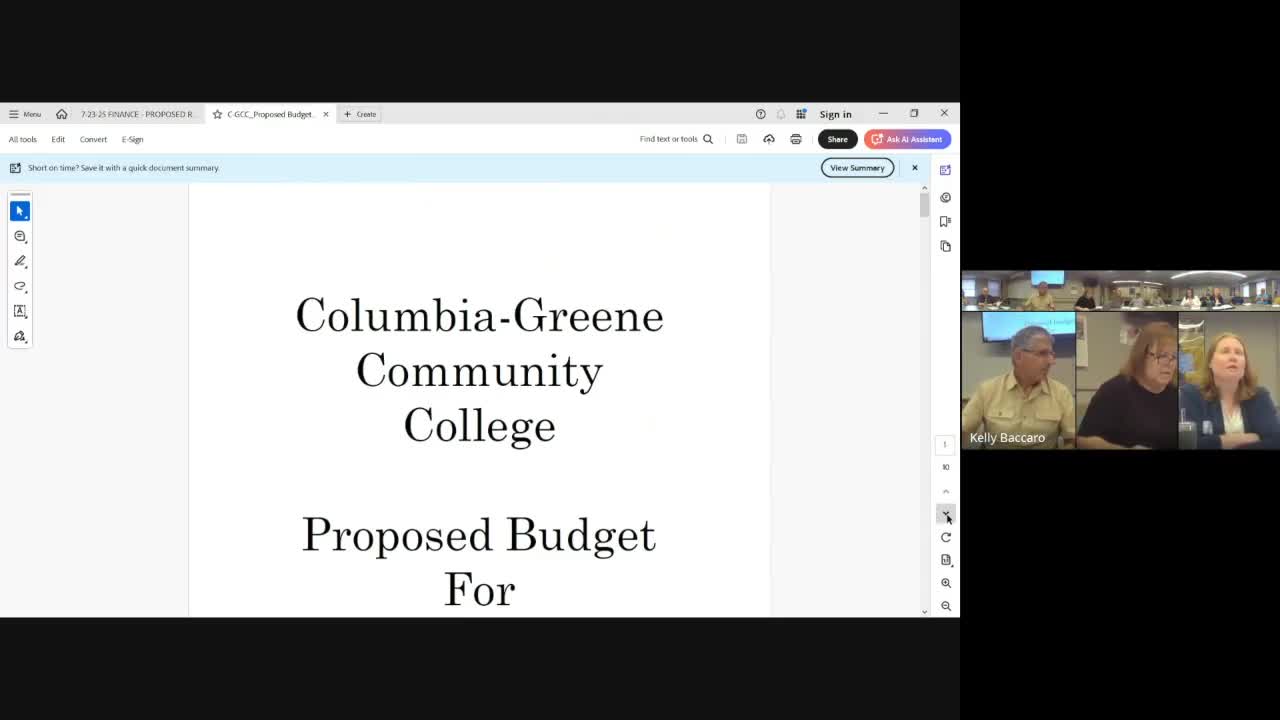
Summary
The Columbia County Finance Committee approved the proposed 2025–26 operating budget for Columbia‑Greene Community College, a $19 million plan that keeps tuition flat, increases several student fees and reduces reliance on fund balance while funding new software and workforce initiatives.
The Columbia County Finance Committee voted to approve the proposed 2025–26 operating budget for Columbia‑Greene Community College, a roughly $19,000,000 spending plan that keeps tuition flat and relies less on the college’s fund balance. The committee recorded one opposed vote before carrying the measure.
College finance staff presented the budget and a line‑by‑line review at the July committee meeting. “The tuition will remain flat for this year,” the presenter said, and added that the college has “not touched the fund balance for this year. And as of today, our balance in our checking accounts is 9,100,000.0.”
The presenter described the budget’s revenue mix as 33% county support, 28% tuition and fees, 14% state aid, 11% county chargebacks and the remaining 14% from fund balance, grants, contracts and other revenue sources. The college projects a 2.5% reduction in total expenditures, which the presenter said equates to approximately $500,000 in year‑over‑year savings. The full budget figure presented to the committee was about $19 million.
Why it matters: the budget funds payroll (about 70% of the total), targeted program investments and IT upgrades while attempting to restore reserve levels after prior declines. Committee members pressed staff on assumptions for tuition, fee changes, grants and how the college manages unpaid tuition and bad debt.
Key provisions and discussion points
- Tuition and fees: Staff said tuition will remain unchanged for in‑district students; the college shifted some nonresident/out‑of‑state tuition into a blended formula that produced a modest $20,000 increase in that category. The technology fee was raised from $180 to $300, which contributed to an overall projected increase in fee revenue of 23.3% versus the prior budget. Fee revenue is projected at $408,000 for 2025–26.
- Revenue and grants: The presenter said the college expects roughly $820,250 in state grants and contracts and cited multiple foundation commitments, including $175,000 for a second year of support for the college’s Center for Innovation in Teaching and Learning and $150,000 for a second year of funding for a dean of health care post. The college also anticipates roughly $108,640 in indirect‑cost recovery from a SUNY‑administered, $1.5 million high‑needs grant.
- Chargebacks and sponsorships: County sponsorships and chargebacks were discussed: Columbia County reported 604 sponsored students last year (three‑year rolling average 588), while Greene County recorded 502 (three‑year average 528). Chargeback revenue was calculated using 170.7 full‑time equivalent (FTE) non‑sponsoring students at a flat rate of $12,910, producing a projected chargeback revenue of about $2,200,000.
- Fund balance and reserves: Staff reported an operating cash/checking balance of about $9.1 million and said the college reduced reliance on fund balance by 59.4% versus the prior year. Committee members asked whether the college has an official fund‑balance policy; staff said no policy exists currently and that they have opened separate bank accounts to segregate grant and foundation funds from operating reserves.
- Payroll and labor costs: Salaries and wages were presented at about $9.1 million total: roughly $2.8 million for administrators, $3.8 million for faculty, $2.3 million for staff and about $136,000 for student workers, tutors and coaches. The budget includes a $2,000 annual increase for faculty (contractual) and a $1.10 per hour increase for staff (collective bargaining). Staff also said administrators were given the $1.10 increase to maintain internal equity.
- Program investments and equipment: The budget includes IT infrastructure spending of $200,000 for network switch replacements, $25,000 for automotive program equipment, $20,000 for new science‑lab chairs, and other modest equipment and furniture allocations. Staff noted investments in new admissions and student‑experience software (Slate and the Ellucian Experience app) to modernize enrollment and student services.
- Workforce programs and continuing education: Continuing education (noncredit) is budgeted conservatively at $200,000 despite higher actual receipts last year. The college also budgets payroll and benefit reimbursements and indirect cost recoveries tied to workforce and Department of Labor grants.
- Student account management and bad debt: The budget includes a $170,000 allowance for bad debt or unpaid tuition. Committee members questioned why students are allowed to remain registered without payment; staff described deregistration processes, refund schedules (percent refunds that taper by the time of withdrawal) and options such as payment plans, collection referral and small‑amount relief through the college foundation or a student persistence fund.
- Academic programs pending approval: Staff reported a recent visit from the New York State Office of the Professions and said they are “very hopeful” about starting a Licensed Practical Nurse (LPN) program in the fall and spring, but noted program start is contingent on state approval.
Action and next steps
The committee voted on Resolution No. 33, authorizing approval of the 2025–26 operating budget for Columbia‑Greene Community College. The motion was moved, seconded and carried with one named opposition (Mary). Staff said they will provide an end‑of‑year financial report when the fiscal year closes and will prepare a fund‑balance policy for committee review.
The committee also discussed scheduling quarterly finance check‑ins so college staff and county supervisors can review budget performance and minimize surprises.
Ending
Committee members thanked staff for the detailed presentation and emphasized continued oversight of reserves, grant accounting, and enrollment assumptions. Staff said they will separate restricted grant and foundation funds from operating reserves and return with a fund‑balance policy and year‑end figures for committee review.