
Staff recommends 100‑foot riparian buffers and higher SEPA exemptions; council seeks more analysis
Get AI-powered insights, summaries, and transcripts
Subscribe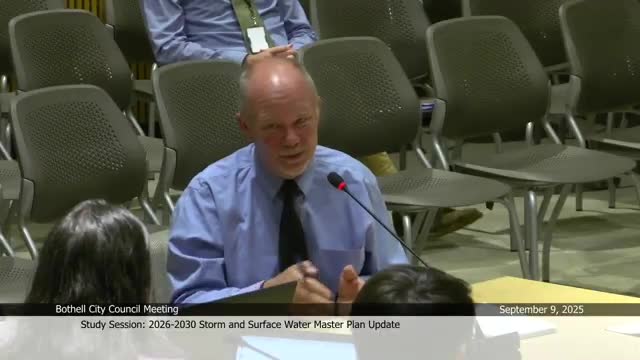
Summary
Bothell staff opened a Sept. 9 study session on a Critical Areas Ordinance update and possible SEPA threshold revisions, recommending a fixed 100‑foot riparian management zone with a vegetative buffer standard and considering higher SEPA categorical exemption thresholds.
Bothell staff presented an initial study session on proposed updates to the city’s Critical Areas Ordinance (CAO) and potential changes to SEPA categorical exemptions on Sept. 9. The discussion was informational; staff sought council direction before public hearings and formal ordinance drafting.
What staff proposed: The staff presentation — delivered by a deputy director filling in for planner Jacqueline Sampson — summarized best‑available‑science work completed for the 2024 comprehensive plan and recommended simplifying riparian protections by adopting a fixed 100‑foot riparian management zone (stream buffer) for all stream types together with a vegetative‑buffer standard. Staff said the 100‑foot approach provides predictability compared with the site‑potential tree‑height methodology, which can vary widely (examples in the best‑available science suggested buffers from roughly 100 feet to over 230 feet depending on soils and tree‑height calculations).
The staff package also proposed a 10‑foot setback from the outer edge of the riparian management zone for structures, updated definitions, targeted clarifications for small isolated wetlands, noxious‑weed references, signage/fencing guidance for critical areas and nonconforming‑structure rules to manage growing buffer footprints over time.
SEPA thresholds: Staff outlined potential changes to city SEPA categorical exemption thresholds and noted the state sets a floor but allows local jurisdictions to increase categorical exemptions up to state maximums. Staff reviewed a 10‑year record and found 194 SEPA determinations in Bothell; 191 of those resulted in no mitigation beyond existing code standards. Based on that record and the desire for predictability, staff recommended considering raising local SEPA thresholds toward the state maximums used by some neighboring jurisdictions.
Council questions: Council members voiced mixed concerns. Some members supported simplifying rules and increasing SEPA thresholds for predictability and to reduce duplicative review. Others expressed concern that a significant increase in buffer widths (some science variants suggested buffers over 200 feet) could create large nonconformities and should be balanced to avoid rendering many properties undevelopable. Council members asked staff to return with comparative maps, property‑level impacts and clearer analysis of how proposed buffers would affect existing trees and nonconforming uses.
Next steps: Staff will meet with the Planning Commission, refine maps and analysis, and carry the draft through public hearings with the goal of completing the CAO update by the end of the year as required under the Growth Management Act. No ordinance was adopted on Sept. 9.