
Addison council keeps Taste event in 2026 budget amid sharp debate over costs and revenue
Get AI-powered insights, summaries, and transcripts
Subscribe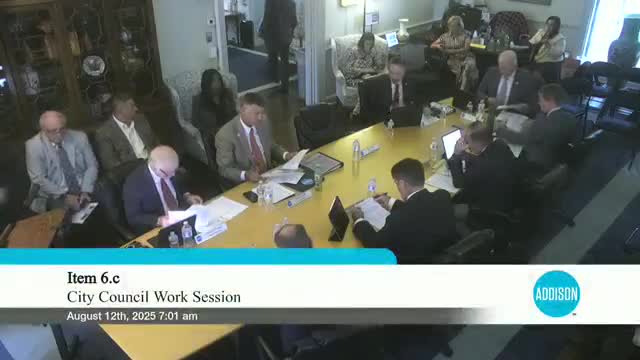
Summary
Council debated whether to keep the Taste of Addison festival in the fiscal 2026 budget after staff presented updated hotel-fund projections and a $140,000 revenue uptick. Supporters said the event can be retooled; critics called for a different model or deeper changes to protect hotel-restricted funds.
Addison — The Addison City Council voted to keep the Taste of Addison event in the town’s proposed fiscal 2026 budget after an extended discussion on Tuesday about rising costs, projected revenues and alternative approaches to promoting local restaurants.
At a work session earlier the same evening, Steven Glitter, the town’s chief financial officer, told council members that updated revenue assumptions added about $140,000 to the hotel fund projections and improved the 10-year reserve outlook. Glitter also said staff moved several previously phased improvements for the Addison Theater Center into the FY2026 decision package, which increased one-time spending out of the hotel fund.
The debate centered on whether the current Taste model — with park activation, entertainment and significant town-led infrastructure — is sustainable. Council members and the event director, Abby (event director), described efforts to raise new revenue streams and to increase ticket and vendor pricing. Council Member Dan said the proposed budget includes “increased emission prices, new and different revenue streams” and staff intends to pursue a mix of options, including premium packages.
Several council members urged more dramatic changes. Council Member Howard proposed replacing a large town-run festival with a marketing-driven campaign that would keep the Taste name but rely on paid advertising and merchant buy-in, saying the town “would spend way less than $465,000 and have a much better event.” Howard outlined a concept in which restaurants pay participation fees and the town matches funds to drive media buys and web-based promotions rather than closing the park and hiring large production crews.
Council Member Randy and others pressed on funding restrictions tied to the hotel occupancy fund. Glitter reminded the council that certain hotel-fund dollars are intended to generate overnight stays and therefore carry statutory or policy constraints; he noted staff had budgeted $175,100 in paid advertising and about $121,500 in in-kind advertising resources for related promotions.
Other council members advocated refining the existing large-event model rather than replacing it. Council Member Darren said he backed the plan as presented if staff hardens guardrails for future years: “I can sign off on this year’s plans and move forward and then with hard handcuffing for 2027 or ’28 planning,” he said.
Council members repeatedly stressed that staff must know whether the council wants to include Taste in the FY2026 budget before staff completes the budget book this fall. As the council discussed a placeholder investment figure used in earlier briefings, Glitter said the proposed budget assumed Taste would be included and that staff would return with specifics on new revenue streams and pricing options.
The council did not vote on a separate motion to cancel Taste; by approving the larger budget package later in the meeting, members effectively kept the event funding in the proposed FY2026 plan and directed staff to pursue additional revenue options and monitoring.
The discussion laid out two paths: continue the large-scale, town-operated festival while pushing for new revenue streams and tighter financial guardrails, or pursue a reimagined, lower-cost marketing program that relies on restaurant buy-in and advertising to drive visits without major park activations. Council members asked staff to return with concrete proposals and clearer revenue estimates for the next budget milestone.
Clarifying details from the meeting: staff reported a $140,000 upward revision to projected hotel-related revenue; the hotel fund reserve under the updated projection was described as approximately $4.9 million (about 64.3% of operating expenditures and fund balance); advertising allocations cited by staff included a $175,100 paid advertising figure and roughly $121,500 in in-kind advertising; council discussed a placeholder event funding figure that has been described in internal materials but was debated on its size and sustainability (exact placeholder amounts referenced in the transcript were presented in different formats and not consistently stated). No formal ordinance or contract award related to Taste was adopted that night.
Why it matters: Taste is the town’s primary restaurant-focused tourism event and has been a visible part of Addison’s marketing; its funding comes partly from hotel-related revenues that are intended to generate overnight stays. Council direction will determine whether staff runs the event in the current model, retools it, or re-allocates hotel-restricted dollars in ways that meet legal and policy limits.
Looking ahead: Council members asked staff to return with refined revenue scenarios, implementation details for VIP or fast-pass concepts, and a short-term plan to limit FY2026 exposure if the event underperforms. Staff also committed to measuring results against stated expectations and to propose a follow-up policy conversation for 2027 planning if revenues remain short of projections.