
Commission considers using impact fees for rescue truck and equipment as finance director seeks $500,000 in cuts
Get AI-powered insights, summaries, and transcripts
Subscribe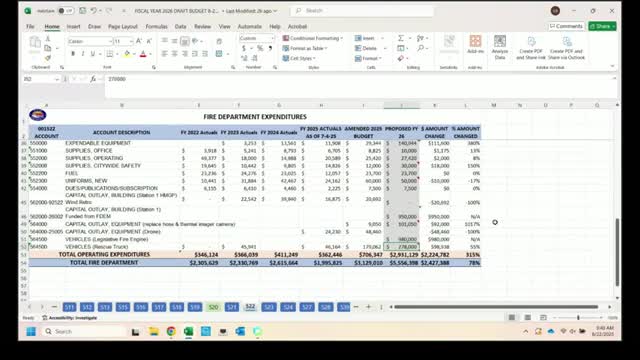
Summary
City staff and the fire chief discussed replacing an aging rescue truck and life-safety equipment and whether restricted impact fees or surtax money should pay for them. Staff said the rescue truck replacement could be funded from impact fees; commissioners asked staff to research exact available balances.
Lynn Haven — The City Commission discussed fire department capital needs at a budget workshop and directed staff to research whether restricted impact fees could pay for a new rescue truck and some equipment as a way to reduce the general fund shortfall.
Finance Director Kiki Roman flagged a rescue truck priced at $278,000 in the draft budget that had been charged to the general fund. She told commissioners staff could instead use available impact fees to purchase the vehicle and reduce pressure on the general fund. “If you'd instruct me to, we could use impact fees for that $278,000,” she said.
Fire Chief Mark Johnson told the commission the department also needs $101,000 for hose replacement and thermal-imaging cameras. He explained the safety rationale: hoses age and fail and thermal imagers help locate people and heat sources during low-visibility rescues. “If we have a fire to go in and find people during search and rescue … Without those items, we are in the blind,” Johnson said. He estimated thermal imagers would last about five years and some hoses seven to ten years depending on use.
Commissioners noted impact-fee rules are restrictive. Roman and Chief Johnson said some equipment associated with an emergency response vehicle could be eligible under the state statute for impact-fee purchase, but staff must verify eligibility and current impact-fee account balances. Roman said she would research how much impact-fee cash is available and return with a recommendation; she confirmed she could fund the rescue truck with impact fees if the balance permitted.
The commission also discussed longer-term funding for a proposed Fire Station 3. Roman said current impact-fee balances are insufficient to pay for constructing a new station and that building the station would likely require issuing a bond. “The impact fees will never cover … Fire Station Number 3,” Roman said; she recommended pursuing design funds through legislative appropriations to have plans ready when construction funding becomes available.
No formal vote was taken at the workshop. Staff will report back with precise impact-fee balances and eligibility for specific items prior to the September proposed budget presentation so the commission can decide which fire purchases to reallocate from the general fund.