
Council denies conditional-use permit for arcade with claw machines at 1101 Alma St.
Get AI-powered insights, summaries, and transcripts
Subscribe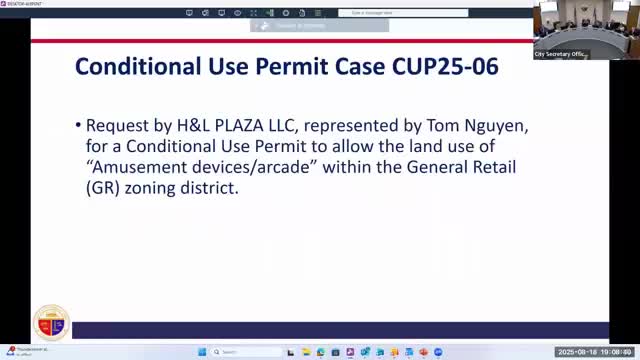
Summary
After concerns about child safety, supervision and parking, the Planning & Zoning Commission’s unanimous recommendation for denial of a conditional‑use permit for an amusement devices arcade (claw machines) at 1101 Alma Street was upheld by council; the motion failed on first reading.
The Tomball City Council on Aug. 25 declined to approve a conditional‑use permit for an amusement‑device arcade (claw machines) proposed at 1101 Alma Street. The planning staff presented the application and said the building is in a multi‑tenant retail center abutting a multifamily complex and single‑family properties.
At the Planning & Zoning (P&Z) Commission meeting earlier in the month, commissioners voted 5–0 to recommend denial after raising concerns about the location, safety and supervision of minors, lack of sidewalks to the site, parking availability and the facility’s hours. Tona Ross, chair of the Planning & Zoning Commission, summarized the commission’s concerns to council, saying the application lacked clear definition of age restrictions and supervision for minors and that commissioners worried the business could become “a magnet for problems with youth.”
The applicant, who identified himself as a property owner’s representative and said the proposed unit would be about 2,000 square feet with roughly 10–12 claw machines, told council the business would be family‑oriented, staffed and operate roughly 10 a.m.–9 p.m. The applicant said prizes would be toys, not cash.
Council members referenced the P&Z concerns, the absence of sidewalks and the limited parking available in the shopping center (staff said the center has 39 spaces shared among tenants). Staff explained that parking calculations would limit machines to roughly one parking space per machine and that build‑out permitting would determine final parking allowances.
Following discussion, the council voted against the first reading of the ordinance to approve the conditional‑use permit; the official vote result recorded was that the motion failed unanimously. Councilmembers and P&Z commissioners said conditions could be considered (hours, size limit, staffing, age policies) but that in the application presented the commission and council were not comfortable approving the use.