
Commissioners grant variance to Aspen Utility for small-diameter conduit with conditions after discussion of water-line strikes
Get AI-powered insights, summaries, and transcripts
Subscribe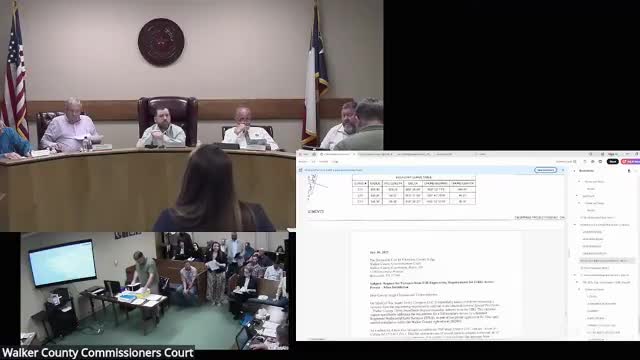
Summary
Walker County granted a limited variance to Aspen Utility (Comcast) on Aug. 11 to reduce some preconstruction drawing requirements for a small conduit install, conditioning the approval on 811 locates, potholing/hydro‑vac, as-built drawings and an installer note accepting responsibility for right‑of‑way verification.
Walker County Commissioners Court on Aug. 11 granted a limited variance to Aspen Utility LLC (Comcast) for installing a small‑diameter conduit in county rights-of-way, subject to conditions intended to reduce the risk of utility strikes.
Aspen requested relief from certain engineering-plan requirements for a 2‑inch conduit that (as company representatives described) is significantly smaller than major utility projects and would not require full-profile engineering drawings. Company representatives said standard industry practices would be used to identify existing utilities and avoid damage, including contacting 811, potholing, and, when necessary, hydro‑vacuum excavation.
Commissioners, Precinct officials and county staff raised concerns about recent water-line strikes in county roads and the adequacy of locates. One commissioner said county water providers had experienced multiple hits and boil‑water notices in recent weeks and asked Aspen to halt work until specific mitigations were in place. Aspen representatives said they had stopped work near Spring Lake and were redesigning that segment after coordination with the Texas Commission on Environmental Quality.
County planning staff recommended conditions rather than a blanket waiver. The court’s no-objection/variance approval included the following conditions: require 811 locates and potholing/hydro‑vac prior to excavation, require the contractor to provide as-built drawings showing the installed locations and profile views after construction, and a general note on plans that the utility installer is responsible for confirming legal right to occupy public rights-of-way or obtaining private easements before installation. The county expressly declined to waive the installer’s responsibility for right‑of‑way confirmation.
“We will contact 811 and hydro‑bag where necessary,” said a company representative, Ernest Spicer (first name used), summarizing Aspen’s approach. County staff said they would require a two‑foot minimum clearance under culvert flow lines for any crossings, and the installer agreed to meet that standard.
The court’s action was a procedural variance that will not constitute final permit approval; Aspen must return with final permit documents and satisfy the stated conditions before work proceeds. Commissioners emphasized that the county expects immediate phone/text notice from Aspen or its representative if any utility damage occurs.
Ending: The variance allows the company to proceed with reduced initial drawing requirements but only under strict conditions: 811 locates, potholing/hydro‑vac as needed, as-built plan submission and a note accepting installer responsibility for right-of-way verification; final permit approval remains subject to staff review and compliance.