
Council hears market options for McGuinness site as legal limits slow marketing
Get AI-powered insights, summaries, and transcripts
Subscribe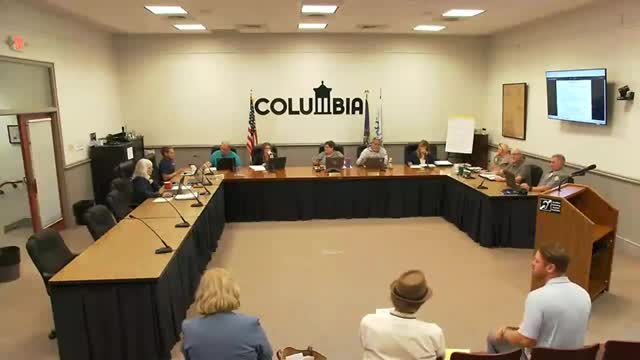
Summary
At a Sept. 2 Columbia Borough Council workshop, a commercial realtor outlined redevelopment options for the 60‑acre McGuinness Airport site — including 55+ housing, retirement communities and light industrial — while council and staff described state bidding rules and an EDC attorney opinion that could delay marketing through a broker.
On Sept. 2, 2025, Columbia Borough Council workshop members heard a market briefing on the borough’s McGuinness Airport redevelopment site and discussed legal and procedural constraints that may delay a broker-led marketing campaign.
The presentation came from Justin Geisenberger, a commercial realtor with Sable Commercial Realty, who described possible uses for the roughly 60‑acre property, including for‑profit retirement communities, 55+ housing and light manufacturing or small industrial buildings. Geisenberger told the council residential senior projects could yield higher taxable improvement value per square foot than typical warehouse buildings, while noting residential uses can add pressure on local emergency services.
The discussion matters because the borough has prioritized the site to strengthen the tax base and create jobs. Council members and staff raised three linked issues: what the market will support, how different uses affect municipal services and tax revenue, and how state procurement rules and the Columbia EDC’s attorney opinion limit immediate use of an EDC-administered marketing approach.
Geisenberger said residential senior uses generally allow more vertical development and higher construction values, giving an example that a 10,000‑square‑foot building at $300 per square foot would be a $3 million improvement versus $1 million for a 10,000‑square‑foot warehouse at $100 per square foot. He told council those differences translate into substantially different taxable values when assessed at typical local ratios. He also said senior housing often brings ancillary spending downtown, such as visits to restaurants and shops, which could add local economic benefits beyond direct tax receipts.
Council members asked about service impacts. Multiple council members and staff noted the borough already has high per‑capita police call volume and stressed the need to consider EMS and fire demand if residential units are built. Geisenberger acknowledged any large‑scale development will add pressure to local services and suggested tax revenues from new development could be used to support those services.
Procurement and marketing constraints were a central part of the workshop. Staff explained state law requires public disposal steps (public auction, sealed bids or public solicitation) before the borough may list property directly with a commercial broker. Council staff and multiple members also said Columbia’s local economic development corporation (EDC) initially appeared to be a partner but the EDC’s attorney later advised it could not act as a pass‑through or market the property if a broker would also be involved. As a result, staff said the borough is exploring options such as a public RFP or auction with a reserve price; if those steps do not sell the property, the borough could then contract directly with a broker.
Council members described the practical effect: planned marketing that earlier might have moved this year is likely to slip into next year while legal options are clarified. Staff said they would have their solicitor speak with the EDC’s attorney to determine whether any approach allows the EDC to continue assisting without violating its attorney guidance.
Other points raised included prior zoning changes made by council to expand permitted uses on the site, an appraisal that staff said indicated light business/light industrial as a strong commercial use, and residents’ concerns about nonprofit operators (for example, existing local facilities that do not pay full tax amounts) and prior high call volumes at some developments. Council members said they remain split on whether to prioritize pure commercial/industrial uses or allow senior residential uses that could produce higher assessed values but increase service demand.
No formal motion or vote was taken at the workshop. Staff were directed to confer with legal counsel and the EDC’s attorney on procurement options and return to council with a recommended path, including timing implications for public solicitation or broker engagement.
The council indicated it wants a marketing approach that both satisfies state disposal rules and maximizes competitive interest in the property; potential next steps discussed included an RFP/solicitation or an auction with a reserve price followed, if necessary, by broker listing.