
Study finds Ellis and Lafayette industrial park lacks required fire flow without additional tank
Get AI-powered insights, summaries, and transcripts
Subscribe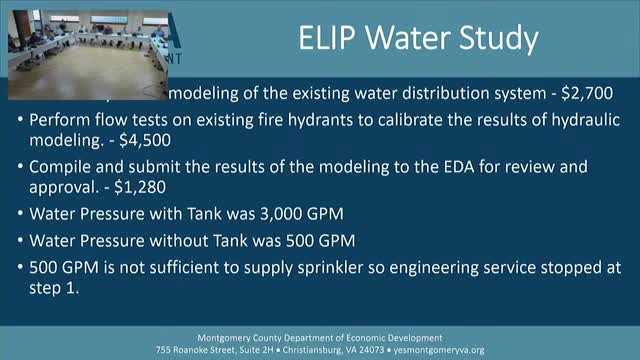
Summary
Staff reported hydraulic testing showed flow of about 3,000 gallons per minute with the site tank and about 500 gpm without it; the county stopped the contracted study after the initial testing and discussed waiting until a second tank is online before further work.
At the meeting, county staff reported results of a hydraulic test at the Ellis and Lafayette Industrial Park showing the site’s fire-flow capability falls sharply when the local tank is taken offline. The testing showed about 3,000 gallons per minute with the tank online and about 500 gallons per minute without it — a flow county staff said would not meet fire-suppression needs. County staff said the Economic Development Authority (EDA) approved the water study and that the board paused further study after completing the initial field test, the $2,700 step in the work plan.
The findings matter because low flow can leave businesses and industrial sites without adequate fire suppression during a tank disinfection or outage. County staff told the board the only practical way to reach the needed flow at the site would be an additional storage tank near the Town of Christiansburg (the site named in discussion was “Camp Christy”), which could provide redundancy when one tank is taken offline. A figure of 300,000 gallons was mentioned in discussion as a typical tank size for the site; staff said doubling that capacity would likely be necessary to reach required fire flow.
Board members and staff discussed alternatives. Staff said extending the existing 12-inch main from Roanoke Street would not provide sufficient flow. The group discussed revisiting the hydraulic modeling once the town’s planned additional tank is operational; staff recommended stopping at the initial, $2,700 field-testing step for now and possibly running the modeling after the second tank is online. A board member asked clarifying questions about flow versus pressure; staff clarified the numbers reported were flow (gallons per minute), not static pressure.
No formal policy change or funding commitment was made at the meeting. The board recorded no vote on the study beyond the decision to stop at the initial test and to consider further modeling after the town adds storage. Staff said the full modeling and report had estimated additional costs (a line-itemized sequence was discussed: $2,700 for initial testing, $45 for modeling, and $12,800 for compiling a final report), but the board did not authorize those further steps at this time.