
Water Boards adds a "blank water modified" matrix for specific toxicity controls; staff flag inconsistent use of "lab water"
Get AI-powered insights, summaries, and transcripts
Subscribe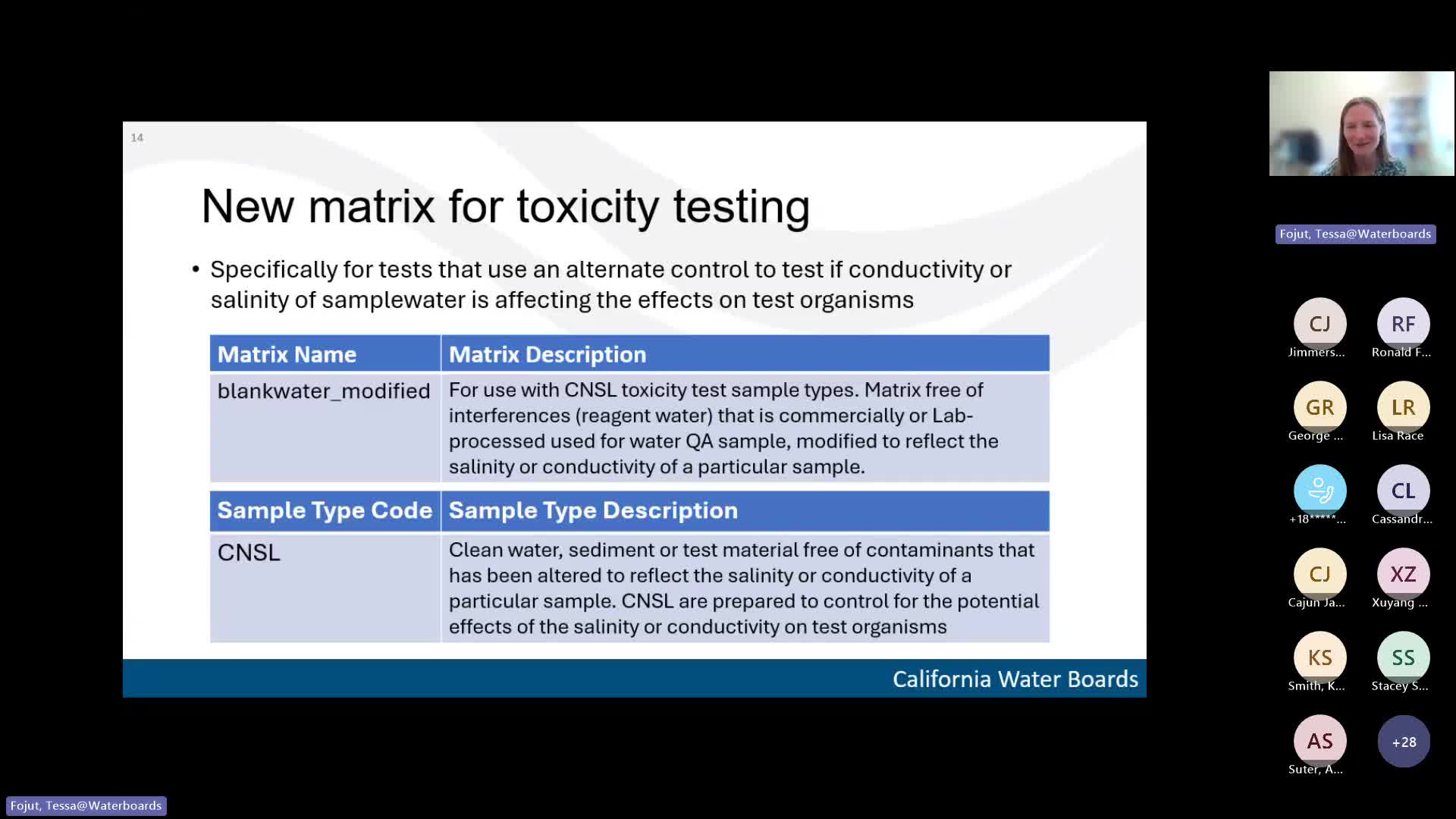
Summary
Staff added a narrowly defined "blank water modified" matrix for toxicity tests that use an alternate control (sample type code CNSL). Participants also questioned how labs use the existing "lab water" matrix and asked staff to update descriptions to reflect laboratory practice.
Staff announced a new matrix specifically to support a toxicity testing control used when an alternate control is required to test whether conductivity or salinity in a sample affects test organisms. Tessa said the sample-type code for that control is CNSL and that the new matrix — described as "blank water modified" — is "specifically for use with the CNSL test type sample sample types." She emphasized the matrix should be used only for that limited purpose and not as a general blank. Attendees raised related issues: toxicity and chemistry templates differ in how they record controls, some labs historically used a separate lab-water code rather than blank water, and chemistry control types such as laboratory control spike (LCS) or matrix spikes have parallels to modified blanks. Tori and other lab-affiliated participants said their contracted labs have long used the lab-water code and asked staff to verify whether the lab-water description reflects how labs actually prepare that water (for instance, laboratories sometimes mix reagent-grade or modified hard water tailored to the organism). On the lab-water matrix, Tessa noted the current description says "unprocessed laboratory tap water," and she questioned whether that matched laboratory practice. Participants suggested either clarifying the lab-water description or keeping the code but updating the description to align with how labs prepare organism-supporting waters. Why this matters: accurate matrix and sample-type coding matters for data interpretation and quality-control analyses; inconsistent use of lab-water versus blank-water codes could confuse comparisons and lead to misinterpretation of control or QC results.