
Johnson County supervisors agree to draft short-term funding instrument as GuideLink providers negotiate state ASO contracts
Get AI-powered insights, summaries, and transcripts
Subscribe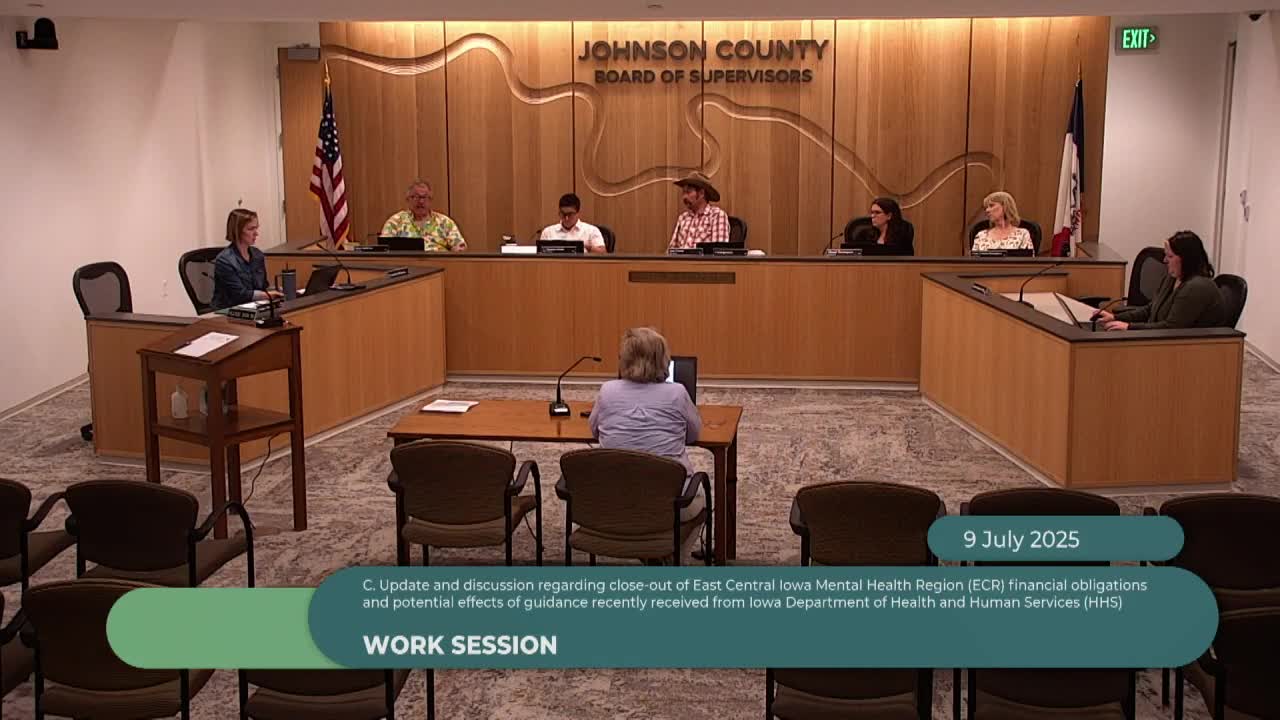
Summary
Supervisors discussed possible short-term county support for GuideLink access-center partners after new state Administrative Service Organization contracts shifted expected costs to local providers; staff were directed to draft an agreement and continue monthly check-ins while providers seek state or alternative funding.
Johnson County supervisors directed staff to draft a short-term funding instrument and continue monthly provider meetings to keep GuideLink operations running while state Administrative Service Organization (ASO) contracts and billing details are negotiated.
The board discussed a proposal to provide limited, temporary financial support for GuideLink — the county'hosted behavioral health access center that brings together multiple providers — after providers said recent ASO contracts left gaps in expected reimbursement. County staff and provider leaders asked for flexibility to cover invoices that may arrive late under new billing cycles while they work with the state to resolve contract language.
Why it matters: GuideLink provides crisis triage, sobering and other crisis services used by residents across eastern Iowa. Providers warned that if billing gaps are not bridged, some services could become unsustainable in the near term.
County staff said the state had changed how some crisis and substance-use services are categorized in ASO contracts, and that could leave providers with uncovered costs. Diane Bridal of Abbey Health described clients as frequently presenting with co-occurring mental health and substance-use needs, which complicates a narrow split of billed services. "I would say yes," Bridal said when asked whether co-occurrence is common.
Lisa and other county staff reported the provider group agreed to meet monthly to coordinate responses while seeking clarifications from the state. Providers asked for a 120-day runway rather than a 90-day bridge because invoices for July services may not arrive until August or September under the new billing timeline.
Supervisors and county attorneys discussed options for the county instrument. County counsel and staff proposed drafting either a memorandum of understanding, a short-term contract amendment, or a grant-style agreement with a blanked "not-to-exceed" amount to be finalized after further analysis. Supervisors asked for protections in any instrument that preserve the county's ability to seek reimbursement if the state later assumes the costs.
Dave Curtis and county counsel noted the county's current budget lines for GuideLink operations total about $1.4 million and that any funds expended above that level during a temporary bridge would require difficult choices elsewhere. At the meeting a board member referenced an estimate from a GuideLink provider that one organization could face roughly $450,000 of shortfall over a year, though staff noted that estimate carried uncertainties and would be clarified in follow-up.
The board asked staff to draft the proposed instrument for legal review and bring it back in a future work session. Supervisors also requested monthly written updates on provider billing, state responses and any revised cost estimates.
Ending: County staff and GuideLink providers will continue coordination and report back to the board. The county'led drafting work is intended to give providers time to maintain services while the state and local partners negotiate contract and billing details.