
Council moves to pursue conditional rezoning for Braswell Milling properties after resident opposition
Get AI-powered insights, summaries, and transcripts
Subscribe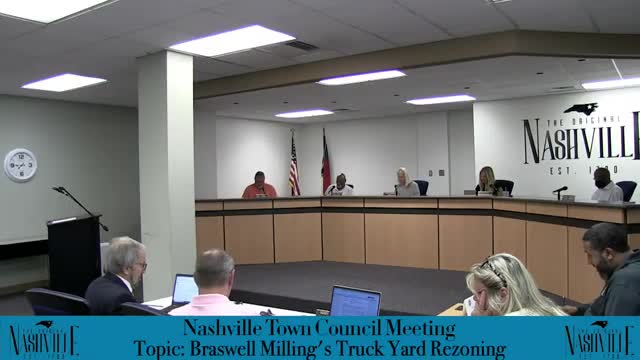
Summary
After a public hearing with residents opposing the rezoning of several parcels to I-1, the council agreed to table a straight rezoning and directed staff to pursue a conditional industrial rezoning that would cap future uses to those now occurring on the site.
The Town of Nashville council on Sept. 2 held a public hearing on a staff-initiated rezoning to correct mismatched parcel designations for properties used by Braswell Milling and ultimately directed staff to pursue a conditional industrial rezoning rather than a straight residential-to-industrial map change.
Staff described four parcels near South Austin Street and East Railroad Street, two larger lots about 2 acres each already zoned I-1 and two smaller parcels (0.38 and 0.89 acres) zoned R-10 and one 0.63-acre parcel zoned B-1. Staff said Braswell agreed to the rezoning and that the town had mailed notices to roughly 75 property owners and posted signs in late July; the Technical Review Committee and the planning board recommended approval. Andrea Smith and other residents submitted written statements opposing rezoning the nearby residential parcels to industrial, citing air and noise concerns and the risk of displacement.
Town staff and council members explained that the current truck-wash bay and storage uses on the parcels were nonconforming under the existing zoning and that rezoning to I-1 would make the existing uses conforming — which could remove some limits on expansion. Town attorney (referred to in the meeting as Mr. Harvey) and staff suggested a conditional industrial rezoning would allow the property to be rezoned but limit allowed uses to those currently operating, preventing more intensive industrial activities in the future. Council voted to table consideration of a straight rezoning and return with a draft conditional rezoning with specific conditions for council review.
Resident Andrea Smith read a family letter into the record stating, "We strongly oppose Braswell Milling Company's request to have 117 East Railroad Street and parcel ... rezoned from residential 10 to industrial 1" and raising concerns about noise and air pollution. Staff acknowledged the parcels are already used for truck washing and storage and said the proposed action was a cleanup of the town's zoning atlas; council members emphasized the importance of crafting conditions to prevent more intense future uses.
Council directed staff to draft conditional zoning language that identifies and caps the uses allowed on the property to the existing operations; the motion to table and return with conditional rezoning language passed by voice vote with the mayor saying, "Motion carries."