
Jefferson County staff warn Medicaid and SNAP changes could raise demands on local services; work session set for August
Get AI-powered insights, summaries, and transcripts
Subscribe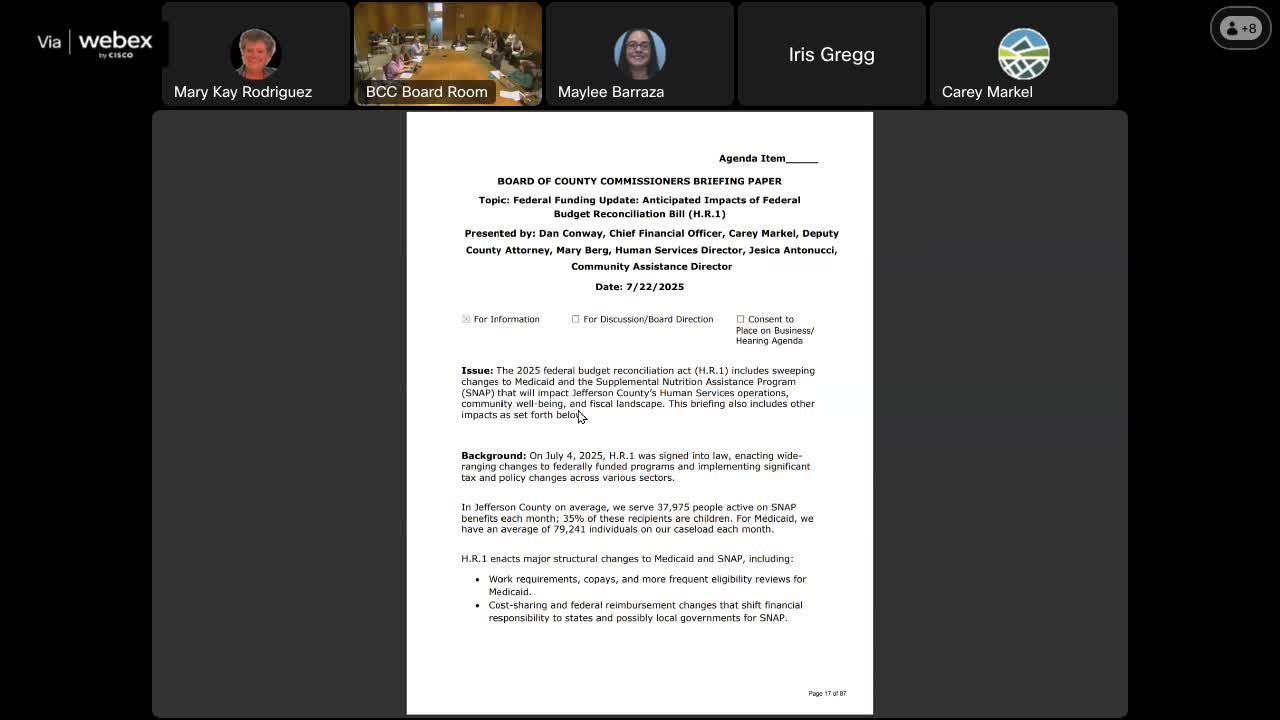
Summary
County staff briefed commissioners on provisions in the federal budget reconciliation bill that add Medicaid work requirements and expand SNAP work rules, warned of increased administrative workload and potential cost shifts, and scheduled a deeper work session for August 12 to prepare.
County staff presented a high-level briefing on anticipated impacts from the recently passed federal budget reconciliation package, focusing on Medicaid and SNAP changes that will affect program administration in Colorado.
Dan Conway and Mary (last name not specified in transcript) told the Board that several provisions either take effect on enactment or are phased in beginning in 2026 and 2027. Staff said one immediate change restricted federal payments for some providers (citing planned parenthood) and that many Medicaid provisions, including new work requirements for the Medicaid expansion population, are slated to begin in December 2026. “We are not operating on any guidance for any of these changes as implementation starts at the 2026,” staff said.
Why it matters: Staff warned the county will likely see more documentation demands, higher call-center volume and additional administrative work tied to redeterminations. On SNAP, staff highlighted that the bill raises work requirement ages (previously up to age 54) to age 64 and extends work-activity documentation to households with children older than 14; the county lacks implementing guidance and stated there is no additional funding or infrastructure yet.
Staff and commissioners discussed possible state-level responses, including whether a special legislative session is needed to adjust state statute or provide funding to backfill administrative costs. County staff noted current rules limit local contributions to 20% of administrative costs and said changes to that statutory match would require state action.
Board direction and follow-up: Commissioners requested a deeper dive at an August 12 work session that will include (a) Jefferson County-specific population and fiscal estimates, (b) payment-error-rate strategies for SNAP administrative matches, and (c) legal analysis of where counties may lawfully backfill costs. Staff said they will monitor state and federal guidance, gather county-specific data, and participate in statewide working groups on implementation. Commissioners also asked staff to prepare communications for nonprofit and provider partners and to consider an outreach/survey to document community impacts.
Ending: County staff scheduled a webinar and other stakeholder briefings and advised the board that many implementation timelines run into 2026–2027; commissioners emphasized the need to press state officials for clarity and possible statutory relief if needed.